
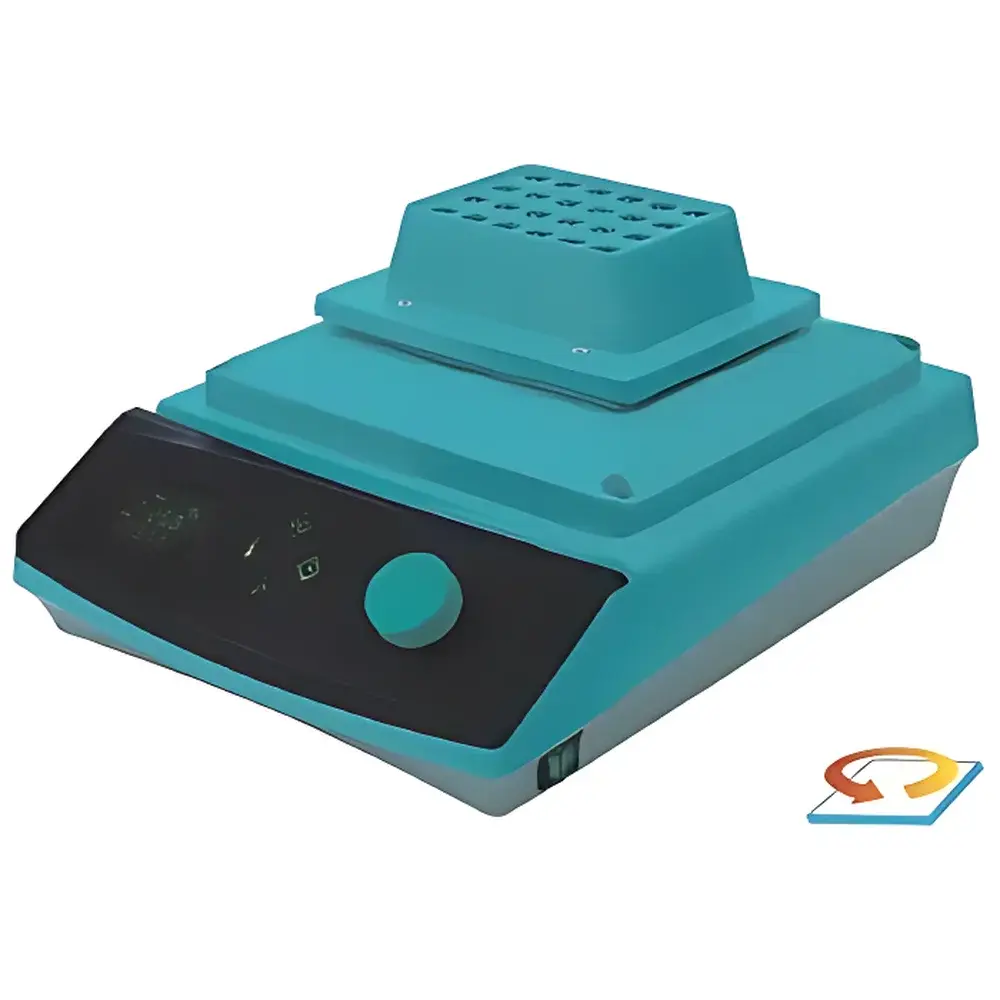
JEIO TECH CBS-350 Heated Orbital Shaker
| Brand | JEIO TECH |
|---|---|
| Origin | South Korea |
| Model | CBS-350 |
| Oscillation Mode | Orbital |
| Speed Range | 150–1500 rpm (module-dependent) |
| Amplitude | 2 mm |
| Temperature Range | Ambient +5°C to 100°C |
| Temperature Uniformity at 80°C | ±0.5°C |
| Temperature Accuracy at 80°C | ±0.15°C |
| Heating Power | 360 W |
| Timer Function | Programmable (10 user-defined programs, each with up to 10 steps |
| Display | Vacuum Fluorescent Display (0.1°C resolution) |
| Safety Features | Over-temperature protection, current overload protection, auto-diagnostic system, thermal cutoff |
| Construction | PP housing with anodized aluminum heating plate |
| Dimensions (W×D×H) | 249 × 325 × 120 mm |
| Net Weight | 8.3 kg |
| Power Supply | 120 V / 60 Hz (3.4 A) or 230 V / 50–60 Hz (1.7 A) |
| Operating Environment | 5–40°C, ≤80% RH |
| Compliance | CE-marked, designed for GLP-compliant laboratories |
Overview
The JEIO TECH CBS-350 Heated Orbital Shaker is a precision-engineered laboratory instrument designed for consistent, thermally controlled agitation of biological and chemical samples in microtiter plates, microcentrifuge tubes, and standard test tubes. It operates on the principle of orbital motion—generating uniform circular displacement at the sample interface—to ensure homogeneous mixing without vortexing or splashing. Integrated PID-controlled heating and high-resolution speed regulation enable simultaneous control of temperature and rotational dynamics across a broad operational envelope (ambient +5°C to 100°C; 150–1500 rpm), making it suitable for applications ranging from enzyme kinetics and cell culture maintenance to solubility studies and reagent preparation. Its compact footprint and modular platform design support rapid reconfiguration for diverse vessel formats while maintaining thermal stability and mechanical reproducibility.
Key Features
- PID feedback temperature control with real-time calibration capability and ±0.15°C accuracy at 80°C, ensuring minimal thermal drift during extended incubation protocols.
- Vacuum fluorescent display (VFD) with 0.1°C resolution and intuitive touch-key interface for parameter entry, program recall, and status monitoring.
- Programmable multi-step operation: up to 10 independent programs stored in non-volatile memory, each supporting up to 10 sequential steps with adjustable speed, temperature, and duration.
- Interval operation mode enables alternating phases of shaking and static incubation—critical for synchronized metabolic assays or staged reaction protocols.
- Dual timer initiation logic: timing can commence either upon device activation or only after reaching the target setpoint temperature, eliminating thermal ramp artifacts in time-sensitive experiments.
- Anodized aluminum heating plate bonded directly to the shaker deck ensures rapid thermal response and uniform heat distribution across the entire surface area.
- Chemically resistant polypropylene (PP) housing with rubber-damped base minimizes transmission of vibration and acoustic noise into the lab environment.
- Comprehensive safety architecture includes over-temperature cutoff, circuit-level current limiting, thermal fuse protection, and automatic fault diagnostics with on-screen error codes.
Sample Compatibility & Compliance
The CBS-350 accommodates a wide range of standardized consumables via interchangeable modules—including 96-well PCR plates (0.2 mL), microcentrifuge tubes (0.5 mL, 1.5 mL), conical centrifuge tubes (15 mL, 50 mL), and round-bottom test tubes (⌀12 mm, ⌀13 mm). Each module is engineered for secure retention and optimal heat transfer. The system meets CE marking requirements and is constructed to support Good Laboratory Practice (GLP) workflows. While not inherently 21 CFR Part 11 compliant, its programmable parameters, timestamped operation logs (when interfaced with optional data logging software), and audit-ready configuration facilitate integration into regulated environments where traceability and procedural consistency are mandated.
Software & Data Management
The CBS-350 operates as a standalone instrument with no embedded connectivity; however, its programmable architecture supports external data capture through optional RS-232 or USB-to-serial adapters compatible with third-party laboratory information management systems (LIMS) or custom scripting environments (e.g., Python-based automation frameworks). All user-defined programs—including temperature setpoints, speed profiles, dwell times, and interval sequencing—are retained in non-volatile memory and persist through power cycles. For validation purposes, temperature and speed calibration records may be manually documented using the built-in VFD readouts and external calibrated reference standards per ISO/IEC 17025 guidelines.
Applications
- Maintenance of suspension cultures (e.g., insect cells, yeast, bacterial strains) under defined thermal and agitation conditions.
- Thermal denaturation studies requiring precise ramp-and-hold temperature profiles coupled with gentle orbital mixing.
- Enzymatic digestion and antigen-antibody binding assays where kinetic uniformity depends on consistent shear rates and thermal homogeneity.
- Preparation of homogeneous stock solutions, buffer equilibration, and dissolution testing in pharmaceutical development labs.
- High-throughput screening workflows utilizing 96-well formats, particularly in immunoassay development and ELISA optimization.
- Accelerated stability testing of biologics and small-molecule formulations under controlled thermal stress conditions.
FAQ
What is the maximum load capacity for the 15 mL tube module?
The AAAJ4505 module supports up to 15 × 15 mL conical centrifuge tubes, distributed evenly across the orbital platform.
Can the CBS-350 maintain temperature uniformity across all positions when operating at 100°C?
At 100°C, temperature uniformity is ±0.8°C across the working surface (measured per ASTM E145-22 Annex A3 methodology); performance improves significantly below 80°C.
Is the vacuum fluorescent display readable under low-light biosafety cabinet conditions?
Yes—the VFD provides high-contrast, wide-angle visibility without backlight dependency, making it suitable for use inside Class II laminar flow hoods and darkroom settings.
Does the instrument support remote start/stop via digital input signals?
No native digital I/O is provided; external control requires relay-based interfacing or serial command emulation via optional communication adapters.
How frequently should temperature calibration be performed according to manufacturer recommendations?
JEIO TECH recommends annual verification against NIST-traceable references, with additional checks following equipment relocation or exposure to extreme ambient fluctuations.





