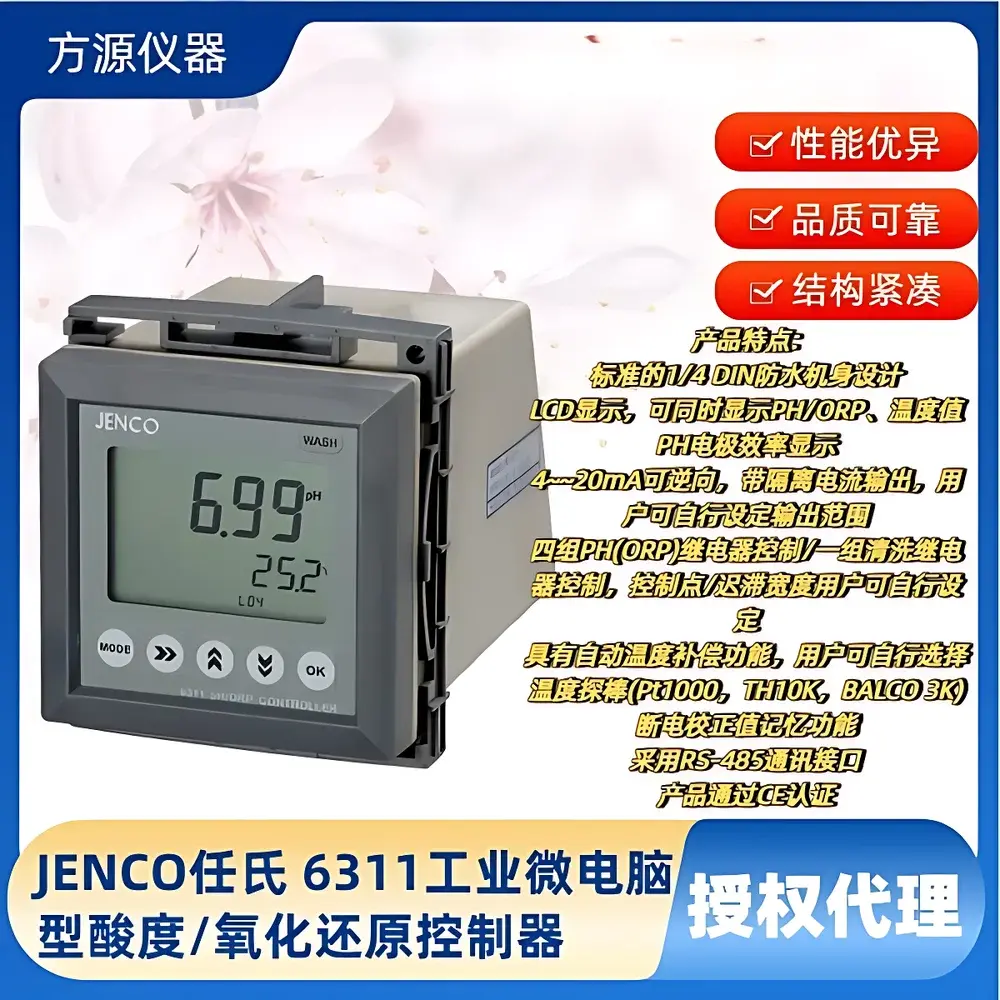
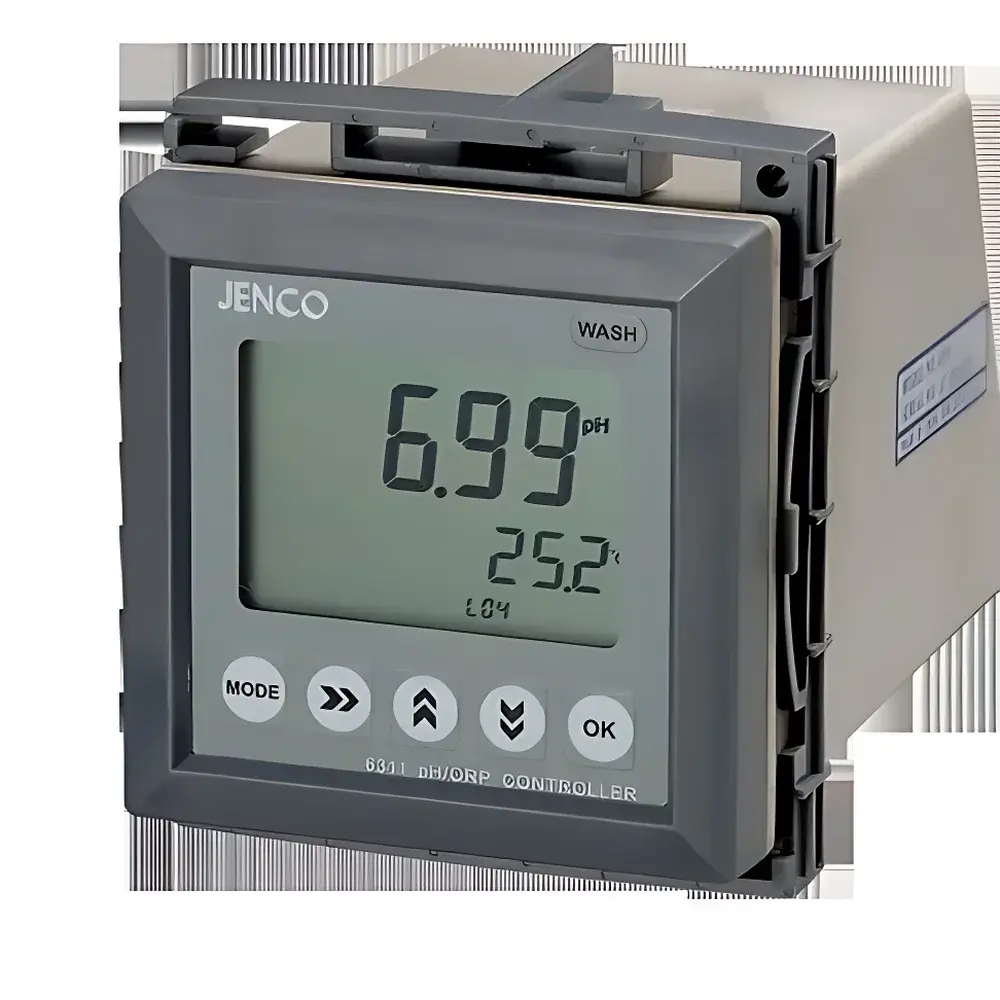
JENCO 6311 Industrial Microcomputer-Based Online pH/ORP Controller
| Brand | JENCO |
|---|---|
| Origin | USA |
| Model | 6311 |
| pH Range | -2.00 to 16.00 pH |
| Resolution | 0.01 pH |
| Accuracy | ±0.01 pH |
| Dimensions | 96 × 96 × 148 mm |
| Weight | 0.96 kg |
| IP Rating | IP65 |
| Temperature Compensation | Automatic, with user-selectable sensor types (Pt1000, TH10K, BALCO 3K) |
| Output | Isolated, reversible 4–20 mA |
| Relay Outputs | Four pH/ORP control relays + one cleaning relay |
| Communication | RS-485 |
| Certifications | CE |
Overview
The JENCO 6311 Industrial Microcomputer-Based Online pH/ORP Controller is a robust, DIN-standard process analyzer engineered for continuous, high-stability monitoring and control of acidity and redox potential in demanding industrial environments. Operating on potentiometric measurement principles, the 6311 interfaces directly with glass pH electrodes and noble-metal ORP sensors to deliver real-time electrochemical data with traceable metrological integrity. Its dual-channel capability enables simultaneous acquisition of pH (or ORP) and temperature—both essential for accurate thermally compensated calculations per NIST-traceable calibration protocols. Designed for integration into distributed control systems (DCS), programmable logic controllers (PLC), and SCADA architectures, the unit complies with IEC 61000-6-2 (EMC immunity) and IEC 61000-6-4 (EMC emissions), and carries CE marking for conformity with EU Machinery and EMC Directives. The controller’s microprocessor-based architecture ensures deterministic response timing, critical for closed-loop feedback applications such as neutralization tank control, chemical dosing synchronization, and effluent compliance monitoring.
Key Features
- 1/4 DIN waterproof enclosure (IP65-rated front panel) for reliable operation in humid, washdown, or corrosive atmospheres
- Backlit LCD display showing concurrent pH/ORP value, temperature reading, electrode status (efficiency indicator), and system alarm icons
- Isolated, bidirectional 4–20 mA analog output with user-configurable span and zero points—supports both sink and source configurations
- Four independently programmable SPST relays for pH/ORP control (e.g., acid/base dosing pumps, solenoid valves) plus dedicated cleaning relay for automatic electrode maintenance cycles
- Auto-temperature compensation (ATC) with selectable probe types: Pt1000 RTD, TH10K thermistor, or BALCO 3K sensor—ensuring accuracy across -10.0 to 120.0 °C
- Non-volatile memory retains calibration coefficients, setpoints, and configuration parameters during power interruption
- RS-485 serial interface compliant with Modbus RTU protocol for seamless integration into plant-wide communication networks
- Acoustic keypress feedback and four-digit password protection prevent unauthorized parameter changes—supporting audit-ready operational discipline
Sample Compatibility & Compliance
The 6311 is compatible with standard industrial pH and ORP electrodes—including JENCO’s ST873 high-temperature probes, IP-600 series for wastewater (e.g., IP-600-10 for sludge-laden streams), and IR-500 redox sensors—enabling deployment across municipal water treatment, electroplating rinse lines, pharmaceutical buffer preparation, and food-grade CIP systems. Its input impedance exceeds 10¹³ Ω, minimizing loading errors with high-impedance reference junctions. All electrical outputs meet SELV (Safety Extra-Low Voltage) requirements under IEC 61010-1. The device supports GLP-compliant workflows through timestamped calibration logs, configurable relay event history, and optional Modbus register mapping for external data archiving. While not FDA 21 CFR Part 11 certified out-of-the-box, its configuration-locking and change-audit features align with GMP Annex 11 expectations when deployed with validated software layers.
Software & Data Management
No proprietary PC software is required for basic commissioning; all setup is performed via intuitive front-panel navigation. However, advanced configuration—including relay hysteresis tuning, custom buffer selection (4.01/7.00/10.01 or 4.00/6.86/9.18), slope/offset compensation (±30% / ±100 mV), and ORP reference offset adjustment—is accessible via Modbus RTU registers (0x0001–0x00FF). Third-party SCADA platforms (e.g., Ignition, Siemens Desigo, Honeywell Experion) can poll real-time values, alarm states, and diagnostic flags—including electrode impedance warnings and temperature sensor fault codes. Calibration events are stored locally with date/time stamps and operator ID fields (when integrated with external authentication systems), supporting ISO/IEC 17025 traceability frameworks.
Applications
- Continuous pH stabilization in chemical dosing skids for lime softening or sulfuric acid neutralization
- ORP monitoring in chlorine disinfection basins and ozone contact chambers per EPA Method 300.0
- Real-time acidity tracking during fermentation broth pH control in biopharmaceutical upstream processing
- Effluent discharge compliance verification against local regulatory limits (e.g., EPA NPDES, EU Urban Wastewater Directive)
- Electrolyte management in battery recycling hydrometallurgical circuits
- Process validation support for ASTM D1293 (pH of water) and ISO 10523 (water quality — determination of pH)
FAQ
Does the 6311 support two-point pH calibration with user-defined buffers?
Yes—users may select from two pre-programmed buffer sets (NIST-traceable or DIN-compliant) or enter custom pH values for up to three calibration points.
Can the 4–20 mA output be configured for ORP-only mode?
Yes—the analog output channel is fully assignable to pH, ORP (absolute or relative), temperature, or derived values such as % slope deviation.
What is the maximum cable length supported for RS-485 communication?
Up to 1,200 meters at 9.6 kbps, provided twisted-pair cabling with proper termination and grounding per TIA/EIA-485-A.
Is the unit suitable for hazardous locations?
No—it is rated for general-purpose industrial use (non-explosion-proof); intrinsic safety barriers must be added externally if deployed in Class I, Div 2 areas.
How does the electrode efficiency indicator function?
It calculates and displays real-time impedance-derived health metrics based on low-frequency AC excitation, alerting users to coating, dehydration, or reference junction blockage prior to measurement drift.