
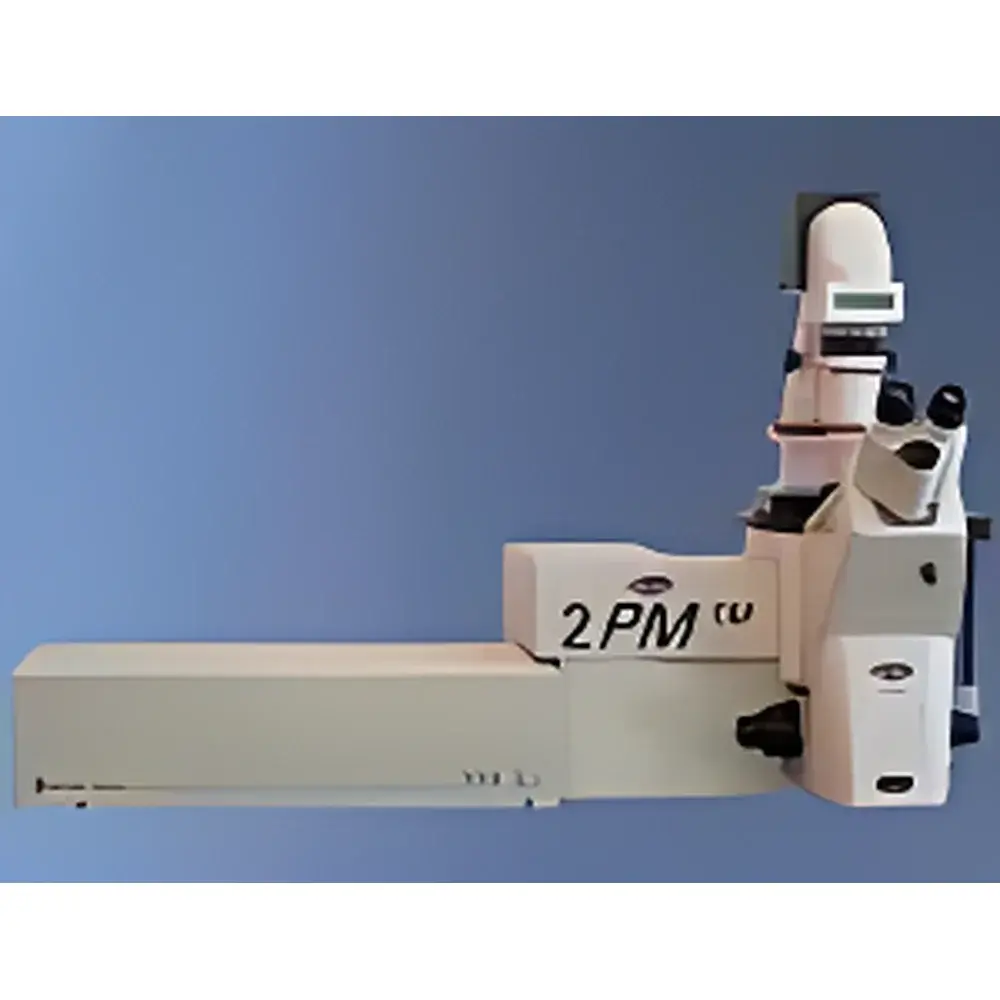
JenLab 2PM™ Compact Multiphoton Microscopy System
| Brand | JenLab |
|---|---|
| Origin | Germany |
| Model | 2PM™ |
| Type | Imported Scientific Instrument |
| Distribution Channel | Authorized Distributor |
Overview
The JenLab 2PM™ Compact Multiphoton Microscopy System is a turnkey, benchtop-integrated imaging platform engineered for high-fidelity, label-free, and fluorescence-based deep-tissue visualization using near-infrared (NIR) femtosecond pulsed laser excitation. Operating on the fundamental principle of simultaneous absorption of two or more low-energy photons—typically in the 700–1300 nm range—the system enables intrinsic optical sectioning with subcellular spatial resolution (lateral < 0.5 µm, axial < 2 µm) without requiring physical sectioning or confocal pinholes. Its compact, vibration-damped optical architecture minimizes alignment drift and supports stable long-term acquisition—critical for longitudinal in vivo studies. Designed for integration into core imaging facilities and university laboratories, the 2PM™ delivers quantitative morphological and functional contrast via second-harmonic generation (SHG), third-harmonic generation (THG), and two-photon excited fluorescence (TPEF), making it particularly suited for non-invasive, three-dimensional structural and dynamic assessment of living biological specimens.
Key Features
- Integrated NIR femtosecond laser source (tunable 680–1300 nm, pulse width < 100 fs) with automated dispersion compensation for optimal peak intensity at the sample plane
- Benchtop footprint (< 60 × 45 × 35 cm) with rigid monolithic optical baseplate and active thermal stabilization
- Motorized XYZ scanning stage with piezo-driven Z-focus (sub-nanometer step resolution) and high-speed galvanometric mirrors (up to 30 fps at 512 × 512 pixels)
- Dual-channel non-descanned detection (NDD) optimized for spectral separation of SHG, THG, and TPEF signals using high-quantum-efficiency GaAsP photomultiplier tubes (PMTs)
- Real-time image reconstruction engine supporting multi-channel spectral unmixing, lifetime-resolved imaging (TCSPC-ready interface), and drift correction algorithms
- Modular design compliant with ISO 13849-1 safety standards; CE-marked and RoHS-compliant
Sample Compatibility & Compliance
The 2PM™ accommodates a broad range of specimen formats—including live anesthetized rodents (head-fixed or freely moving via compatible behavioral rigs), ex vivo tissue slices (100–500 µm thick), 3D organoids, hydrogel-embedded cell cultures, and transparent model organisms (e.g., zebrafish larvae, C. elegans). All optical pathways meet ISO 10110 surface quality specifications, and laser output conforms to IEC 60825-1:2014 Class 4 safety requirements with integrated interlock circuitry. The system supports GLP-compliant workflows through audit-trail-enabled acquisition logs, user-access control tiers, and metadata embedding per frame (including laser power, dwell time, PMT gain, and objective ID). It is routinely validated against ASTM E2925-21 (Standard Practice for Evaluation of Multiphoton Microscopes) for resolution and signal-to-noise performance.
Software & Data Management
Acquisition and analysis are managed via JenLab’s proprietary Insight™ Suite, a Windows-based application built on a modular, plugin-architected framework compliant with FDA 21 CFR Part 11 (electronic signatures, audit trails, and data integrity controls). The software provides real-time spectral fingerprinting, batch processing pipelines for large-volume time-lapse datasets, and native export to HDF5, OME-TIFF, and NRRD formats for interoperability with ImageJ/Fiji, MATLAB, Python (via ome-zarr), and commercial platforms such as Imaris or Arivis Vision4D. Raw data storage adheres to FAIR principles (Findable, Accessible, Interoperable, Reusable), with optional integration into institutional LIMS or ELN systems via RESTful API.
Applications
- Neuroscience: In vivo dendritic spine dynamics, calcium activity mapping in cortical layers, and microglial surveillance behavior under physiological conditions
- Stem Cell & Developmental Biology: Longitudinal tracking of lineage commitment in embryoid bodies and gastruloids using endogenous SHG from collagen deposition
- Tissue Engineering: Non-destructive quantification of extracellular matrix maturation (collagen I/III ratio via SHG polarization anisotropy) and vascular network formation
- Pharmaceutical Research: Real-time assessment of drug penetration kinetics and intracellular distribution in 3D tumor spheroids or skin explants
- Fluorescent Protein Characterization: High-sensitivity detection of low-expression FPs (e.g., mNeonGreen, jRGECO1a) with minimal photobleaching and phototoxicity
FAQ
What laser wavelengths are supported by the 2PM™ system?
The integrated ultrafast laser offers continuous tunability from 680 nm to 1300 nm, enabling optimal excitation of diverse fluorophores and nonlinear contrast mechanisms across biological tissues.
Is the system compatible with electrophysiology or behavioral setups?
Yes—standardized mechanical and electrical interfaces (including TTL synchronization I/O, analog voltage outputs, and Ethernet-triggered acquisition) support seamless integration with patch-clamp rigs, treadmill systems, and optogenetic stimulators.
Does the 2PM™ support lifetime imaging?
The system provides TCSPC-ready detector ports and timing electronics; full time-domain FLIM capability requires optional TCSPC module integration and corresponding software license.
Can acquisition parameters be scripted or automated?
All hardware control and image acquisition functions are fully exposed via Python API (PyJenLab), enabling custom experimental protocols, adaptive scanning, and AI-guided region-of-interest targeting.
What maintenance is required for long-term operational stability?
Annual calibration of laser pulse duration and beam pointing stability is recommended; optical components are sealed and do not require user alignment—only routine cleaning of external optics per ISO 10110-7 guidelines.



