
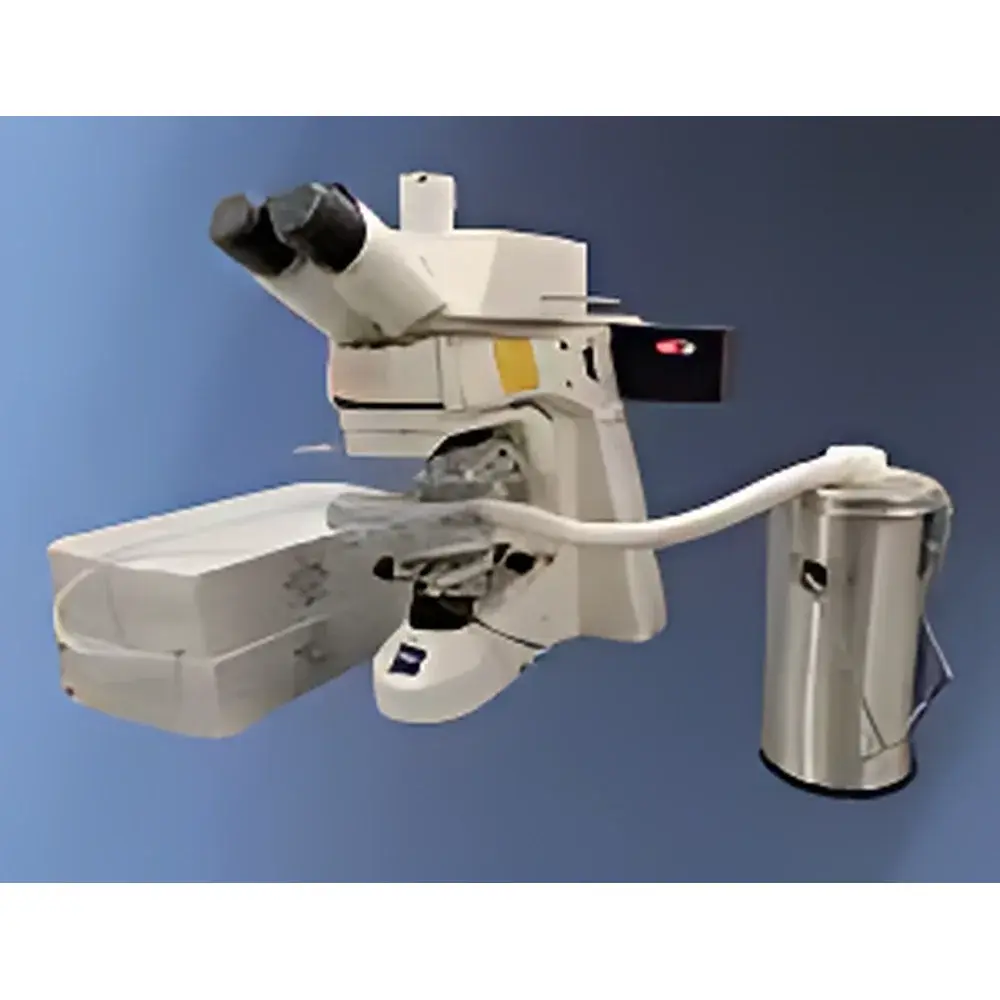
JenLab 2PM™-Cryo Compact Cryogenic Two-Photon Microscopy System
| Brand | JenLab |
|---|---|
| Origin | Germany |
| Model | 2PM™-Cryo |
| Laser Source | Ti:Sapphire femtosecond oscillator (710–920 nm, 80 MHz, 100–200 fs, <1.3 W) |
| Temperature Range | 77 K to 873 K (−196 °C to +600 °C) |
| Cooling/Heating Rate | 0.01–150 K/min |
| Spatial Resolution | <0.5 µm (lateral), <2 µm (axial) |
| Temporal Resolution | 200 ps (TCSPC, up to 256 time channels) |
| FOV | 250 µm × 250 µm (lateral), ≤2 mm depth |
| Objective | Standard 40×, NA 1.3 (optional objectives available) |
| Software | JenLab Control & JenLab Image |
| Compliance | CE-marked |
| Power Supply | 115 VAC / 60 Hz or 230 VAC / 50 Hz |
| Dimensions (excl. laser) | 700 × 520 × 800 mm³ |
Overview
The JenLab 2PM™-Cryo is a purpose-engineered compact cryogenic two-photon microscopy system designed for high-fidelity, label-free functional imaging across extreme thermal conditions—from liquid nitrogen temperatures (77 K) to high-temperature regimes (873 K). Built upon a stabilized Ti:sapphire femtosecond oscillator, the system delivers near-infrared excitation (710–920 nm) with pulse durations of 100–200 fs and repetition rates of 80 MHz, enabling efficient nonlinear excitation while minimizing photodamage and thermal load. Its core measurement principle relies on simultaneous two-photon absorption, which provides intrinsic optical sectioning, deep-tissue penetration (>2 mm in low-scattering specimens), and sub-diffraction spatial confinement—critical for quantitative analysis of dynamic biophysical processes under controlled thermal stress.
Key Features
- Integrated cryo-thermal stage with precise, programmable temperature control from 77 K to 873 K and adjustable ramp rates (0.01–150 K/min), enabling reproducible freeze-thaw cycling and isothermal stabilization.
- Time-correlated single-photon counting (TCSPC) detection architecture supporting fluorescence lifetime imaging (FLIM) with 200 ps temporal resolution and up to 256 time channels—essential for quantifying microenvironmental changes in autofluorescent biomolecules (e.g., NAD(P)H, flavins, chlorophyll).
- Multiparametric contrast modalities: two-photon excited fluorescence (TPEF), second-harmonic generation (SHG), and spectral unmixing-capable multiphoton spectroscopy—facilitating structural and metabolic phenotyping without exogenous labeling.
- Modular scanning engine supporting full-frame acquisition, user-defined region-of-interest (ROI) scanning, line scans, and single-point excitation with wavelength tuning—optimized for both high-throughput screening and targeted kinetic measurements.
- Robust mechanical architecture with vibration-damped optical bench and air-cooled laser source (no external chiller required), housed in a compact footprint (700 × 520 × 800 mm³ excluding laser unit) suitable for shared-core facilities and cleanroom-integrated workflows.
Sample Compatibility & Compliance
The 2PM™-Cryo accommodates diverse biological and material science specimens—including intact plant leaves (e.g., Arabidopsis thaliana), mammalian and avian tissue sections, cryopreserved cell monolayers, mineralized matrices, and engineered hydrogels—without requiring fixation or staining. Its open-stage design permits direct integration with custom environmental chambers or microfluidic interfaces. The system conforms to EU Directive 2014/30/EU (EMC) and 2014/35/EU (LVD), bearing the CE mark for safe operation within laboratory environments. All hardware and software components are designed to support GLP-compliant data acquisition, including audit-trail-enabled parameter logging and timestamp-synchronized metadata embedding per image stack.
Software & Data Management
JenLab Control serves as the real-time instrument orchestration platform, providing synchronized control of laser parameters, thermal stage profiles, scanning geometry, and detector gating. JenLab Image offers post-acquisition processing pipelines for FLIM decay fitting (multi-exponential and phasor analysis), SHG/TPEF spectral unmixing, 3D volume rendering, and spatiotemporal correlation mapping. Raw TCSPC histograms and metadata are stored in vendor-neutral HDF5 format, ensuring compatibility with third-party analysis tools (e.g., MATLAB, Python-based photonpy, or ImageJ/Fiji plugins). Optional FDA 21 CFR Part 11 compliance packages include electronic signatures, role-based access control, and immutable audit logs for regulated research applications.
Applications
- Quantitative assessment of cryopreservation efficacy in biobanking—monitoring mitochondrial redox state (via NAD(P)H τ₁/τ₂ ratio) and membrane integrity during vitrification and rewarming.
- In situ investigation of thermal stress responses in photosynthetic tissues, including chloroplast-level dynamics of chlorophyll fluorescence lifetime shifts under freezing or heat shock.
- Material phase transition analysis in polymers and ceramics, correlating SHG signal anisotropy with crystalline domain reorientation across thermal cycles.
- Development and validation of low-temperature experimental protocols for super-resolution correlative microscopy (e.g., CLEM workflows integrating cryo-TPM with FIB-SEM).
- Climate resilience studies in model organisms, where subcellular FLIM metrics serve as early biomarkers of oxidative damage preceding morphological change.
FAQ
What temperature stability can be achieved during long-duration FLIM acquisitions?
The system maintains ±0.1 K stability over 60-minute isothermal holds at any setpoint between 100 K and 600 K, verified via calibrated Pt100 sensor feedback and active PID regulation.
Is vacuum compatibility supported for ultra-low-temperature (<77 K) operation?
Standard configuration operates under ambient or inert gas (N₂/Ar) purge; optional vacuum-compatible stage variants (≤10⁻³ mbar) are available upon request for specialized quantum material studies.
Can the system be integrated with electrophysiology rigs or patch-clamp setups?
Yes—the optical path includes dedicated ports for simultaneous infrared illumination and electrode access; custom mechanical adapters and synchronization TTL triggers are provided for hybrid functional imaging experiments.
Does JenLab provide application-specific protocol development support?
JenLab’s Application Scientists offer remote and on-site method optimization services—including FLIM calibration standards, thermal ramp profiling, and spectral reference libraries—for academic and industrial users under annual service agreements.
Are software updates and firmware patches included post-purchase?
All minor version updates and critical security patches are delivered free of charge for the duration of the standard 2-year warranty; extended software maintenance plans are available.





