
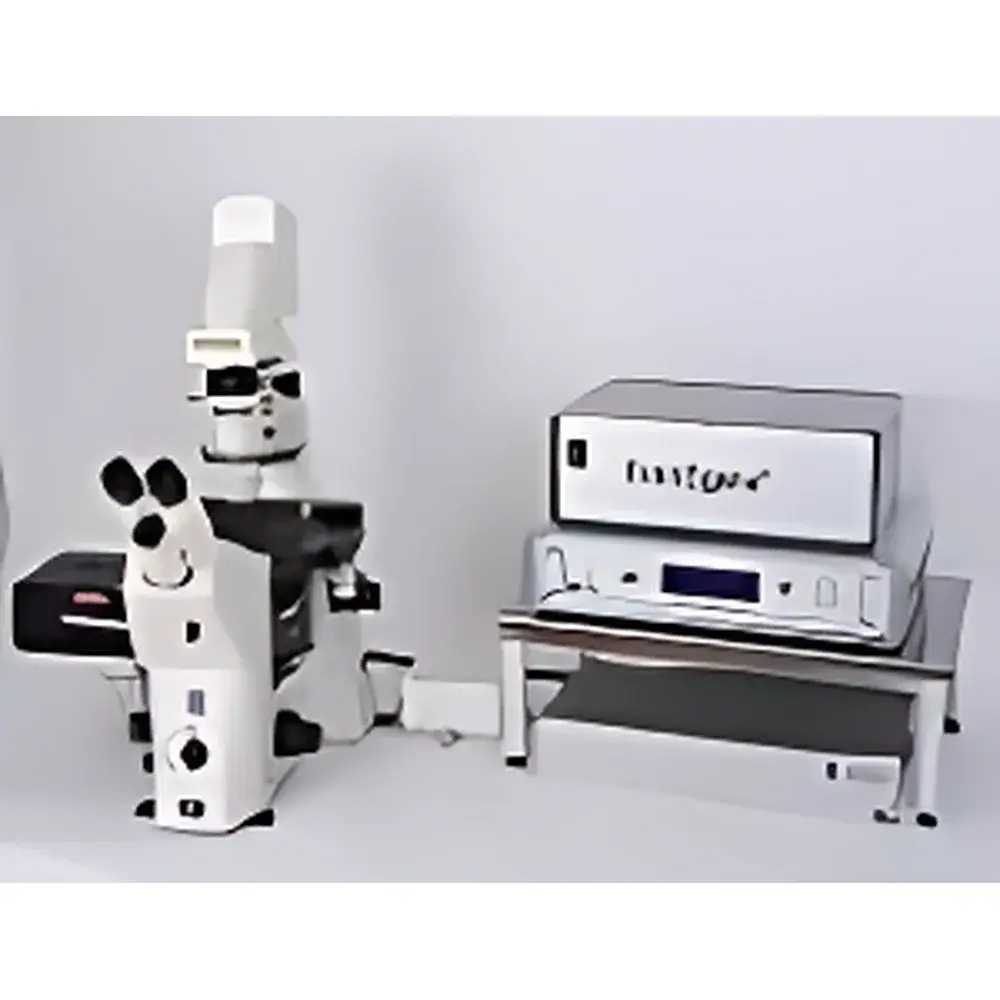
JenLab femtOgene® Sub-20-Femtosecond Laser-Based Targeted Gene Transfer System
| Brand | JenLab |
|---|---|
| Origin | Germany |
| Model | femtOgene® |
| Laser Pulse Width | < 20 fs (typ. < 150 fs) |
| Repetition Rate | 85 MHz |
| Average Power | 200–400 mW |
| Wavelength | 800 ± 10 nm |
| Objective | 40×, NA 1.3 |
| Scan Range | 350 × 350 µm (H), 200 µm (V) |
| Stage Travel | 120 × 102 mm |
| Dispersion Compensation | Integrated high-order module |
| Operating Temp. | 15–35 °C |
| RH | 5–80% |
| Power Supply | AC 230 V, 50 Hz |
| System Footprint | Base 490 × 280 × 480 mm³ |
Overview
The JenLab femtOgene® Sub-20-Femtosecond Laser-Based Targeted Gene Transfer System is a compact, turnkey nonlinear scanning microscope engineered for high-precision, non-invasive intracellular manipulation via multiphoton-induced photoporation. At its core, the system integrates a dispersion-compensated, mode-locked Ti:sapphire laser emitting near-infrared pulses with duration < 20 fs (typically < 150 fs) at 800 ± 10 nm and 85 MHz repetition rate. Coupled with a high-numerical-aperture (NA 1.3) 40× objective, it achieves diffraction-limited focusing into sub-femtoliter (< 1 × 10⁻¹⁵ L) volumes—enabling controlled, transient nanoscale pore formation in cellular membranes through localized multiphoton absorption. This physical mechanism avoids chemical or viral vectors, preserving native cell physiology while permitting direct delivery of exogenous biomolecules—including plasmid DNA, siRNA, proteins, and quantum dots—into the cytosol or nucleus with single-cell resolution.
Key Features
- Sub-20-fs ultrafast laser source with integrated high-order dispersion compensation to maintain transform-limited pulse duration at the sample plane—critical for reproducible nonlinear interaction and minimal collateral thermal or photochemical damage.
- Galvanometric scanning architecture enabling flexible illumination modes: full-field raster scan, region-of-interest (ROI) targeting, line scan, and single-spot ablation—supporting both photoporation and submicrometer-scale nano-surgery (e.g., organelle ejection, chromosome isolation).
- Optimized optical path design with calibrated beam delivery, ensuring stable pulse energy distribution across the entire 350 × 350 µm (H) × 200 µm (V) scan field and precise spatial registration between imaging and manipulation coordinates.
- Motorized XYZ translation stage (120 × 102 mm travel) with sub-micron repeatability, compatible with standard Petri dishes, multi-well plates, and custom microfluidic chambers.
- Real-time CCD-based fluorescence and brightfield monitoring with digital video output, facilitating live assessment of membrane integrity, transfection efficiency (e.g., GFP expression onset within 24–48 h), and post-treatment viability.
- Turnkey operation with pre-aligned, sealed laser head and modular control electronics—designed for integration into biosafety level 2 (BSL-2) laboratories without requiring external optical tables or active vibration isolation.
Sample Compatibility & Compliance
The femtOgene® system is validated for use with adherent and suspension mammalian cells—including primary human stem cells (e.g., salivary gland and pancreatic progenitors), induced pluripotent stem cells (iPSCs), and differentiated lineages. Its non-contact, label-free photoporation mechanism eliminates cytotoxicity associated with electroporation or lipid-based reagents, supporting high post-transfection viability (> 90%) and rapid membrane resealing. The platform complies with ISO 13485 design controls for medical device-related R&D instrumentation and meets electromagnetic compatibility (EMC) requirements per IEC 61326-1. While not a CE-marked medical device, its operational parameters align with GLP-compliant workflows for preclinical gene editing validation and meet technical prerequisites for FDA 21 CFR Part 11–ready data acquisition when paired with compliant third-party software environments.
Software & Data Management
System control and experiment orchestration are managed via JenLab’s proprietary femtOgene® Control Suite—a Windows-based application supporting scriptable protocol definition, time-stamped event logging, and synchronized acquisition of imaging and laser exposure metadata. All parameter sets (pulse energy, dwell time, ROI coordinates, scan velocity) are stored with UUID-tagged experiment files, enabling full traceability for audit purposes. Raw image sequences and fluorescence intensity time courses export in TIFF and HDF5 formats, compatible with Fiji/ImageJ, MATLAB, and Python-based analysis pipelines. Optional API integration supports connection to laboratory information management systems (LIMS) and electronic lab notebooks (ELN) for automated metadata ingestion and workflow tracking.
Applications
- Targeted gene transfection in stem cells: Efficient delivery of CRISPR-Cas9 ribonucleoprotein complexes or reporter plasmids into human mesenchymal and epithelial stem populations without compromising self-renewal or differentiation capacity.
- Subcellular nanosurgery: Precision ablation of mitochondria, lysosomes, or centrosomes to study organelle dynamics, mitophagy, or asymmetric division mechanisms.
- Chromosome microdissection: Isolation of intact metaphase chromosomes using localized multiphoton cleavage—enabling downstream karyotyping, FISH, or single-chromosome sequencing.
- Optical injection of functional probes: Delivery of calcium indicators, optogenetic actuators, or metabolic sensors directly into defined subcellular compartments (e.g., dendritic spines, nuclear envelope).
- Developmental biology studies: Spatiotemporally resolved perturbation of embryonic tissues in zebrafish, mouse, or organoid models under physiological culture conditions.
FAQ
What laser safety class does the femtOgene® system operate under?
The system is classified as Class 4 laser product per IEC 60825-1. It requires installation in a designated laser-controlled area with interlocked access, appropriate eyewear (OD ≥6 @ 800 nm), and documented standard operating procedures aligned with ANSI Z136.1.
Can the system be used for in vivo applications?
While primarily designed for in vitro and ex vivo use on cultured cells and tissue slices, limited proof-of-concept studies have demonstrated feasibility in superficial murine skin and corneal epithelium—subject to institutional animal care and use committee (IACUC) approval and depth-limited irradiation protocols.
Is real-time feedback on pore formation available during operation?
No intrinsic real-time biophysical readout (e.g., impedance or capacitance sensing) is embedded. However, secondary indicators—including immediate propidium iodide influx (if co-administered), subsequent GFP expression kinetics, and time-lapse phase-contrast morphological stability—serve as validated functional proxies for successful photoporation.
Does the system support multi-well plate automation?
Yes—the motorized stage and software API allow integration with third-party robotic handlers for unattended serial processing across 6-, 24-, or 96-well formats, provided plate height and lid clearance fall within mechanical envelope specifications.
What maintenance is required for long-term stability?
Annual recalibration of laser pulse width and energy stability is recommended. The sealed laser head and dispersion module require no user-serviceable optics; routine cleaning of objective front lens and chamber windows with spectroscopic-grade solvents suffices for optical throughput preservation.





