
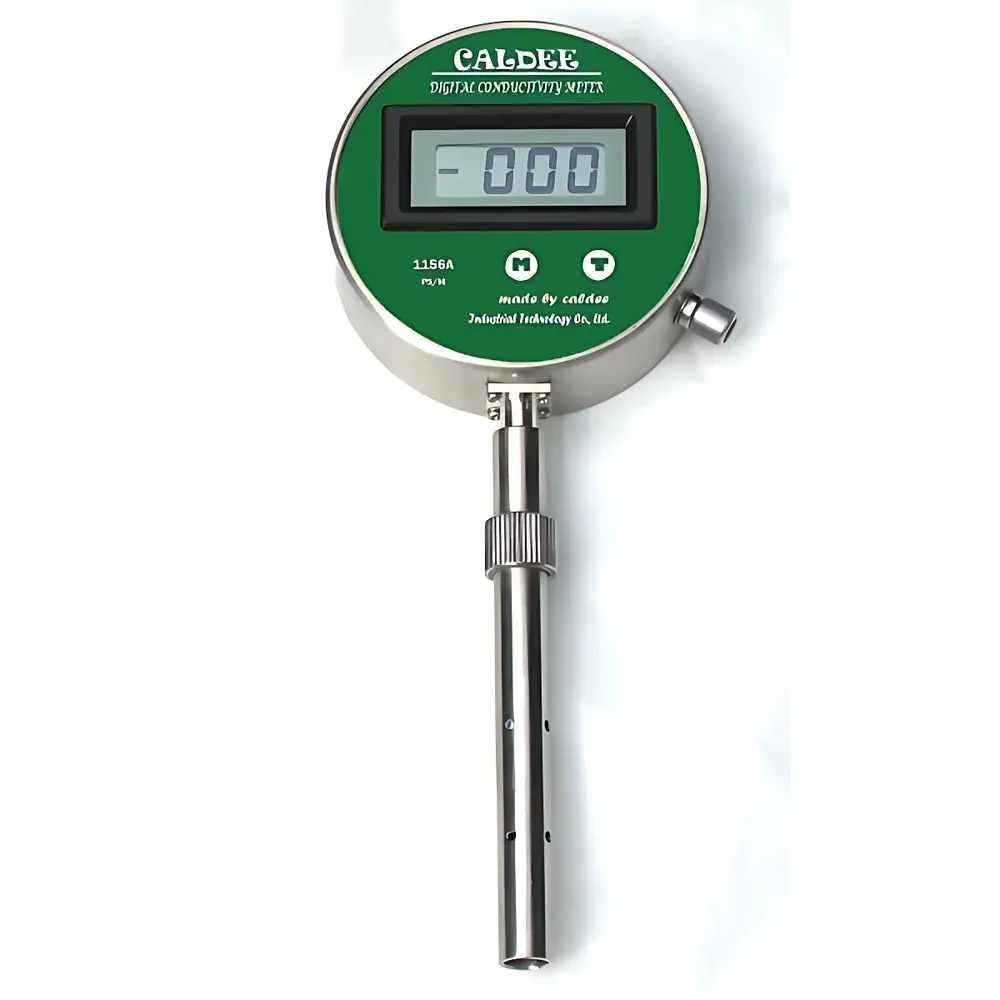
Jetstar 1156A Portable Aviation Fuel Digital Precision Conductivity Meter
| Origin | Shaanxi, China |
|---|---|
| Manufacturer Type | Authorized Distributor |
| Origin Category | Domestic (PRC) |
| Model | 1156A |
| Detection Parameter | Single-parameter (Conductivity) |
| Portability | Portable |
| Conductivity Range | 0–1999 pS/m |
| Resistivity Range | 0–1999 pS/m (inverted scale) |
| Temperature Range | 32–165 °F (0–75 °C) |
| Accuracy | ±2% of reading |
| Minimum Resolution | 1 pS/m |
| Calibration | Internal auto-calibration |
| Display | LCD with over-range indicator ("1" on left) |
| Power Supply | Three 6 V alkaline batteries |
| Enclosure | Anodized aluminum housing with corrosion-resistant coating |
| Probe | Detachable, ruggedized for field use |
| Compliance | ASTM D2624, ASTM D4308, ISO 6297, GB/T 6539, GB 6950, GB 13348 |
Overview
The Jetstar 1156A Portable Aviation Fuel Digital Precision Conductivity Meter is a purpose-engineered electrochemical instrument designed specifically for the accurate, repeatable, and field-deployable measurement of electrical conductivity in aviation turbine fuels (Jet A, Jet A-1, JP-5, JP-8) and related hydrocarbon distillates. It operates on the principle of two-electrode AC conductometry—applying a low-frequency alternating current across a calibrated cell to minimize polarization effects and electrode fouling typical in low-conductivity non-aqueous media. Unlike general-purpose aqueous conductivity meters, the 1156A is optimized for the ultra-low conductivity regime characteristic of refined hydrocarbons (typically 0.1–1000 pS/m), where static charge accumulation poses critical safety hazards during fuel handling, transfer, and aircraft refueling operations. Its design directly addresses the electrostatic ignition risk mitigation requirements defined in international aviation safety standards, enabling real-time verification of fuel antistatic additive efficacy and compliance with minimum conductivity thresholds (e.g., ≥50 pS/m per ASTM D2624 and GB/T 6539).
Key Features
- True portable architecture: Compact, lightweight (≤1.2 kg), and battery-operated—enabling direct in-situ measurements inside fuel storage tanks, tanker compartments, and aircraft refueling nozzles without external power or data logging hardware.
- Dual-range resolution: 1 pS/m minimum resolution across the full 0–1999 pS/m span ensures detection of subtle changes in additive depletion or contamination-induced conductivity shifts.
- Robust mechanical construction: Anodized aluminum housing with industrial-grade corrosion-inhibiting coating provides resistance to hydrocarbon exposure, humidity, and mechanical impact in hangar, refinery, and depot environments.
- Detachable probe assembly: Chemically inert stainless-steel electrodes with integrated temperature sensor allow rapid insertion into sample ports or dip-tube adapters; cable length supports measurements up to 3 m from instrument body.
- Intelligent operational interface: Two-button operation (M for Measure, C for Calibrate) minimizes user error; automatic internal calibration eliminates need for external standard solutions during routine field use.
- Environmental resilience: Validated performance across 0–75 °C (32–165 °F), supporting year-round operation in arctic ground depots and tropical coastal airfields.
Sample Compatibility & Compliance
The 1156A is validated exclusively for non-aqueous, low-dielectric hydrocarbon liquids—including aviation turbine fuels, kerosene-type distillates, and diesel blends—with no solubility, emulsification, or electrolyte interference. It is not suitable for aqueous solutions, alcohols, or high-polarity solvents. Regulatory alignment includes full functional conformance with ASTM D2624 (Standard Test Method for Electrical Conductivity of Aviation Turbine Fuels), ASTM D4308 (for fuels containing static dissipater additives), ISO 6297 (Petroleum products — Determination of electrical conductivity), and Chinese national standards GB/T 6539, GB 6950, and GB 13348. Instrument output meets traceability requirements for GLP-compliant fuel quality records; while the device itself does not provide electronic audit trails, its calibrated readings are admissible as primary data in safety-critical documentation required by civil aviation authorities (CAAC, EASA, FAA) and petroleum industry HSE management systems.
Software & Data Management
The 1156A operates as a standalone, embedded-system meter with no onboard memory or digital communication interfaces (e.g., USB, Bluetooth, RS-232). All measurements are displayed in real time on a high-contrast, wide-viewing-angle LCD panel. Data recording is manual—users log timestamped readings alongside sample identifiers (e.g., tank number, batch ID, location) in paper-based or LIMS-integrated spreadsheets. For laboratories requiring electronic data capture, optional third-party analog-to-digital converters (e.g., certified 4–20 mA transmitters or USB data loggers with NIST-traceable calibration) may be interfaced via the instrument’s analog output signal path—subject to validation per 21 CFR Part 11 if used in regulated GMP environments.
Applications
- Pre-flight fuel quality verification at commercial and military airbases
- In-line monitoring of conductivity during fuel blending and additive injection at refineries
- Periodic tank-bottom sampling and static hazard assessment in bulk storage facilities
- Field audits of fuel delivery trucks and mobile refuelers prior to aircraft servicing
- Root-cause analysis of electrostatic discharge incidents in fuel-handling infrastructure
- Validation of antistatic additive stability during long-term fuel storage (e.g., strategic reserves)
FAQ
Does the 1156A require periodic recalibration with certified reference standards?
Yes—while internal auto-calibration compensates for drift between uses, annual verification against traceable conductivity standards (e.g., NIST SRM 3198 for hydrocarbon simulants) is recommended per ISO/IEC 17025 and ASTM D2624 Annex A3.
Can the probe be immersed in hot fuel (>60 °C)?
Yes—the probe and cable assembly are rated for continuous operation up to 75 °C; however, prolonged exposure above 65 °C may accelerate seal degradation and should be minimized.
Is the instrument intrinsically safe for Zone 1 hazardous areas?
No—the 1156A is not ATEX- or IECEx-certified; it must be operated outside classified zones or used only after verifying local area gas detection and ventilation protocols.
What battery life can be expected under typical field use?
Approximately 200 hours of intermittent measurement time using fresh alkaline cells; battery voltage is monitored continuously, with low-power warning displayed prior to cutoff.
How is temperature compensation applied during measurement?
The integrated Pt100 sensor enables automatic linear compensation referenced to 20 °C, using the standard temperature coefficient for hydrocarbons (β = 2.0 %/°C), as specified in ASTM D2624 Section 8.3.




