
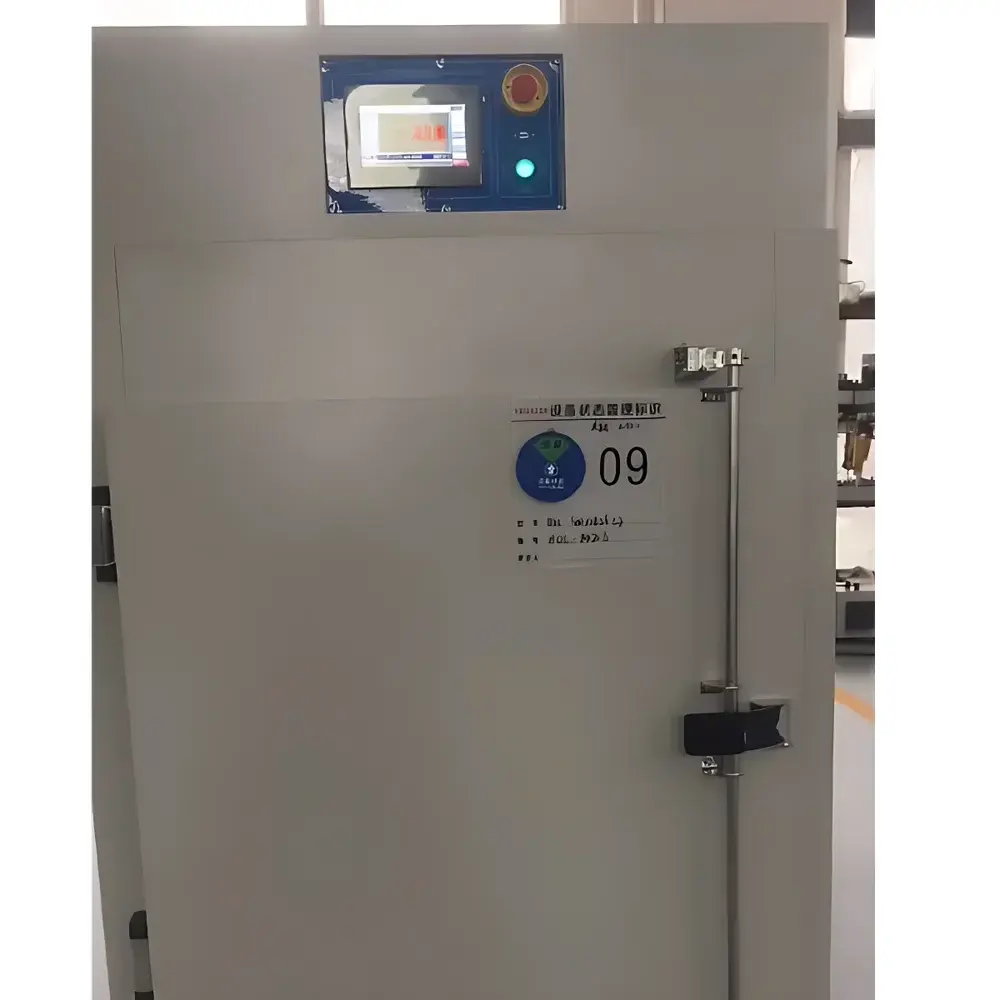
JH High-Temperature Thermal Aging Test Chamber for Semiconductor PI Curing
| Brand | Jianhu |
|---|---|
| Origin | Shanghai, China |
| Model | JH High-Temperature Thermal Aging Test Chamber |
| Temperature Range | −70 °C to +150 °C |
| Refrigeration Method | Compressor-Based Cooling |
| Explosion-Proof Design | Yes |
| Temperature Fluctuation | ±0.5 °C |
| Temperature Uniformity | ±2.0 °C (at working volume center) |
| Temperature Deviation | ±2.0 °C (vs. setpoint) |
| Heating Rate | ≤60 min (−70 °C to +150 °C) |
| Cooling Rate | ≤45–80 min (depending on configuration and load) |
| Interior Dimensions | Customizable (small / medium / large chamber variants available) |
| Shelving | Multi-tier adjustable stainless-steel shelves, fully customizable in number, height, and load capacity |
Overview
The JH High-Temperature Thermal Aging Test Chamber is an engineered environmental test system designed for precision thermal aging, post-cure stabilization, and high-reliability process validation—particularly for polyimide (PI) film curing in semiconductor packaging, flexible printed circuit (FPC) manufacturing, and advanced electronic assembly. Operating on forced-air convection with dual-mode heating/cooling architecture, the chamber delivers tightly controlled thermal profiles across a wide operating range (−70 °C to +150 °C), supporting both accelerated life testing per IEC 60068-2-2 and process qualification per JEDEC JESD22-A108. Its explosion-proof construction meets Class I, Division 2, Group A–D hazardous location requirements (per UL 60079-0 and GB/T 3836.1), enabling safe operation during solvent-based PI precursor curing or outgassing-sensitive processes. The core thermal management architecture integrates asymmetric airflow ducting, multi-point PID-controlled heating elements, and adaptive refrigerant expansion control—enabling stable thermal uniformity (±2.0 °C across usable volume) even under dynamic load conditions.
Key Features
- Explosion-proof certified enclosure with intrinsically safe internal wiring and pressure-relief venting—validated per GB 3836.1–2021 and UL 60079-0.
- Forced-air convection system with three-speed programmable axial fans and user-selectable airflow modes: horizontal laminar flow (optimized for thin-film substrates), vertical recirculation (for tall fixtures or stacked wafers), and hybrid turbulence mode (for heterogeneous sample loads).
- Multi-zone thermal compensation algorithm using eight calibrated PT100 sensors (distributed at top/mid/bottom, front/mid/rear)—enabling real-time spatial correction of heater power output to maintain ±2.0 °C uniformity within defined working volume.
- Modular shelving system: stainless-steel perforated shelves (304 grade) with 25 mm pitch adjustment; up to 12 tiers configurable per chamber; maximum shelf load: 25 kg per tier (uniformly distributed).
- Programmable ramp-soak profiles with up to 99 segments; compliance-ready logging (timestamped, uneditable) meeting FDA 21 CFR Part 11 audit trail requirements when paired with optional data acquisition module.
- Integrated thermal inertia compensation: automatic adjustment of heating/cooling duty cycles based on chamber loading mass estimation (via user-input weight or auto-calibrated thermal time constant).
Sample Compatibility & Compliance
The JH chamber accommodates diverse sample geometries—from 8-inch wafer carriers and panelized FPCs to molded IC packages and encapsulated MEMS devices—without compromising thermal fidelity. Perforated shelves minimize airflow obstruction while maintaining mechanical stability under thermal cycling. All internal surfaces are electropolished stainless steel (Ra ≤ 0.4 µm) to prevent particle shedding and facilitate cleaning under ISO 14644-1 Class 5 cleanroom protocols. The system complies with key international standards including IEC 60068-3-5 (environmental testing guidance), ASTM D3045 (thermal aging of plastics), and GB/T 10589–2008 (low-temperature test chambers). Optional GMP-compliant validation packages include IQ/OQ documentation templates aligned with Annex 15 and ISO/IEC 17025 traceability requirements.
Software & Data Management
Control is executed via a 10.1″ capacitive touchscreen HMI running embedded Linux with deterministic real-time kernel. Firmware supports dual-language UI (English/Chinese) and stores ≥10,000 hours of compressed temperature/humidity (if equipped)/alarm/event logs locally. USB export enables CSV-formatted raw data extraction compatible with JMP, Minitab, and Python pandas workflows. Optional Ethernet/WiFi connectivity enables remote monitoring via Modbus TCP or OPC UA—integrated into enterprise MES systems (e.g., Siemens Opcenter, Rockwell FactoryTalk). Audit trails record operator ID, parameter changes, calibration events, and alarm acknowledgments with SHA-256 hashing for tamper evidence—fully compliant with GLP and 21 CFR Part 11 when configured with digital certificate authentication.
Applications
- Thermal aging validation of polyimide dielectric layers in fan-out wafer-level packaging (FO-WLP) and chip-on-flex interposers.
- Post-mold curing of epoxy molding compounds (EMCs) under nitrogen purge (optional accessory).
- High-temperature storage testing of automotive-grade power modules (AEC-Q102 qualified).
- Outgassing profile characterization of space-grade adhesives and conformal coatings (per ECSS-Q-ST-70-02C).
- Accelerated moisture resistance testing (AMRT) preconditioning for humidity-sensitive devices (per J-STD-020).
- Reliability screening of battery separator films and solid-state electrolyte membranes.
FAQ
What is the maximum allowable sample mass for uniform temperature distribution?
Uniformity specifications assume ≤70% volumetric loading with thermally conductive fixtures. For loads >15 kg, consult engineering team for thermal inertia assessment and potential ramp-rate adjustment.
Can the chamber operate continuously at 150 °C for >1000 hours?
Yes—validated for uninterrupted operation at 150 °C with full-load thermal cycling (−40 °C ↔ +150 °C, 1000-cycle endurance test per IEC 60068-2-14 completed).
Is third-party calibration support available?
Yes—NIST-traceable calibration services (including as-found/as-left reports) are offered globally via ISO/IEC 17025-accredited partners.
How does the system handle thermal overshoot during rapid ramping?
Adaptive feedforward control uses historical thermal response models to pre-compensate heater output, limiting overshoot to <1.2 °C at all rates.
Are custom airflow baffles or inert gas purging options supported?
Yes—custom ductwork, nitrogen purge manifolds (with mass flow control), and argon-compatible seals are available under engineering consultation.



