
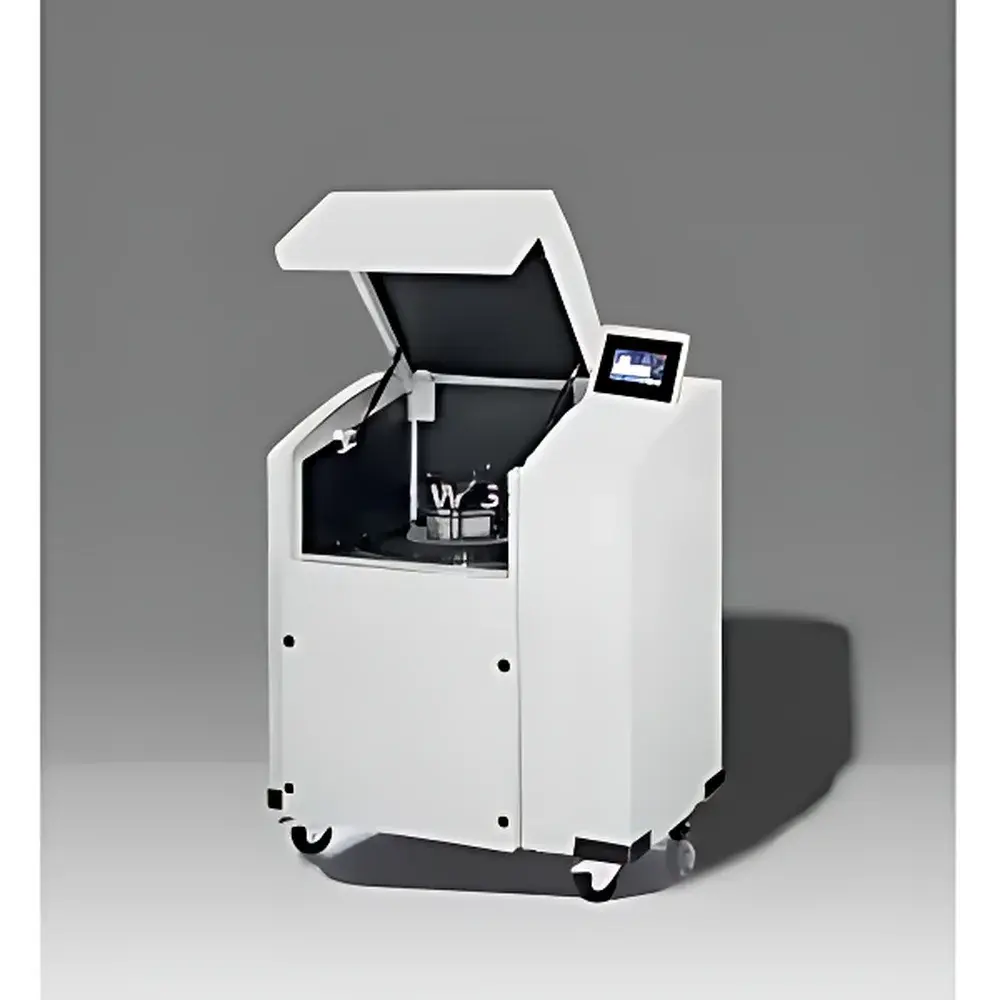
JH-NM10 Nanomaterial Vibratory Disperser
| Brand | Jihepu (Jinan Hopu) |
|---|---|
| Origin | Shandong, China |
| Model | JH-NM10A/B/C |
| Timer Range | 0–99 h |
| Vibration Frequency | 1500 cycles/min |
| Grinding Vessel Capacity | 50–1000 mL |
| Vessel Materials | PTFE, Zirconia, Tungsten Carbide, Stainless Steel, Nylon, Agate |
| Bead Materials | Zirconia, Tungsten Carbide, Stainless Steel |
| Display & Control | LCD Touchscreen (1–100-step programmable gradient) |
| Dimensions | Φ600 × 800 mm |
| Weight | 140 kg |
| Voltage | 220 V |
Overview
The JH-NM10 Nanomaterial Vibratory Disperser is an engineered laboratory-scale dispersion and size-reduction system designed for high-efficiency deagglomeration, surface modification, and homogeneous mixing of nanoscale powders in liquid media. It operates on the principle of three-dimensional high-frequency vibratory motion—generating up to 1500 controlled mechanical impacts per minute—to simultaneously apply shear, friction, and impact forces to suspended particles. Unlike conventional ball mills relying on rotational tumbling or ultrasonic cavitation limited by energy transfer efficiency and thermal management, the JH-NM10 delivers reproducible mechanical energy input across the entire slurry volume via electromagnetic actuation. This architecture enables rapid kinetic energy transfer without significant localized heating, supporting stable colloidal dispersion of nanoparticles where van der Waals attraction and Brownian motion dominate interparticle behavior. The system is purpose-built for wet-milling applications requiring precise control over particle size distribution (PSD), surface functionalization, and uniform spatial distribution—critical parameters in advanced ceramic precursors, conductive inks, battery electrode slurries, and nano-enhanced polymer composites.
Key Features
- Three-axis high-frequency vibration mechanism delivering consistent mechanical energy input at 1500 cycles/min, enabling rapid particle size reduction and deagglomeration within minutes
- Modular grinding vessel configuration: selectable models support 1 (JH-NM10A), 3 (JH-NM10B), or 6 (JH-NM10C) independent vessels for parallel processing and experimental scalability
- Programmable multi-stage operation via 7-inch LCD touchscreen interface—supports up to 100 user-defined steps with real-time monitoring of power consumption, vibration amplitude balance, and elapsed time
- Chemically inert and wear-resistant vessel options including PTFE, zirconia, tungsten carbide, stainless steel, agate, and nylon—ensuring compatibility with acidic, alkaline, or abrasive slurries
- Dispersion media compatibility with a broad range of grinding beads (zirconia, tungsten carbide, stainless steel) optimized for density, hardness, and contamination control
- Integrated thermal stability design minimizes slurry temperature rise during extended operation—critical for preserving dispersant integrity and preventing nanoparticle reagglomeration
Sample Compatibility & Compliance
The JH-NM10 accommodates diverse material systems including metal oxides (TiO₂, SiO₂, Al₂O₃), carbon-based nanomaterials (graphene oxide, CNTs), metallic nanoparticles (Ag, Cu, Ni), and polymeric nanocomposites. Its modular vessel design supports both low-viscosity dispersions (<500 cP) and moderately viscous pastes (<5,000 cP), provided appropriate bead-to-sample ratio and dispersant selection are applied. While not certified to ISO/IEC 17025 or ASTM E2932, the instrument’s programmable logic controller (PLC) architecture supports GLP-compliant data logging when integrated with external audit-trail-capable software. Users are responsible for validating dispersant formulation (solvent type, surfactant concentration, pH adjustment) and process parameters (bead loading, amplitude setting, dwell time) per application-specific requirements—consistent with USP , ISO 13320, and ASTM D7823 guidance on nanomaterial dispersion protocol development.
Software & Data Management
The embedded control system provides local data capture—including timestamped vibration profiles, power draw curves, and step-wise parameter logs—exportable via USB to CSV format. No cloud connectivity or remote access capability is included; all operational data remains resident on-device unless manually exported. The interface supports password-protected user accounts and configurable alarm thresholds for vibration imbalance or timeout events. For regulated environments, integration with third-party LIMS or ELN platforms is achievable via RS-232 or Modbus RTU serial output (optional adapter required). Full audit trail functionality—including operator ID, parameter changes, and execution history—must be implemented externally per FDA 21 CFR Part 11 requirements.
Applications
- Deagglomeration and primary particle size stabilization of nanocellulose, quantum dots, and perovskite precursors
- Mechanical surface modification of mineral fillers (talc, kaolin) for improved polymer matrix adhesion
- Slurry homogenization for lithium-ion battery cathode/anode formulations prior to coating
- Preparation of stable aqueous or organic-phase nanofluids for thermal conductivity enhancement studies
- High-energy milling for mechanochemical synthesis of intermetallic compounds and amorphous alloys
- Rapid screening of dispersant efficacy across solvent systems (e.g., NMP, DMF, ethanol, water)
FAQ
What types of dispersants are compatible with the JH-NM10?
The system does not prescribe specific dispersants; users must select surfactants, polymeric stabilizers, or ionic agents based on zeta potential optimization and Hansen solubility parameter matching for their target nanoparticle and solvent system.
Can the JH-NM10 operate under inert atmosphere?
Yes—vessels may be sealed and purged with N₂ or Ar prior to operation; however, no built-in gas manifold or pressure regulation is provided.
Is temperature control integrated into the system?
No active cooling/heating is embedded; ambient air convection and optional external jacketed vessels (user-supplied) are recommended for thermally sensitive formulations.
How is vibration amplitude calibrated and verified?
Amplitude is fixed per model configuration and verified at factory using laser Doppler vibrometry; field recalibration requires manufacturer service tools and traceable reference standards.
Does the device meet CE or UL safety certification?
The unit complies with IEC 61000-6-2 (immunity) and IEC 61000-6-4 (emission) for industrial environments; CE marking is not affixed as it is intended for research use only and not placed on the EU market directly by the manufacturer.



