
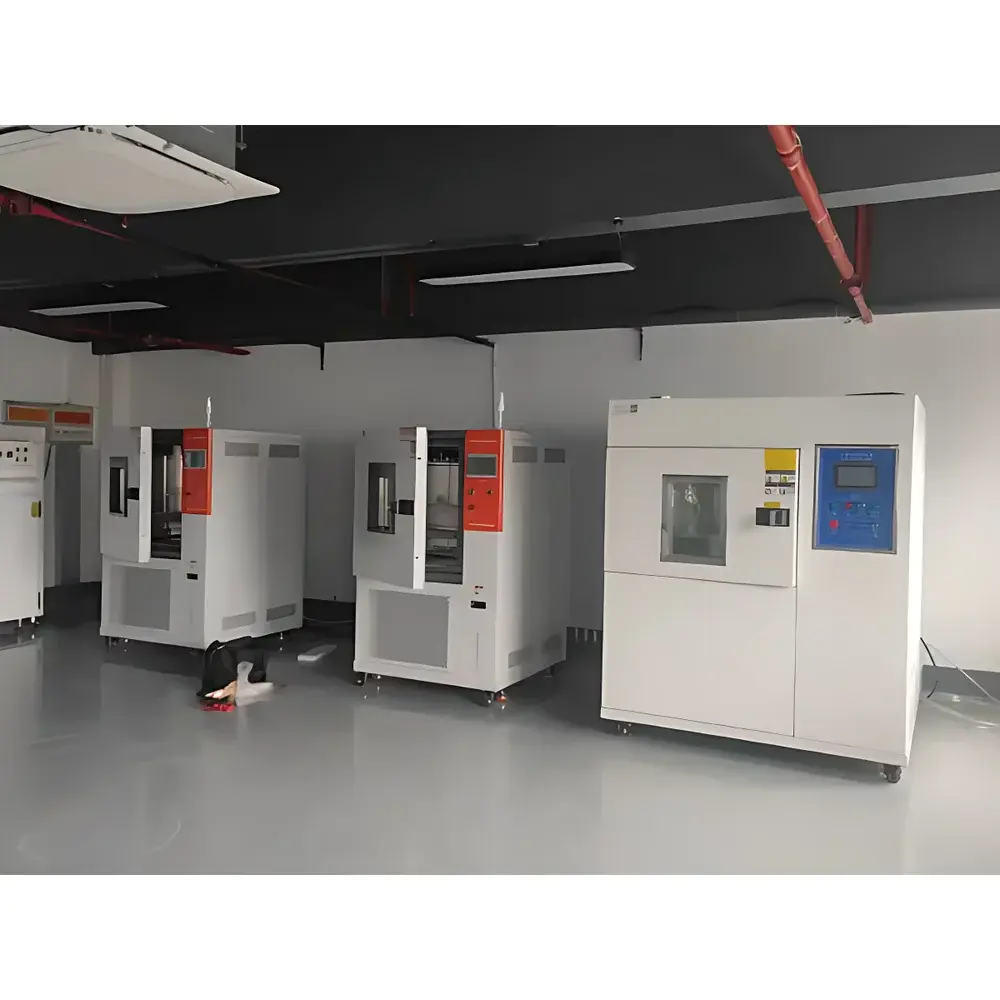
JH Series Professional Environmental Test Chamber – High-Low Temperature & Humidity Cycling Chamber with Customizable Thermal Profiles
| Brand | JH Instruments |
|---|---|
| Origin | Shanghai, China |
| Model | JH-Professional Environmental Test Chamber |
| Temperature Range | -80°C to +150°C |
| Thermal Shock Range | -40°C to +150°C |
| Temperature Stability | ±0.5°C to ±2.0°C |
| Heating Rate | 1–3°C/min |
| Cooling Rate | ≤2°C/min |
| Humidity Range | 20–98% RH |
| Humidity Control Accuracy | ±2% RH |
| Temperature Uniformity | ±2°C |
| Compliance | ISO 16750-4, IEC 60068-2-1, IEC 60068-2-2, IEC 60068-2-14, ASTM D4332, MIL-STD-810H (Section 501.7, 502.7) |
Overview
The JH Series Professional Environmental Test Chamber is an engineered solution for accelerated environmental stress testing of industrial components, electronic systems, automotive modules, and aerospace subassemblies under rigorously controlled temperature and humidity conditions. Based on the principles of convective thermal transfer and psychrometric humidity control, the chamber employs dual-stage cascade refrigeration, high-efficiency electric heating elements, and a precision steam-based humidification system to deliver stable, repeatable, and traceable environmental profiles. Designed for laboratory-grade reliability and long-term operational integrity, it supports both steady-state conditioning and dynamic cycling protocols—including ramp-hold-soak sequences and multi-step thermal shock profiles—per international standards governing environmental qualification (e.g., IEC 60068, ISO 16750, MIL-STD-810). Its modular architecture allows integration into automated test systems via RS485/Modbus or Ethernet/IP interfaces, enabling synchronized data acquisition and remote supervision in GLP- and GMP-aligned validation environments.
Key Features
- Wide operational envelope: -80°C to +150°C temperature range with optional extended low-temperature capability down to -100°C upon request
- Precise humidity control from 20% to 98% RH at temperatures ≥10°C, utilizing saturated steam generation and PID-regulated condensate management
- Programmable thermal profiling engine supporting up to 99 segments per test cycle, including ramp rates, dwell times, and conditional branching logic
- Advanced microprocessor-based controller with 7-inch color touchscreen HMI, real-time graphing, and onboard data logging (≥10,000 hours of timestamped温/humidity/pressure points)
- Optimized airflow design featuring tangential circulation fans and perforated stainless-steel baffle plates to ensure ≤±2°C temperature uniformity across working volume
- Structural integrity verified per ISO 13374-2 for vibration resistance; insulated double-wall construction with 150 mm polyurethane foam (λ = 0.022 W/m·K) and vacuum-sealed door gaskets
- Comprehensive safety architecture: independent over-temperature cutoff, refrigerant leak detection, door interlock, and emergency power-off circuitry compliant with IEC 61000-6-2/6-4
Sample Compatibility & Compliance
The chamber accommodates samples ranging from PCB assemblies and battery packs to full-size electrical cabinets and telecom base station enclosures—supporting custom internal dimensions up to 5 m (W) × 3 m (D) × 2.5 m (H). Internal shelving and mounting rails are configurable in stainless steel or epoxy-coated aluminum to prevent galvanic corrosion during prolonged humidity exposure. All control firmware and calibration records adhere to ISO/IEC 17025 requirements for accredited laboratories. The system is preconfigured for compliance with key industry-specific test methods: thermal cycling per AEC-Q200 for automotive electronics; damp heat storage per IEC 60068-2-78 for photovoltaic inverters; and temperature-humidity bias testing per JEDEC JESD22-A110 for semiconductor packages. Optional IQ/OQ documentation packages are available for FDA 21 CFR Part 11–compliant validation in pharmaceutical and medical device manufacturing facilities.
Software & Data Management
JH’s proprietary TestControl Suite v4.2 provides full lifecycle test orchestration—from protocol authoring and remote scheduling to real-time monitoring and post-test statistical analysis. The software supports ASTM E29–compliant rounding rules for reported values and exports raw data in CSV, XML, and PDF formats with embedded digital signatures. Audit trails record all user actions, parameter modifications, and alarm events with immutable timestamps, satisfying ALCOA+ principles for data integrity. Integration with LIMS platforms (e.g., LabVantage, Thermo Fisher SampleManager) is achieved through HL7 and RESTful API endpoints. Calibration certificates for integrated Pt100 sensors and capacitive RH probes are NIST-traceable and include uncertainty budgets per ISO/IEC 17025 Annex A.5.
Applications
- Reliability screening of EV battery modules under combined thermal-humidity stress (UN38.3, GB/T 31467.3)
- Qualification of avionics cooling systems across rapid thermal transients (-55°C ↔ +85°C in <15 min)
- Accelerated aging of polymer-based optical connectors exposed to cyclic condensation
- Validation of hermetic seal integrity in MEMS pressure sensors using humidity soak-and-leak protocols
- Environmental stress screening (ESS) of military-grade power supplies per MIL-STD-883 Method 1010.8
- Climate simulation for biodegradable packaging materials per ISO 14855-2
FAQ
What is the standard calibration interval for temperature and humidity sensors?
Annual recalibration is recommended; however, interval adjustments may be made based on usage frequency and criticality of application per ISO/IEC 17025 Clause 7.7.
Can the chamber be configured for nitrogen-purged operation?
Yes—optional inert gas purge kits with mass flow controllers and O₂ analyzers are available for oxygen-sensitive applications such as lithium-ion cell testing.
Is remote firmware update supported over Ethernet?
Firmware updates require authenticated USB media upload to prevent unauthorized modification; network-based updates are disabled by default for cybersecurity compliance (IEC 62443-3-3 SL2).
Does the system support third-party SCADA integration?
Yes—OPC UA server implementation is included as standard, enabling bidirectional communication with Siemens Desigo, Honeywell Experion, and Rockwell FactoryTalk systems.
What documentation is provided for regulatory submissions?
Standard delivery includes Factory Acceptance Test (FAT) report, Installation Qualification (IQ) checklist, and electronic copies of all schematics, P&IDs, and component datasheets—all formatted for inclusion in 510(k), CE Technical File, or IATF 16949 audit dossiers.
Related Products



