
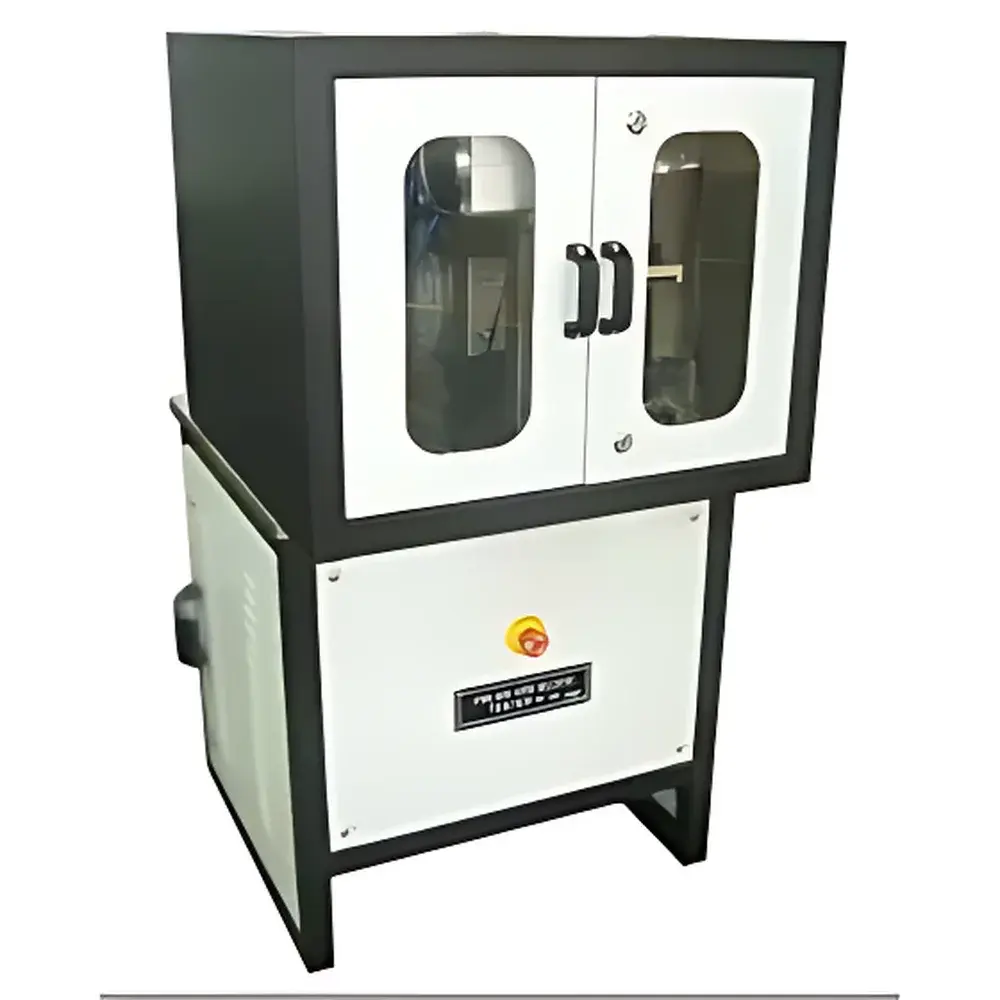
JHT TR 22 Pin-on-Vee Block Tribological Tester
| Brand | JHT |
|---|---|
| Origin | USA |
| Model | TR 22 |
| Maximum Friction Force | 20 N |
| Friction Force Resolution | 0.4 mN |
| Maximum Test Temperature | 200 °C |
| Speed Range | 100–500 rpm |
| Load Range | 0–4500 lbf |
| Torque Range | 0–100 in-lb |
| Test Duration | 0–999.9 min |
| Power Supply | 230 V / 1 Ph / 50–60 Hz / 2 kVA |
| Compliance | ASTM D 5620, D 2625, D 2670, D 3233, IP 241, FTM 791-3807.1, FTM 791-3812.1 |
Overview
The JHT TR 22 Pin-on-Vee Block Tribological Tester is a precision-engineered benchtop instrument designed for standardized evaluation of lubricant performance under boundary and mixed-film lubrication regimes. Based on the classical pin-on-vee block geometry—comprising two fixed hardened steel vee blocks and a rotating cylindrical pin pressed between them—the system replicates high-contact-stress sliding conditions typical of gear teeth, cam followers, and journal bearings. Load is applied via a calibrated ratchet mechanism that incrementally increases normal force during testing, enabling automated determination of load-carrying capacity and scuffing resistance. The test assembly is fully immersed in a thermostatically controlled bath, allowing precise temperature regulation from ambient to 200 °C. Real-time measurement of friction torque, applied load, bath temperature, and rotational speed enables construction of torque–load curves, identification of failure load (defined as the point at which either pin shear or ratchet stalling occurs), and quantification of lubricant film durability through time-to-threshold torque rise.
Key Features
- Automated ratchet-driven load application with incremental stepping, supporting progressive load increase per ASTM D 2670 and D 3233 protocols
- Integrated PID-controlled heating system with ±1 °C stability across full 20–200 °C operating range
- High-resolution torque transducer (0–100 in-lb, resolution ≤0.01 in-lb) and load cell (0–4500 lbf, resolution ≤1 lbf)
- Motorized speed control maintaining constant rotational velocity (100–500 rpm) across full load spectrum
- Over-torque and over-temperature safety interlocks that halt motor operation and trigger audible/visual alerts
- Pre-calibrated reference tools included for periodic verification of torque, load, and temperature sensors in accordance with ISO/IEC 17025 traceability requirements
- Robust stainless-steel test chamber with sealed access ports, compatible with mineral oils, synthetic esters, and greases
Sample Compatibility & Compliance
The TR 22 accommodates standard test specimens per ASTM and IP specifications: cylindrical pins (typically 0.25″ diameter × 0.75″ length, hardened to 58–62 HRC), V-blocks (AISI 52100 steel, ground and polished to Ra ≤0.2 µm), and optional Brinell ball attachments for alternative contact geometries. All wetted components are corrosion-resistant and chemically inert to common base oils and additive packages. The instrument conforms to multiple international tribology standards, including ASTM D 5620 (lubricant film life), D 2625 (scuffing resistance), D 2670 (load wear index), D 3233 (extreme pressure performance), IP 241 (gear oil scuffing), and U.S. Department of Defense test methods FTM 791-3807.1 and 791-3812.1. Its mechanical design and calibration protocol support GLP-compliant operation and audit readiness for pharmaceutical excipient or aerospace fluid qualification.
Software & Data Management
Data acquisition and real-time visualization are implemented via a LabVIEW-based software suite compliant with FDA 21 CFR Part 11 requirements. The system provides electronic signatures, audit trails, user role management, and immutable data logging with timestamped metadata (operator ID, test ID, environmental conditions). Raw sensor outputs—including analog torque, digital load steps, thermocouple readings, and encoder pulses—are sampled at ≥100 Hz and stored in hierarchical data format (HDF5) for post-processing interoperability with MATLAB, Python (NumPy/Pandas), or commercial statistical analysis platforms. Automated report generation includes torque–load plots, time-to-failure metrics, wear scar measurements (when used with optional microscope integration), and pass/fail flags against predefined specification limits.
Applications
- Quantitative ranking of anti-wear (AW) and extreme pressure (EP) additive packages in engine oils, gear lubes, and hydraulic fluids
- Screening of biodegradable lubricants for agricultural and marine applications under elevated thermal stress
- Development validation of solid lubricant coatings (e.g., MoS₂, DLC) on bearing surfaces
- Corrosion-inhibitor efficacy assessment in water-contaminated systems
- Supporting OEM lubricant qualification programs requiring repeatable, third-party-verified scuffing and seizure data
- Academic research into tribofilm formation kinetics and shear-induced chemical degradation pathways
FAQ
What is the definition of “failure load” in TR 22 testing?
Failure load is defined as the highest applied load at which either (a) the test pin undergoes complete shear fracture, or (b) the ratchet mechanism fails to advance due to excessive frictional resistance—both indicating loss of lubricating film integrity.
Can the TR 22 be operated under inert atmosphere or vacuum?
No—the standard configuration is designed for open-bath immersion testing in air. Custom modifications for glovebox integration or sealed nitrogen-purged chambers require engineering review and are available upon request.
Is calibration certificate included with shipment?
Yes—a NIST-traceable calibration certificate covering torque, load, and temperature sensors is supplied with each unit, valid for 12 months from date of issue.
How is wear scar measured after testing?
Wear scars on pins and V-blocks are evaluated using the included metallurgical microscope (10×–100× magnification) and calibrated stage micrometer; image analysis software for automated scar width/depth quantification is optional.
Does the system support automated test sequence programming?
Yes—the LabVIEW interface allows creation of multi-step test protocols (e.g., ramped temperature + stepped load + timed duration) with conditional branching based on real-time torque thresholds.
Related Products



