
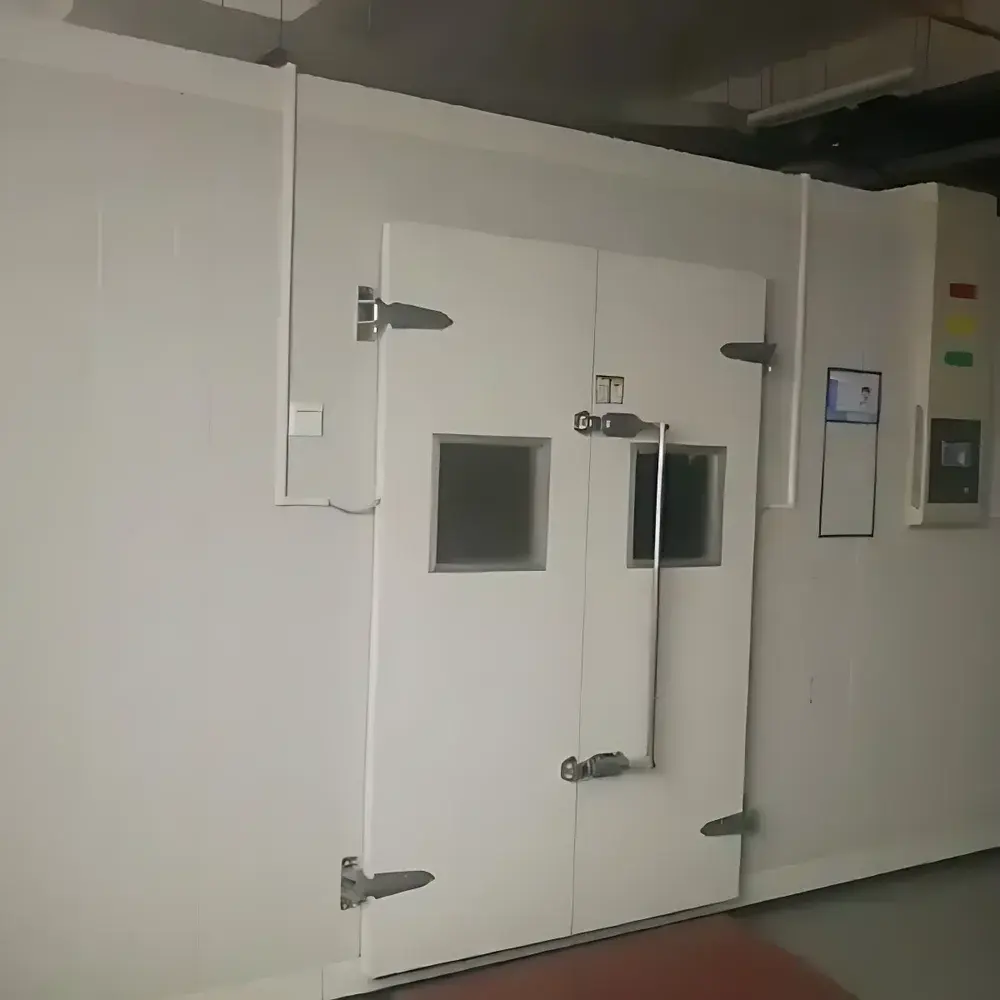
Jianhu 2026 Custom Walk-in Nylon Conditioning & Toughening Chamber
| Brand | Jianhu |
|---|---|
| Origin | Shanghai, China |
| Manufacturer Type | Authorized Distributor & Solution Provider |
| Country of Origin | China |
| Model | JH-2026 |
| Price Range | USD 7,300 – 13,800 (FOB Shanghai) |
| Internal Dimensions (D×W×H) | Fully Customizable |
| Temperature Range | -10°C to +85°C (Customizable per Application) |
| Humidity Range | 10% RH to 98% RH (Customizable) |
| Temperature Uniformity | ±0.5°C (at steady state, per IEC 60068-3-5) |
| Humidity Uniformity | ±2.0% RH (at steady state, per ISO 17025-accredited validation protocol) |
| Control Resolution | 0.1°C / 0.1% RH |
| Programmable Stages | Up to 99 segments with ramp/soak logic |
Overview
The Jianhu JH-2026 is a fully customizable walk-in environmental test chamber engineered specifically for the controlled hygrothermal conditioning and toughening of polyamide-based engineering plastics—primarily PA6 and PA66. Unlike generic humidity chambers, the JH-2026 integrates material-specific thermal-hygric response modeling into its control architecture, enabling precise replication of moisture diffusion kinetics aligned with the glass transition temperature (Tg) shifts and crystallinity-dependent absorption profiles of nylon polymers. Its operational principle relies on forced-air convection with laminar flow optimization, combined with dual-stage steam injection and desiccant-assisted dehumidification, ensuring thermodynamic equilibrium across large-volume loads under GMP-aligned process conditions. Designed for integration into QC/QA workflows and pre-production conditioning lines, the chamber supports both accelerated equilibrium protocols and multi-step gradient conditioning—critical for mitigating dimensional instability, improving impact resistance, and stabilizing mechanical property variance in automotive, electronics, and precision gear applications.
Key Features
- Material-Centric Control Logic: Preloaded and field-configurable conditioning curves for PA6 (higher equilibrium moisture uptake, ~9–10% w/w at 23°C/50% RH) and PA66 (lower saturation, ~5–6% w/w), accounting for thickness-dependent diffusion coefficients (Fickian vs. non-Fickian behavior)
- Structural Integrity for Large-Scale Operation: Reinforced stainless-steel frame with triple-sealed insulated doors; certified structural deflection <0.1 mm/m under full load per ASTM E145-22 Annex A3
- High-Fidelity Humidity Delivery System: Corrosion-resistant stainless-steel steam generator with PID-modulated output; integrated chilled-mirror hygrometer (Vaisala HMP155) traceable to NIST standards
- Uniformity-Optimized Air Management: CFD-validated horizontal airflow plenum with variable-frequency drive (VFD) fans; validated humidity uniformity ≤ ±2.0% RH (9-point mapping, empty & loaded per ISO 17025)
- Robust Industrial Control Platform: Siemens SIMATIC S7-1200 PLC with redundant I/O modules; 10.1″ HMI touchscreen supporting multi-user access levels and audit trail logging
- Compliance-Ready Architecture: Built-in support for 21 CFR Part 11 electronic signatures, ALCOA+ data integrity principles, and configurable electronic batch records (EBR)
Sample Compatibility & Compliance
The JH-2026 accommodates bulk palletized parts, injection-molded assemblies, and stacked sheet stock up to 3,000 mm × 2,500 mm × 2,200 mm (D×W×H). It complies with core international standards governing environmental testing and process validation, including ISO 291 (standard atmospheres for conditioning), ISO 62 (determination of water absorption), ASTM D5229/D5229M (moisture content in polymer matrix composites), and IEC 60068-2-78 (damp heat, cyclic). All factory acceptance tests (FAT) include third-party witnessed uniformity verification and calibration certificates issued by CNAS-accredited laboratories. Optional IQ/OQ documentation packages are available to support GLP, GMP, or IATF 16949-compliant implementation.
Software & Data Management
Jianhu’s proprietary JianTest™ v4.2 software provides real-time monitoring, multi-parameter trending (T/RH/time vs. predicted moisture content), and automated report generation compliant with ISO/IEC 17025 clause 7.8. Data is stored locally on encrypted SSD with automatic cloud backup (AWS S3, optional). The system supports OPC UA connectivity for MES/SCADA integration and exports CSV, PDF, and XML formats compatible with LIMS platforms. Audit trails record all user actions—including parameter changes, manual overrides, and calibration events—with time-stamped digital signatures. Remote diagnostics via secure TLS 1.3 tunnel enables proactive maintenance alerts and firmware updates without onsite intervention.
Applications
- Pre-conditioning of PA66 automotive intake manifolds to stabilize post-molding shrinkage and reduce NVH-related micro-cracking
- Controlled equilibration of electronic connectors prior to solder reflow to prevent popcorning failure during assembly
- Toughening treatment of PA6-based sports equipment components to enhance notched Izod impact strength by ≥22% (vs. dry-as-molded baseline)
- Validation of moisture barrier packaging efficacy using gravimetric tracking inside conditioned reference samples
- Accelerated aging studies correlating hygrothermal exposure history with long-term creep modulus decay (per ASTM D2990)
FAQ
What are the primary differences in conditioning parameters between PA6 and PA66?
PA6 exhibits higher equilibrium moisture content and faster diffusion kinetics than PA66 due to lower crystallinity and greater amorphous phase volume. Consequently, PA6 typically requires shorter soak durations (e.g., 48–72 h at 23°C/50% RH) versus PA66 (72–120 h under identical conditions). Multi-stage humidity ramps are recommended for thick-section PA66 parts to minimize surface-to-core moisture gradient-induced stress.
How is humidity uniformity verified—and what tolerance is acceptable for production use?
Uniformity is validated per ISO 17025 using nine calibrated Vaisala HMP155 probes placed at standardized locations (corners, center, mid-height). Acceptance criteria for production-grade conditioning are ≤ ±2.0% RH deviation across all points at steady state. Jianhu provides full validation reports with uncertainty budgets upon delivery.
What structural considerations apply when customizing chambers exceeding 2 m in height or width?
Larger chambers require finite element analysis (FEA)-verified frame reinforcement, segmented insulation layers with thermal break design, and dynamic airflow recalibration via ANSYS Fluent simulation. Door sealing must meet Class 3 leak rate per ISO 5218 to maintain humidity integrity during extended cycles.
Does Jianhu offer process development support beyond hardware supply?
Yes. Jianhu provides application engineering services including moisture-content–mechanical-property correlation modeling, SOP drafting for conditioning SOPs, on-site parameter optimization trials, and annual preventive maintenance with performance re-verification.



