
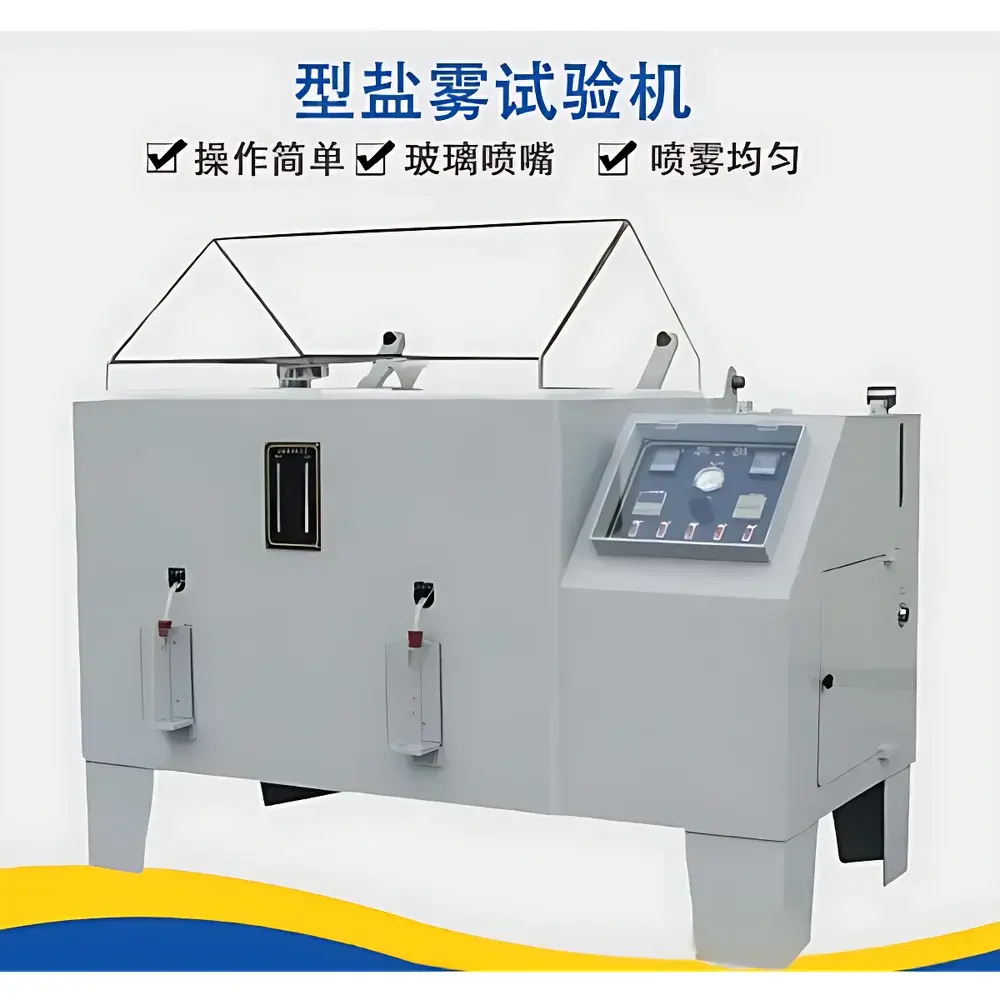
Jianhu Composite Salt Spray Test Chamber
| Brand | Jianhu |
|---|---|
| Origin | Shanghai, China |
| Manufacturer Type | Manufacturer |
| Model | Jianhu Composite Salt Spray Test Chamber |
| Price Range | USD 1,250 – 12,500 (FOB Shanghai) |
| Spray Mode | Continuous Atomization |
| Spray Rate | 1–2 mL / 80 cm²·hr |
| Nozzle Pressure | 0.7–1.0 kgf/cm² |
| De-misting Method | Pneumatic Air-Compression Exhaust |
| Salt Fog Deposition Rate | 1.0–2.0 mL/80 cm²·hr |
| Temperature Range | Ambient + 5°C to 55°C |
| Compliance | ASTM B117, ISO 9227, GB/T 2423.17, IEC 60068-2-11 |
Overview
The Jianhu Composite Salt Spray Test Chamber is an engineered environmental test system designed for accelerated corrosion evaluation of metallic and coated components under controlled saline atmospheric conditions. It operates on the principle of continuous atomization of a standardized sodium chloride (NaCl) solution—typically 5% w/w—into a saturated mist environment maintained within a thermally regulated chamber. Unlike basic salt spray cabinets, this composite variant integrates precise temperature control (±0.5°C stability across 35–55°C operational range), programmable humidity modulation (optional upgrade), and reproducible fog deposition dynamics—enabling conformance to ASTM B117, ISO 9227, and GB/T 2423.17 test protocols. Its architecture supports both neutral salt spray (NSS), acetic acid salt spray (AASS), and copper-accelerated acetic acid salt spray (CASS) testing modes when configured with auxiliary chemical dosing modules. The chamber’s stainless steel 316L interior, sealed gasketed door, and corrosion-resistant internal plumbing ensure long-term metrological integrity in high-chloride exposure environments.
Key Features
- High-stability temperature control system with PID-driven heating elements and forced-air circulation, achieving ±0.5°C uniformity across the working volume (standard chamber: 90 L, customizable up to 1000 L)
- Calibrated pneumatic nozzle array delivering consistent 1–2 mL/80 cm²·hr salt fog deposition rate, traceable to NIST-traceable volumetric standards
- Integrated air-compression de-misting mechanism enabling rapid post-test chamber clearance (<5 min) without residual condensate accumulation
- Corrosion-resistant 316L stainless steel construction—including chamber body, solution reservoir, and piping—with electropolished internal surfaces
- Modular design supporting factory-installed upgrades: humidity control (RH 30–95%), pH monitoring, automated solution replenishment, and digital pressure regulation
- Compliance-ready hardware architecture: RS-485 Modbus interface for SCADA integration; optional data logging module compliant with FDA 21 CFR Part 11 audit trail requirements
Sample Compatibility & Compliance
The chamber accommodates samples up to 600 mm × 450 mm × 400 mm (W×D×H) with adjustable sample racks and non-conductive support fixtures. It is routinely deployed for evaluating corrosion resistance of automotive battery enclosures (IP67-rated aluminum housings, conformal-coated PCBs), aerospace fasteners, marine-grade alloys, and medical device housings. All operational parameters—including fog density, temperature setpoint, exposure duration, and recovery intervals—are configurable to meet application-specific validation protocols. The system conforms to core international standards: ASTM B117 (Neutral Salt Spray), ISO 9227 (Corrosion tests in artificial atmospheres), GB/T 2423.17 (Chinese national standard for salt mist testing), and IEC 60068-2-11. Optional configuration supports GLP/GMP-aligned operation with electronic signature-capable software, user access levels, and full calibration history tracking.
Software & Data Management
The chamber operates via a 7-inch capacitive touchscreen HMI running embedded Linux firmware with real-time parameter visualization (temperature, nozzle pressure, elapsed test time). Standard firmware includes programmable multi-step test profiles (e.g., 2-hr salt spray → 4-hr dry cycle → 2-hr humid soak), event-triggered alarms, and automatic shutdown on fault detection. An optional PC-based software suite (Jianhu TestSuite v3.2) provides extended functionality: remote monitoring via Ethernet/Wi-Fi, CSV/Excel export of time-stamped sensor logs, statistical process control (SPC) charting for fog deposition consistency, and automated report generation aligned with ISO/IEC 17025 laboratory documentation templates. Audit trails record all operator actions, parameter changes, and calibration events—meeting FDA 21 CFR Part 11 electronic record requirements when enabled with digital signature authentication.
Applications
This chamber serves critical roles in product development and quality assurance workflows across multiple regulated sectors. In electric vehicle (EV) battery systems, it validates the long-term sealing integrity of battery pack enclosures under simulated coastal or de-icing salt exposure—supporting functional safety assessments per ISO 26262 and UN ECE R100. In aerospace, it verifies corrosion resistance of titanium alloy landing gear components per AMS 2700. For medical device manufacturers, it supports biocompatibility-related coating durability testing per ISO 10993-15. Additional applications include qualification of printed circuit board conformal coatings (IPC-CC-830), galvanized steel fastener performance (ASTM F1111), and polymer housing UV+salt synergy testing (ISO 4892-2 with optional UV lamp integration). Its modular scalability allows integration into automated reliability test lines alongside thermal shock and vibration stations.
FAQ
What salt concentration is used in standard NSS testing?
A 5.0 ± 0.1% (w/w) aqueous sodium chloride solution, prepared using reagent-grade NaCl and distilled or deionized water (conductivity ≤ 20 µS/cm), is required per ASTM B117 and ISO 9227.
Can the chamber perform cyclic corrosion testing (CCT)?
Yes—when equipped with optional humidity and drying modules, it supports programmable multi-phase cycles including salt spray, drying, and high-humidity conditioning per ISO 11997 and VDA 621-415.
Is calibration certification included with shipment?
Each unit ships with a factory calibration certificate covering temperature uniformity (per ASTM E2203), fog deposition rate (per ISO 9227 Annex A), and pressure transducer accuracy—traceable to CNAS-accredited laboratories.
What maintenance intervals are recommended for sustained accuracy?
Daily: visual inspection of nozzle orifices and solution level; weekly: cleaning of saturator tower and compressed air filter; quarterly: verification of temperature sensor drift and pressure regulator linearity.
Does the system support third-party LIMS integration?
Yes—via Modbus TCP or OPC UA protocol, enabling direct data ingestion into laboratory information management systems (LIMS) such as LabWare, Thermo Fisher SampleManager, or STARLIMS.



