
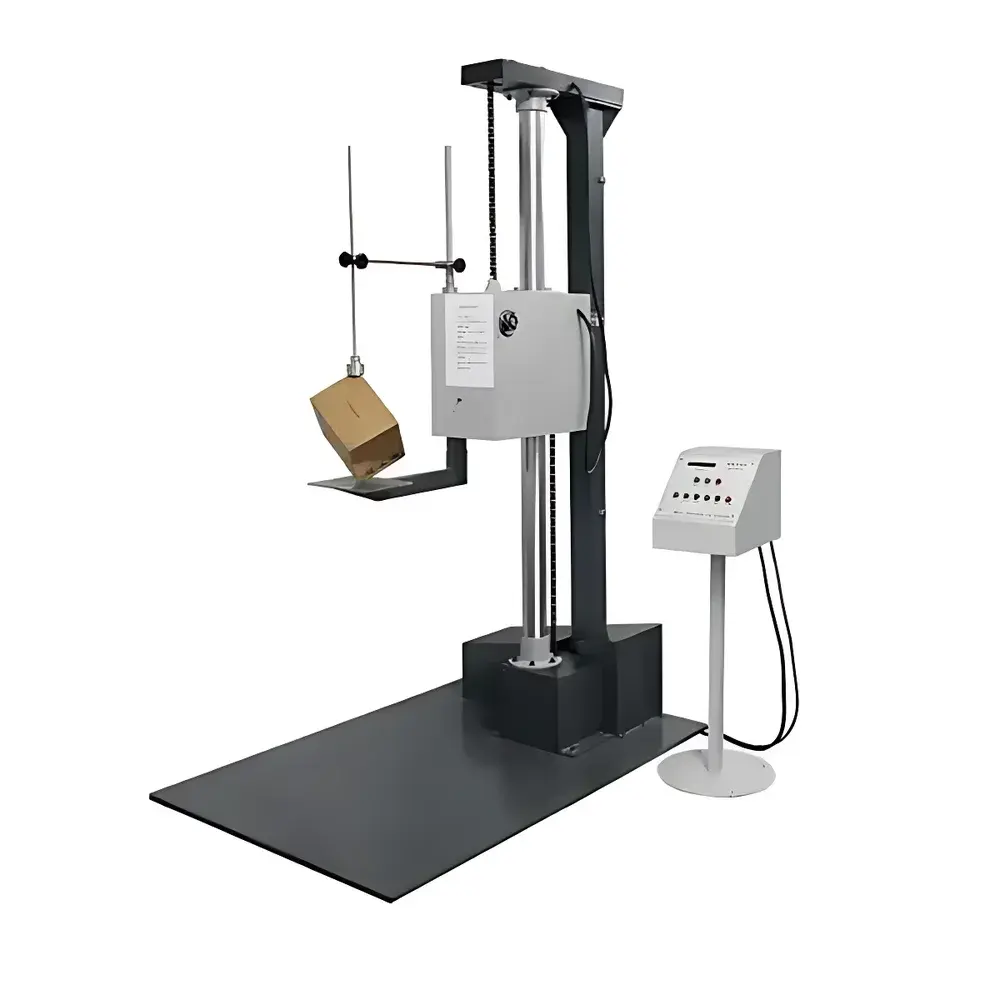
Jianhu DH-ATP Series Fully Automated Touchscreen Drop Testing Machine for Medical Devices
| Brand | Jianhu |
|---|---|
| Origin | Shanghai, China |
| Manufacturer Type | Authorized Distributor |
| Product Origin | Domestic (China) |
| Model | DH-ATP Series |
| Price Range | USD 600 – 6,000 |
| Drop Height Range | 300–1500 mm |
| Maximum Test Specimen Weight | 100 kg |
| Maximum Specimen Dimensions | 800 × 800 × 1000 mm |
| Impact Surface Dimensions | 1700 × 1200 mm |
Overview
The Jianhu DH-ATP Series Fully Automated Touchscreen Drop Testing Machine is an engineered solution designed specifically for the mechanical safety validation of medical devices under real-world handling and clinical use conditions. Unlike generic drop testers intended for consumer electronics or packaging, this system implements controlled, repeatable, and clinically relevant impact protocols grounded in biomechanical load paths and healthcare workflow dynamics. It operates on the principle of programmable free-fall acceleration with synchronized impact force monitoring, enabling precise reproduction of non-vertical drop scenarios—including side-tip (e.g., wheelchair turning instability), low-height sliding ejection (e.g., diagnostic device slipping from a nurse’s tray), and multi-axis impact events common during patient transfer or logistics handling. Its core function is not merely structural integrity verification but functional safety quantification—ensuring that post-impact performance (e.g., brake lock reliability, sensor signal fidelity, data retention stability) meets medically mandated thresholds defined by YY/T 0681.1–2019, ISO 14971:2019 (risk management), and FDA Design Control requirements (21 CFR Part 820).
Key Features
- Multi-angle drop simulation: Programmable tilt-and-release mechanism supports side-tip (0°–90°), corner-drop, and edge-drop configurations to replicate clinical mishandling—not limited to vertical free-fall.
- Medical-grade impact surface options: Interchangeable impact plates calibrated for hospital flooring materials—ceramic tile (ASTM C1028 coefficient of friction ≥0.6), laminated wood (ASTM D2047), and rubberized anti-slip surfaces—ensuring ecologically valid test environments.
- Integrated high-frequency force and displacement sensing: Dual-channel piezoelectric load cells (±0.5% FS accuracy) and laser displacement sensors (0.01 mm resolution) capture dynamic deformation, peak deceleration (g-force), and residual structural deviation in real time.
- Touchscreen HMI with preloaded medical test profiles: Intuitive 10.1-inch capacitive interface includes validated test templates aligned with ISO 11197 (wheelchairs), IEC 60601-1 (electromedical safety), and AAMI TIR42 (transport durability), with user-defined parameter locking for audit compliance.
- Robust structural architecture: Heavy-duty welded steel frame (load-rated to 150 kN static capacity), reinforced impact base with energy-dissipating polymer layer, and vibration-isolated mounting platform ensure long-term repeatability across >50,000 test cycles.
Sample Compatibility & Compliance
The DH-ATP accommodates large-format medical equipment including manual and powered wheelchairs (up to 100 kg, 800 × 800 × 1000 mm), portable ultrasound systems, handheld glucose meters, ECG holter monitors, infusion pumps, and surgical handpieces. All test configurations adhere to regulatory expectations for design verification and process validation under FDA 21 CFR Part 820, ISO 13485:2016, and EU MDR Annex I (General Safety and Performance Requirements). Critical outputs—including drop height, orientation angle, impact velocity, peak g-load, post-test functional verification logs, and operator authentication—are timestamped and stored with full traceability to satisfy GLP/GMP documentation standards and FDA 21 CFR Part 11 electronic record requirements. Calibration certificates follow ISO/IEC 17025 procedures and are traceable to NIM (National Institute of Metrology, China).
Software & Data Management
The embedded control software (Jianhu TestSuite v3.2) provides automated test sequencing, real-time waveform visualization (acceleration vs. time, displacement vs. time), and configurable pass/fail logic based on user-defined thresholds (e.g., “brake lock must engage within 200 ms post-impact”, “sensor output drift ≤0.1% FS”). Exportable reports conform to ASTM E2918 (standard guide for reporting drop test results) and include digital signatures, audit trails, and metadata required for regulatory submissions. Optional network integration enables centralized fleet management across multiple DH-ATP units via secure HTTPS API, supporting SPC trend analysis, CAPA linkage, and integration with LIMS or PLM platforms. All firmware updates undergo formal change control per ISO 13485 clause 7.5.6.
Applications
- Wheelchair structural validation: Quantifying frame deformation under 0.6 m side-tip impact; verifying post-drop static load capacity (75–100 kg) and brake lock retention rate (100% minimum).
- Portable diagnostics safety assurance: Measuring post-impact signal deviation in biosensors (e.g., glucose oxidase electrodes), memory retention integrity (no CRC errors after NAND flash stress), and battery housing seal integrity (IPX7-level leak detection optional).
- Transport simulation: Replicating multi-layer pallet stacking drops (1 m height) to assess structural fatigue in reusable medical carts and sterilization containers.
- Human factors engineering: Supporting ISO 14155-compliant usability studies by correlating drop-induced physical damage with clinician-reported handling difficulty scores.
- Design iteration support: Providing objective metrics for comparative analysis of damping materials (e.g., silicone elastomer vs. thermoplastic polyurethane) and joint reinforcement strategies (spot weld vs. continuous seam weld).
FAQ
Why does medical device drop testing require non-vertical impact simulation?
Clinical drop events rarely occur as idealized vertical free-falls. Wheelchairs tip laterally during corridor turns; diagnostic devices slide sideways off trays before impacting edges. Vertical-only testing underestimates torsional stress and localized strain concentrations—leading to false negatives in structural failure prediction.
How is functional performance verified during and after drop impact?
The DH-ATP integrates external I/O triggers to synchronize with device-under-test (DUT) communication ports (USB, Bluetooth, UART). Real-time telemetry (e.g., ADC readings, CAN bus status flags, error registers) is captured concurrently with mechanical impact data—enabling correlation between physical shock and functional degradation.
Can test parameters be locked to prevent unauthorized modification during QA audits?
Yes. Role-based access control (operator, engineer, administrator) enforces parameter lockdown. Critical test definitions—including height, angle, surface type, and pass criteria—are digitally signed and version-controlled. Any override requires dual authentication and generates an immutable audit log entry.
Is the system compatible with international regulatory submissions?
All generated test reports include mandatory elements for FDA 510(k) and CE Technical File submissions: equipment identification, calibration status, environmental conditions (temperature/humidity logged), operator ID, raw sensor data export (CSV/Excel), and signature fields compliant with 21 CFR Part 11 Subpart B.
What maintenance intervals are recommended for sustained measurement accuracy?
Annual third-party metrological verification is recommended per ISO/IEC 17025. Daily visual inspection of release mechanisms and monthly verification of height encoder linearity (±0.2 mm tolerance) are specified in the maintenance manual. Load cell recalibration is required every 2 years or after 25,000 drops—whichever occurs first.



