
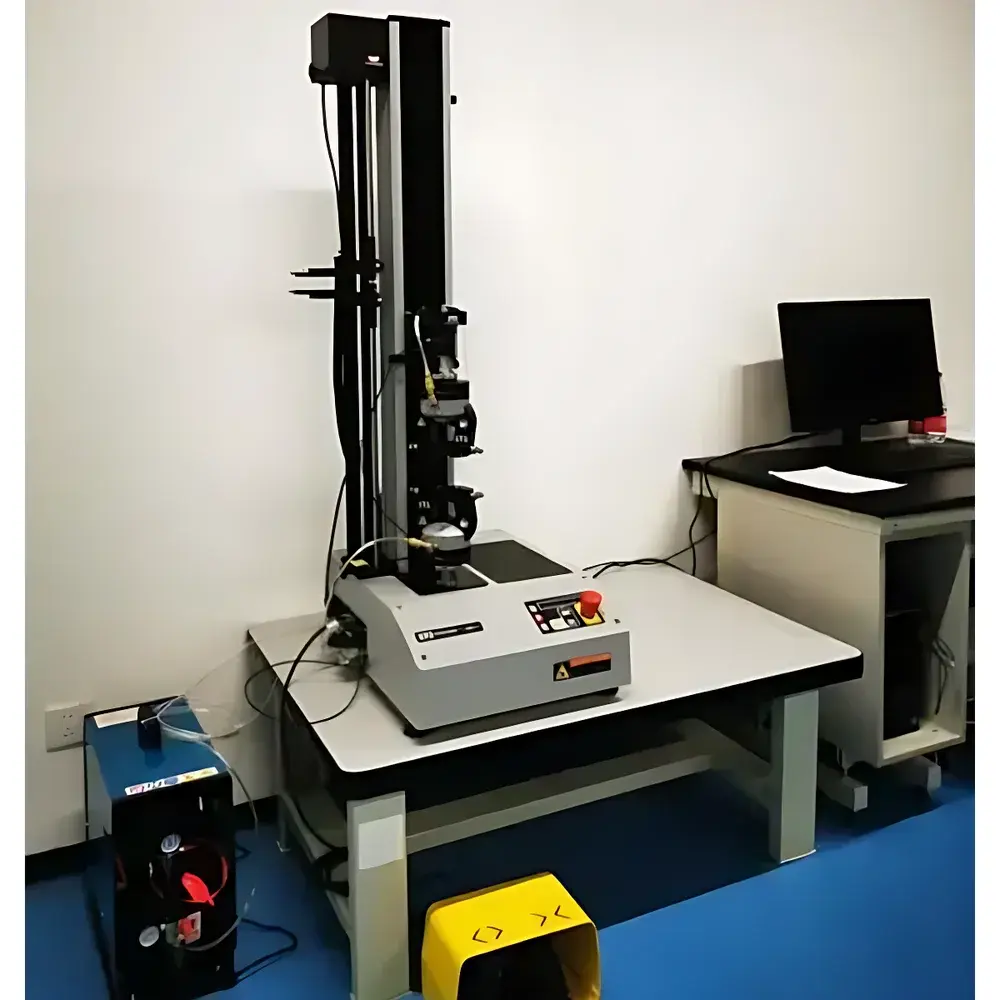
Jianhu DH-Universal Drop Testing Machine with Intelligent Customizable Test Program
| Brand | Jianhu |
|---|---|
| Origin | Shanghai, China |
| Manufacturer Type | Authorized Distributor |
| Product Origin | Domestic (China) |
| Model | DH-Universal Drop Tester |
| Price Range | USD 170 – 1,700 |
| Drop Height Range | 0–1500 mm (Zero-Drop Capable) |
| Maximum Specimen Weight | 300 kg |
| Maximum Specimen Dimensions | 1200 × 1000 × 1200 mm |
| Impact Surface Dimensions | 2000 × 1500 mm |
Overview
The Jianhu DH-Universal Drop Testing Machine is an electromechanically actuated, programmable impact testing system engineered for precision-controlled free-fall simulation across automotive, electronics, packaging, aerospace, and medical device industries. It operates on the fundamental principle of gravitational acceleration-based impact energy delivery—where specimen mass, drop height, and impact surface properties collectively determine peak deceleration (g-force), impulse duration, and structural response. Unlike manual or semi-automated drop testers, this system integrates servo-controlled lift mechanisms, real-time position feedback, and repeatable release actuators to ensure ≤ ±1 mm height repeatability and < 0.5% inter-test variance in impact velocity. Its zero-drop capability enables controlled descent without impact—critical for pre-test positioning, sensor calibration, and non-destructive verification of fixture alignment. Designed for ISO 2247, ASTM D5276, IEC 60068-2-31, and GB/T 4857.5 compliance, it serves as a foundational tool for mechanical robustness validation under transport, handling, and operational shock conditions.
Key Features
- Intelligent customizable test program interface supporting up to 99 user-defined test profiles—including variable drop height sequences, multi-angle orientation presets (face/edge/corner), and timed interval cycling.
- High-strength impact platform (2000 × 1500 mm) with interchangeable surface modules: hardened steel (HV 550), vulcanized rubber (Shore A 60), and composite polymer—enabling material-specific energy absorption modeling per ASTM D5276 Annex A2.
- Integrated digital height encoder and optical position sensor ensuring traceable drop height accuracy within ±0.3 mm across full 0–1500 mm range.
- Robust frame architecture rated for 300 kg static load and dynamic shock loads exceeding 50 kN—validated via FEA-simulated stress analysis under 1500 mm, 300 kg worst-case impact scenario.
- Modular specimen retention system accommodating irregular geometries up to 1200 × 1000 × 1200 mm, with quick-lock clamping and optional vacuum-assisted fixation for low-mass sensors and optical assemblies.
Sample Compatibility & Compliance
The DH-Universal accommodates rigid, semi-rigid, and fragile specimens—from automotive ADAS cameras and millimeter-wave radar housings to lithium battery packs and sterile medical instrument trays. Its dimensional and mass envelope supports full-system-level validation, eliminating the need for subcomponent proxy testing. The system meets essential regulatory and industry requirements including: ISO 16750-3 (road vehicle mechanical loads), USP (package integrity for sterile products), MIL-STD-810H Method 516.8 (drop shock), and China’s GB/T 2423.8. Optional integration with external environmental chambers allows synchronized thermal–mechanical stress testing (e.g., -40°C to +85°C preconditioning prior to drop), addressing coupled failure modes identified in automotive supply chain audits. All mechanical calibrations are traceable to NIM (National Institute of Metrology, China) standards; optional third-party certification available per ISO/IEC 17025.
Software & Data Management
The embedded control software (v3.2+) provides audit-ready test execution with full 21 CFR Part 11 compliance capabilities—including electronic signatures, role-based access control, and immutable audit trails for all parameter changes, test starts/stops, and result exports. Raw data—including time-stamped height, release timing, and optional external sensor inputs (e.g., accelerometer, high-speed camera trigger)—is logged at 10 kHz sampling rate and exportable in CSV, XML, or MATLAB .mat formats. The software supports automated pass/fail evaluation against user-defined thresholds (e.g., “lens mount deformation ≤ 0.05 mm” or “signal drift ≤ 0.5% post-impact”), with visual overlay of pre- and post-test image comparison when paired with optional machine vision modules. Data archives are encrypted and support networked backup to NAS or cloud storage with TLS 1.2+ encryption.
Applications
This system is deployed extensively in Tier-1 automotive supplier R&D labs for validating ADAS sensor survivability—particularly front-facing cameras, ultrasonic parking sensors, and corner radars subjected to logistics-related impacts (e.g., 1 m steel-surface drops simulating parcel sorting errors). In consumer electronics, it verifies structural integrity of foldable smartphone hinges and AR glasses chassis under repeated edge-drop scenarios. Packaging engineers use it to optimize corrugated box designs per ISTA 3A protocols, while medical device manufacturers validate sterilization tray integrity and implantable housing seal performance under simulated hospital handling conditions. Academic institutions—including Tsinghua University and Harbin Institute of Technology—utilize its programmable sequence engine for fundamental impact mechanics research, especially in viscoelastic material response modeling and micro-deformation metrology.
FAQ
Why can’t standardized drop parameters be applied uniformly across automotive sensors?
Sensor function dictates impact vector priority: cameras require face-down drops to assess lens collimation stability, whereas radar modules demand corner/edge impacts to evaluate RF aperture integrity and signal attenuation. Parameter harmonization must align with functional failure modes—not generic mass or volume.
How does zero-drop functionality support GLP-compliant test preparation?
Zero-drop enables precise specimen centering, fixture verification, and pre-test sensor baseline capture without mechanical disturbance—fulfilling GLP requirement §58.130(a) for documented equipment readiness checks prior to data acquisition.
Is the system compatible with external high-speed imaging or strain gauge systems?
Yes. The controller provides TTL-synchronized trigger outputs (BNC) with adjustable delay (0–5 s) and gate width (1–100 ms), fully interoperable with Photron SA-Z, Keyence LK-H series, and Vishay CEA-020 strain amplifiers.
What maintenance intervals are recommended for long-term metrological reliability?
Annual recalibration of height encoder and release mechanism timing is advised; biannual inspection of guide rail preload and brake pad wear is required per manufacturer’s maintenance log (included with shipment).
Can test programs be exported/imported between machines for cross-site method equivalence?
Yes. All test definitions are stored as encrypted XML files with embedded checksums—ensuring version-controlled, tamper-evident transfer across global laboratory networks without revalidation.



