
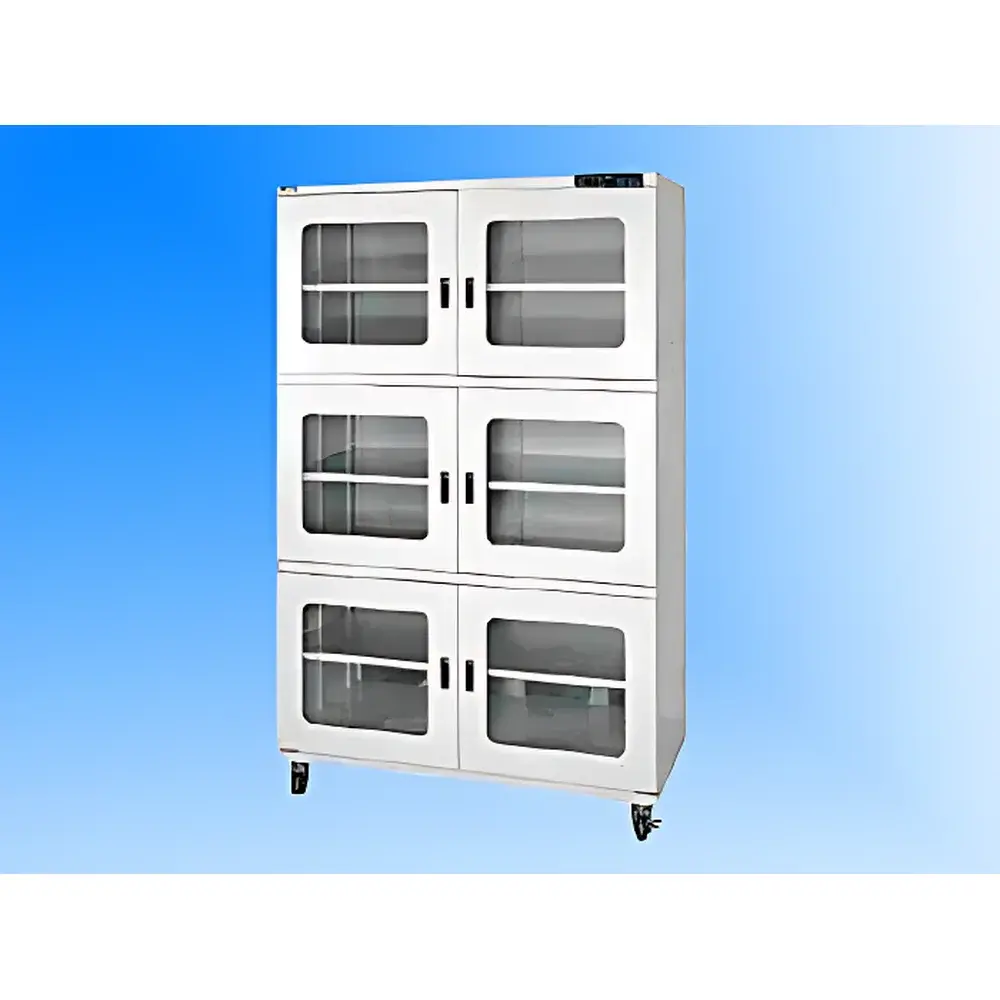
Jianhu Electronic Desiccator Cabinet
| Brand | Jianhu |
|---|---|
| Origin | Shanghai, China |
| Model | JHM-1500 / JHL-1500 Series |
| Humidity Control Range | 1–40% RH or 20–60% RH |
| Temperature Display Range | 1–99°C |
| Humidity Display Range | 1–90% RH |
| Accuracy | ±3% RH (Honeywell Sensor) |
| Power Supply | 220 V AC |
| Max. Power Consumption | 96 W |
| External Dimensions | 1200 × 1885 × 700 mm |
| Internal Dimensions | 1196 × 1827 × 670 mm |
| Shelf Capacity | 5 shelves × 150 kg/shelf |
| Cabinet Material | 1.2 mm cold-rolled steel (Baosteel) |
| Door | 6-panel tempered glass (3 mm), anti-vibration fire-retardant gasket, pressure-embedded handle |
| Casters | 360° swivel conductive casters with brakes |
| Dehumidification Core | Shape-memory alloy (SMA) chemical desiccant |
| Safety Housing | PPS flame-retardant polymer enclosure |
| Compliance | CE-marked design principles |
Overview
The Jianhu Electronic Desiccator Cabinet is an engineered environmental control solution designed for precision-sensitive storage of moisture-vulnerable materials in research laboratories, electronics manufacturing, semiconductor R&D, and quality assurance environments. Unlike conventional heated drying ovens or refrigerated dry boxes, this cabinet employs a passive, non-thermal desiccation principle based on shape-memory alloy (SMA) chemistry — eliminating heat generation, condensation risk, and energy-intensive compressor cycles. The system maintains stable low-humidity conditions through reversible metal hydride absorption, enabling continuous operation at ambient temperature while achieving sub-40% RH setpoints with high repeatability. Its structural integrity — built from 1.2 mm Baosteel cold-rolled steel — ensures long-term dimensional stability and gas-tight sealing, critical for protecting hygroscopic standards, calibration artifacts, optical components, PCB assemblies, and reference materials subject to ASTM E1447 or IEC 60068-2-30 humidity exposure requirements.
Key Features
- High-rigidity cabinet construction using 1.2 mm Baosteel cold-rolled steel, minimizing thermal expansion drift and maintaining seal integrity over time
- Six-panel front access with 3 mm tempered safety glass doors, sealed with fire-retardant anti-vibration gaskets and pressure-embedded ergonomic handles for consistent compression sealing
- Five adjustable stainless-steel shelves, each rated for 150 kg static load, supporting heavy instrumentation, wafer carriers, or multi-tier sample racks
- Honeywell HCH-1000 series capacitive humidity sensor (US-sourced), calibrated to ±3% RH accuracy across 1–90% RH range, with simultaneous digital display of real-time temperature (1–99°C) and relative humidity
- Shape-memory alloy (SMA) desiccant core: zero-emission, non-toxic, maintenance-free chemical absorption technology operating at ambient temperature — no compressor noise, no water drainage, no high-voltage heating elements
- Integrated power-fail resilience: SMA desiccant retains active moisture adsorption capacity for up to 24 hours after power interruption, preserving setpoint integrity during transient outages
- Conductive floor casters with locking brakes enable ESD-safe mobility and repositioning within controlled environments (compliant with ANSI/ESD S20.20 grounding thresholds)
- PPS (polyphenylene sulfide) polymer housing for main control module, meeting UL 94 V-0 flammability rating for enhanced fire safety in enclosed lab spaces
Sample Compatibility & Compliance
The Jianhu Desiccator Cabinet accommodates a broad spectrum of moisture-sensitive samples without thermal or mechanical stress: silicon wafers, photomasks, lithium battery cathode materials, pharmaceutical reference standards, optical filters, MEMS devices, and archival documents. Its sealed architecture meets the physical containment requirements outlined in ISO 14644-1 Class 5–8 cleanroom auxiliary storage applications. While not certified to IEC 61000-4 electromagnetic immunity standards out-of-the-box, its low-power SMA-based operation inherently minimizes RF emissions. When configured with optional data-logging modules, the system supports audit-ready environmental records aligned with FDA 21 CFR Part 11 electronic signature and record retention expectations — particularly relevant for QC labs operating under cGMP or ISO/IEC 17025 accreditation frameworks.
Software & Data Management
Standard configuration includes a high-resolution LCD interface with intuitive menu navigation for humidity setpoint selection (1–40% RH or 20–60% RH ranges), temperature monitoring, alarm threshold definition, and runtime diagnostics. Optional add-ons expand functionality: the Intelligent Readout System enables RS-485 Modbus RTU communication for integration into LabVantage or Thermo Fisher SampleManager LIMS platforms; the Alarm System provides relay-triggered visual/audible alerts and email/SMS notifications via Ethernet gateway (optional); and the Auto-Nitrogen Purge Kit allows inert-gas overlay for ultra-low-O₂ storage of oxidation-prone catalysts or reactive metal powders. All firmware updates are delivered via USB port, ensuring traceable version control per GLP documentation practices.
Applications
This desiccator cabinet serves as a primary environmental stabilization platform across multiple technical domains: storage of hygroscopic analytical standards (e.g., potassium hydrogen phthalate, sodium chloride reference salts) prior to gravimetric preparation; pre-conditioning of humidity-sensitive sensors before calibration; safekeeping of solder paste, conformal coatings, and underfill materials in SMT production lines; preservation of X-ray diffraction reference powders and TEM grid storage; and long-term archiving of forensic evidence requiring documented RH history. Its quiet, vibration-free operation makes it suitable for placement adjacent to AFM, SEM, or optical interferometry workstations where mechanical disturbance must be minimized.
FAQ
What desiccation technology does the cabinet use, and how does it differ from compressor-based or Peltier-cooled dry boxes?
It utilizes shape-memory alloy (SMA) chemical desiccants — solid-state metal hydrides that reversibly bind water vapor at ambient temperature. This eliminates condensation, compressor wear, and thermal gradients common in refrigerated systems.
Is the cabinet suitable for storing lithium-ion battery cells?
Yes — its stable sub-20% RH environment inhibits electrolyte decomposition and SEI layer instability; however, full compliance with UN 38.3 thermal runaway testing requires additional external containment per IATA guidelines.
Can humidity and temperature data be exported for regulatory audits?
With the optional Intelligent Readout System, timestamped CSV logs can be retrieved via USB or streamed to networked servers, supporting 21 CFR Part 11-compliant electronic records when paired with validated user access controls.
What maintenance is required for the SMA desiccant core?
None — the SMA material is regenerable in situ via periodic low-power heating cycles initiated automatically by the controller; service life exceeds 10 years under normal laboratory usage.
Does the cabinet meet ESD safety requirements for semiconductor handling?
Equipped with conductive casters and grounded chassis design, it complies with ANSI/ESD S20.20 for static-dissipative mobility; optional anti-static shelf liners and ionizing accessories further enhance ESD mitigation.



