
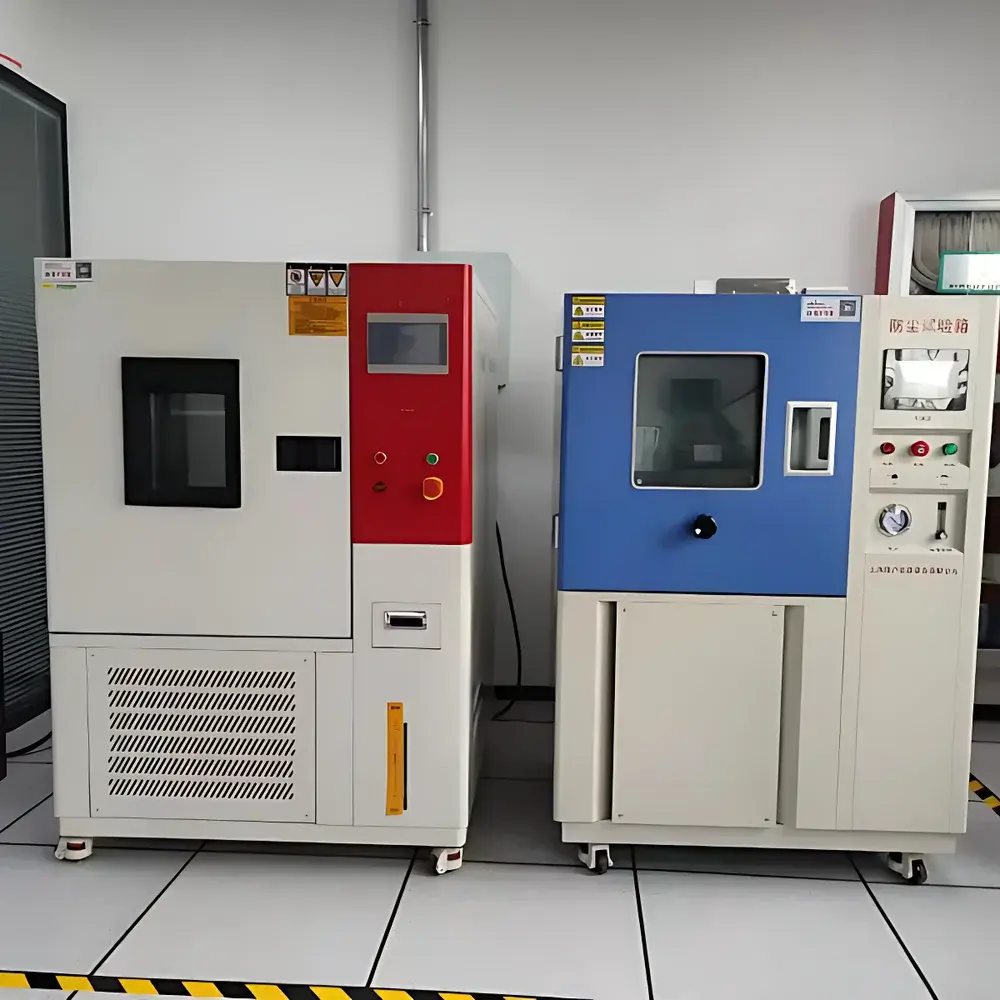
Jianhu IPX56 Sand and Dust Test Chamber
| Brand | Jianhu |
|---|---|
| Origin | Shanghai, China |
| Manufacturer Type | Authorized Distributor |
| Product Category | Domestic |
| Model | IPX56 Sand and Dust Test Chamber |
| Sand Composition | 97–99% crystalline silica (SiO₂) |
| Sand Blowing Concentration | 1.1 g/m³ ±0.25 g/m³ to 2.2 g/m³ ±0.5 g/m³ |
| Sand Blowing Velocity | 0–29 m/s |
| Dust Blowing Concentration | 0.1–10.6 g/m³ ±7 g/m³ |
| Dust Blowing Velocity | 8.9 m/s ±1.2 m/s |
Overview
The Jianhu IPX56 Sand and Dust Test Chamber is an engineered environmental simulation system designed to perform standardized ingress protection (IP) testing per IEC 60529, ISO 20623, and MIL-STD-810H Method 510.7 for sand and dust resistance evaluation. It operates on the principle of controlled airborne particulate suspension within a sealed test volume, utilizing calibrated airflow dynamics and gravimetric particulate delivery to replicate real-world desert, arid, and industrial dust exposure conditions. Unlike legacy chambers relying on static or unmonitored dust dispersion, this system integrates closed-loop feedback control of both concentration and velocity—enabling reproducible, auditable, and traceable test execution across laboratory, QC, and R&D environments. Its architecture supports both coarse sand (defined as particles >75 µm, simulating wind-blown desert grit) and fine dust (down to 5 µm, representing airborne silt and urban particulates), making it suitable for validating enclosures ranging from automotive ECUs and UAV propulsion systems to outdoor telecom housings and medical portable devices.
Key Features
- Real-time dual-parameter feedback control: Independent monitoring and dynamic adjustment of airborne particulate concentration (via optical scattering + gravimetric sensor fusion) and air velocity (using NIST-traceable hot-wire anemometry)
- Programmable sand/dust delivery modes: Selectable between sand-only (IEC 60529 IP5X/IP6X), dust-only (ISO 20623 Class 1–3), or hybrid sequences with ramped velocity profiles (0–29 m/s, ±0.5 m/s accuracy)
- High-fidelity particulate generation: Precision metering of certified SiO₂ test dust (97–99% crystalline silica, median particle size distribution conforming to ISO 12103-1 A4 and A2 standards)
- Robust chamber construction: 304 stainless steel interior with ceramic-coated wear-resistant surfaces; triple-lip silicone sealing system ensuring <0.01 mg/m³ external leakage under negative pressure operation
- Integrated safety interlocks: Automatic shutdown within 500 ms upon door breach, overtemperature, motor stall, or pressure deviation exceeding ±5% setpoint
- Touchscreen HMI with embedded calibration log: 10.1″ capacitive display supporting multi-language UI, audit trail export (CSV/Excel), and GLP-compliant operator authentication
Sample Compatibility & Compliance
The chamber accommodates samples up to 1,200 mm × 1,000 mm × 1,000 mm (W×D×H) and supports continuous operation cycles up to 72 hours. It meets full compliance requirements for IP5X (limited dust ingress, no harmful deposits), IP6X (complete dust-tightness), and extended-duration sand abrasion protocols referenced in SAE J2527 and ASTM D5757. All internal airflow patterns are validated using particle image velocimetry (PIV) to ensure uniformity ≥85% across the test volume per ISO 16750-4 Annex B. The system is compatible with third-party data acquisition interfaces (RS-485, Modbus TCP, Ethernet/IP) for integration into enterprise LIMS and MES platforms. Documentation includes factory calibration certificates traceable to NIM (National Institute of Metrology, China) and optional UKAS-accredited verification reports.
Software & Data Management
Jianhu’s proprietary TestMaster™ v4.2 software provides full lifecycle test management—from method definition and parameter scheduling to real-time visualization and post-test analytics. Each test run generates an immutable digital record containing timestamped concentration/velocity logs, alarm events, operator ID, and environmental metadata (ambient T/RH, power supply stability). Export formats include PDF test reports compliant with FDA 21 CFR Part 11 (electronic signatures, audit trails, role-based access control), as well as raw binary files for external statistical process control (SPC) analysis. Optional cloud synchronization enables remote monitoring and cross-site method harmonization for multinational validation programs. Software updates are delivered via secure OTA protocol with SHA-256 integrity verification.
Applications
- Automotive: Validation of HVAC cabin filters, ADAS sensor housings, battery enclosures, and under-hood ECUs against ISO 16750-4 and GB/T 28046
- Aerospace & Defense: Qualification of UAV avionics, ground support equipment, and portable mission radios per MIL-STD-810H Method 510.7
- Consumer Electronics: IP rating verification for smartphones, action cameras, smartwatches, and ruggedized tablets
- Industrial IoT: Testing of explosion-proof junction boxes, wireless gateways, and edge computing nodes deployed in mining, oilfield, and agricultural settings
- Renewable Energy: Durability assessment of solar inverter cabinets, wind turbine pitch controllers, and EV charging station enclosures
FAQ
What international standards does the IPX56 chamber support?
It fully supports IEC 60529 (IP5X/IP6X), ISO 20623 (sand/dust classification), ISO 16750-4 (road vehicles), MIL-STD-810H Method 510.7, and ASTM D5757 (dust deposition rate measurement).
Can the chamber operate with non-silica test dusts?
Yes—custom particulate introduction ports allow substitution with certified aluminum oxide, iron oxide, or polymer-based test media, provided density and aerodynamic diameter fall within operational Reynolds number limits.
Is remote diagnostics and firmware update capability available?
Yes—standard Ethernet interface supports secure remote login via TLS 1.2, live parameter streaming, and authenticated firmware upgrades with rollback functionality.
How is traceability maintained during calibration and maintenance?
All calibrations are recorded in the onboard database with unique certificate IDs, technician credentials, reference standard IDs (e.g., Fluke 9500B, TSI 3320), and uncertainty budgets per ISO/IEC 17025.
Does the system support automated pass/fail decision logic based on test criteria?
Yes—user-defined acceptance rules can be embedded in test methods (e.g., “fail if internal pressure rise exceeds 1.2 Pa over 60 seconds”) and enforced in real time with configurable alert escalation paths.



