
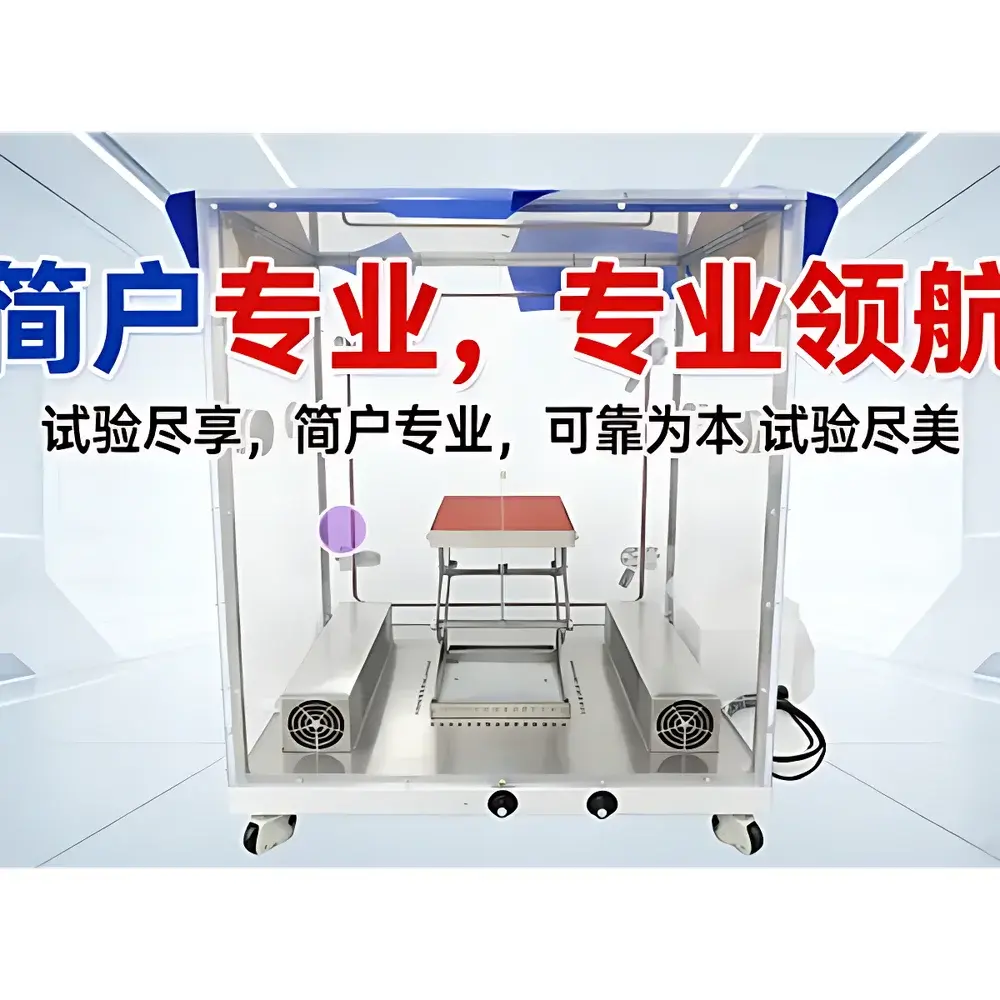
Jianhu JH-2026 Natural Convection High-Low Temperature Test Chamber
| Brand | Jianhu |
|---|---|
| Origin | Shanghai, China |
| Manufacturer Type | Authorized Distributor & OEM Partner |
| Country of Origin | China |
| Model | JH-2026 |
| Price Range | USD 750 – 7,500 |
| Temperature Range | −70 °C to +150 °C |
| Refrigeration Method | Compressor-Based Cooling |
| Explosion-Proof Design | Yes |
| Temperature Fluctuation | ±0.5 °C |
| Temperature Uniformity | ±2.0 °C |
| Temperature Deviation | ±2.0 °C |
| Heating Rate | ≤60 min (−40 °C to +85 °C) |
| Cooling Rate | ≤45–80 min (room temp to −40 °C) |
| Working Chamber Dimensions | Customizable (non-standard configurations available) |
Overview
The Jianhu JH-2026 Natural Convection High-Low Temperature Test Chamber is an ISO 9001-certified environmental simulation system engineered for precision thermal testing under static air conditions. Unlike forced-air chambers, the JH-2026 relies exclusively on natural convection—eliminating fan-induced airflow, turbulence, and localized thermal gradients. This architecture is essential for applications where sample integrity depends on undisturbed thermal equilibrium, such as pharmaceutical stability studies (ICH Q1A–Q1E), polymer crystallinity analysis, passive electronic component aging, and long-term material degradation assessment. The chamber operates across a validated temperature range of −70 °C to +150 °C, with real-time control fidelity maintained via dual PID algorithms and high-stability Pt100 sensors calibrated per ASTM E220 and ISO/IEC 17025 traceable protocols. Its explosion-proof variant complies with IEC 60079-0 and GB/T 3836.1–2021 standards, enabling safe operation in hazardous environments containing flammable vapors or dust.
Key Features
- Natural convection thermal management—no internal fans, ensuring zero airflow disturbance and uniform thermal diffusion across the test volume
- Robust stainless-steel inner chamber with corrosion-resistant alloy construction (SUS304L) and multi-layer vacuum-insulated walls (U-value ≤ 0.18 W/m²·K)
- Dual-stage cascade refrigeration system using environmentally compliant R404A/R23 mixed refrigerant, delivering stable sub-zero performance down to −70 °C
- Explosion-proof certified configuration (Ex d IIB T4 Gb / Ex tb IIIC T135°C Db) with intrinsically safe wiring, pressure-relief vents, and spark-proof components
- Integrated over-temperature cut-off, door safety interlock, refrigerant leak detection, and real-time compressor discharge temperature monitoring
- Modular controller architecture supporting firmware updates, remote diagnostics, and audit-trail-enabled parameter logging per FDA 21 CFR Part 11 requirements
Sample Compatibility & Compliance
The JH-2026 accommodates diverse sample geometries—including PCB assemblies, vial racks, tablet blister packs, composite laminates, and optical substrates—without requiring repositioning or airflow compensation. Its static thermal field meets critical regulatory benchmarks: USP for pharmaceutical storage condition simulation; ASTM D3418 for polymer thermal transition analysis; and MIL-STD-810H Method 501.7 for non-operational temperature survivability testing. All units undergo factory calibration against NIST-traceable reference standards and ship with a Certificate of Calibration (CoC) compliant with ISO/IEC 17025. Optional validation packages include IQ/OQ documentation templates aligned with GMP Annex 15 and EU GMP Annex 11.
Software & Data Management
The embedded 7-inch capacitive touchscreen HMI runs proprietary Jianhu ThermalControl™ firmware, supporting multistep programmable profiles (up to 99 segments), real-time trend plotting, and CSV export via USB or Ethernet. Data integrity safeguards include encrypted local storage, time-stamped event logs (power loss, door open, alarm trigger), and configurable user access levels (Operator, Technician, Administrator). For enterprise integration, optional MODBUS TCP and OPC UA interfaces enable seamless connection to LIMS, MES, or SCADA platforms. Audit trail functionality records all parameter changes, user logins, and calibration events—fully compliant with GLP, GMP, and FDA 21 CFR Part 11 electronic record requirements.
Applications
- Pharmaceutical stability testing per ICH guidelines (long-term, accelerated, intermediate conditions)
- Electronic component reliability screening: solder joint fatigue, capacitor leakage current drift, MEMS sensor hysteresis
- Material science research: glass transition (Tg) mapping, cold-crystallization kinetics, thermal expansion coefficient (CTE) measurement
- Aerospace component qualification: composite layup curing verification, adhesive bond strength vs. thermal cycling
- Automotive electronics validation: ECUs, battery modules, and infotainment systems under extended thermal soak conditions
- Academic research labs requiring reproducible, low-disturbance thermal environments for calorimetric or spectroscopic correlation studies
FAQ
What distinguishes natural convection from forced-air temperature chambers?
Natural convection eliminates mechanical airflow, preventing convective heat transfer artifacts that distort thermal response in sensitive samples—critical for pharmaceuticals, thin-film devices, and hygroscopic materials.
Is the JH-2026 suitable for GMP-regulated environments?
Yes—optional validation support, 21 CFR Part 11-compliant data logging, and full traceability documentation are available upon request.
Can chamber dimensions be customized for large-format samples?
Yes—non-standard working chamber volumes (from 50 L to 2000 L) and specialized door configurations (top-hinged, split-door, pass-through) are supported under engineering review.
What is the standard warranty coverage?
Three-year comprehensive warranty covering refrigeration system, temperature control electronics, chamber structure, and software—excluding consumables and misuse-related damage.
How is temperature uniformity verified during manufacturing?
Each unit undergoes a 72-hour thermal mapping cycle using 9–16 calibrated Pt100 probes per IEC 60068-3-5, with final acceptance requiring uniformity ≤ ±2.0 °C across the entire working volume.



