
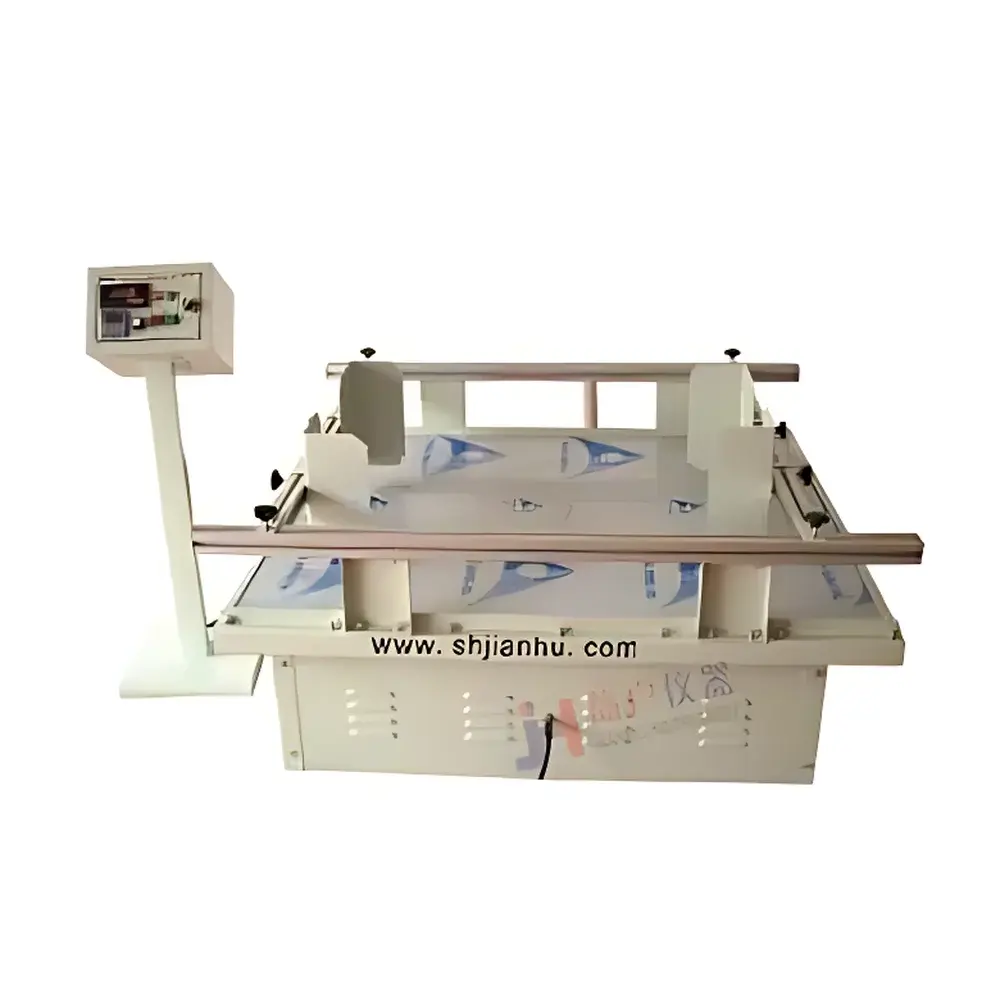
Jianhu JH-7126 / JH-7125 Automotive Road Transport Simulation Vibration Shaker
| Origin | China |
|---|---|
| Manufacturer Type | Authorized Distributor |
| Model | JH-7126 / JH-7125 |
| Table Dimensions (L×W) | 100×100 mm / 100×120 mm |
| Max Load Capacity | 100 kg |
| Frequency Range | 100–300 rpm |
| Amplitude | 25.4 mm |
| Timer Range | 0–99.99 h (selectable in s, min, or h) |
| Power Supply | 220 V AC, 50 Hz, 5 A |
| Compliance Basis | ASTM D4169, ISO 8564, ISTA 3A & 3E |
Overview
The Jianhu JH-7126 and JH-7125 Automotive Road Transport Simulation Vibration Shakers are engineered for controlled laboratory replication of dynamic mechanical stresses experienced during over-the-road freight transport. These shakers operate on a rotary eccentric-mass principle—generating sinusoidal vertical displacement at adjustable rotational speeds—to emulate the broadband vibration spectrum characteristic of Class 8 truck suspension systems traversing paved and unpaved road surfaces. Unlike random or electrodynamic shakers, this design prioritizes repeatability and compliance with standardized transport simulation protocols, particularly those defined in ASTM D4169 (Performance Testing of Shipping Containers and Systems) and ISTA 3-series test plans. The system is calibrated to reproduce the dominant low-frequency energy band (10–100 Hz) where packaging resonance and product fatigue most frequently occur during ground transport. Its fixed-amplitude, variable-frequency architecture enables deterministic test sequencing aligned with regulatory validation requirements in logistics QA/QC environments.
Key Features
- Digital frequency display with ±1 rpm resolution for precise speed control and traceable test execution.
- Low-noise synchronous belt drive system engineered for continuous operation in shared laboratory or office environments—acoustic emission <65 dB(A) at 1 m distance.
- Linear guide rail sample mounting platform ensures repeatable positioning, minimizes lateral drift, and eliminates manual clamping hazards during high-load testing.
- Reinforced C-channel steel base integrated with high-damping natural rubber isolation mounts provides structural rigidity, load stability up to 100 kg, and effective decoupling from facility floor vibrations.
- Design derived from European and North American transport shaker benchmarks—including ISO 8564-compliant motion profiles—and validated against real-world vehicle accelerometer data collected under ISO 2631-1 road roughness classifications.
Sample Compatibility & Compliance
The JH-7126/7125 accommodates rigid and semi-rigid packaged units—including corrugated shipping containers, molded plastic trays, wooden crates, and palletized assemblies—within its 100 × 100 mm and 100 × 120 mm test surface variants. It supports static load verification per ASTM D6055 and dynamic load distribution assessment prior to vibration initiation. Test protocols executed on this system meet documentation requirements for GLP-compliant validation reports, including timestamped parameter logging, operator ID tagging, and audit-ready runtime records. While not certified to IEC 61000-4-xx immunity standards, its electromagnetic emissions conform to CISPR 11 Group 1, Class B limits for laboratory equipment. All operational firmware and mechanical calibrations align with manufacturer-recommended maintenance intervals per ISO/IEC 17025 Clause 6.4.3.
Software & Data Management
The shaker operates via an embedded microcontroller-based interface with non-volatile memory for storing up to 99 user-defined test programs. Each program retains independent settings for frequency, duration, time unit (seconds/minutes/hours), and auto-stop logic. All timer events generate digital timestamps synchronized to internal RTC (real-time clock), supporting traceability in regulated environments requiring FDA 21 CFR Part 11–compatible audit trails—though native electronic signature functionality is not included. Data export is limited to manual screen capture or external stopwatch correlation; integration with LIMS or SCADA platforms requires third-party serial (RS-232) or analog (0–10 V) signal interfacing. Calibration certificates—traceable to NIM (National Institute of Metrology, China)—are provided with initial commissioning and recommended annually.
Applications
This vibration shaker serves as a primary tool for packaging development labs, logistics engineering departments, and third-party certification bodies evaluating transport durability across multiple industries. Typical use cases include: validating child-resistant closures under simulated delivery shock per ASTM F2713; assessing electronic component solder joint integrity after extended transit exposure; verifying furniture assembly retention after simulated cross-country haulage; qualifying ceramic tile packaging for stack compression + vibration combined testing (ASTM D6179); and supporting ISTA 3E-compliant e-commerce parcel testing for last-mile delivery providers. Its fixed 25.4 mm amplitude enables direct comparison with historical datasets generated on legacy rotary shakers widely deployed in Chinese and ASEAN distribution centers.
FAQ
What standards does this shaker directly support?
It is configured to execute test sequences compliant with ASTM D4169 Procedure 1 (Truck Distribution), ISO 8564 Annex B (Rotary Vibration), and ISTA 3A/3E transport simulation profiles.
Can the amplitude be adjusted?
No—the mechanical design fixes amplitude at 25.4 mm to ensure reproducibility across laboratories and alignment with reference test methods.
Is calibration documentation included?
Yes—a factory calibration certificate traceable to national metrological standards is supplied with each unit.
What is the maximum allowable payload for long-duration tests?
For continuous operation exceeding 24 hours, the recommended load limit is 80 kg to maintain thermal stability of the drive motor and bearing assemblies.
Does it support random vibration profiles?
No—this is a deterministic rotary shaker optimized for sinusoidal, fixed-frequency transport simulation—not broadband random or transient shock testing.
Related Products



