
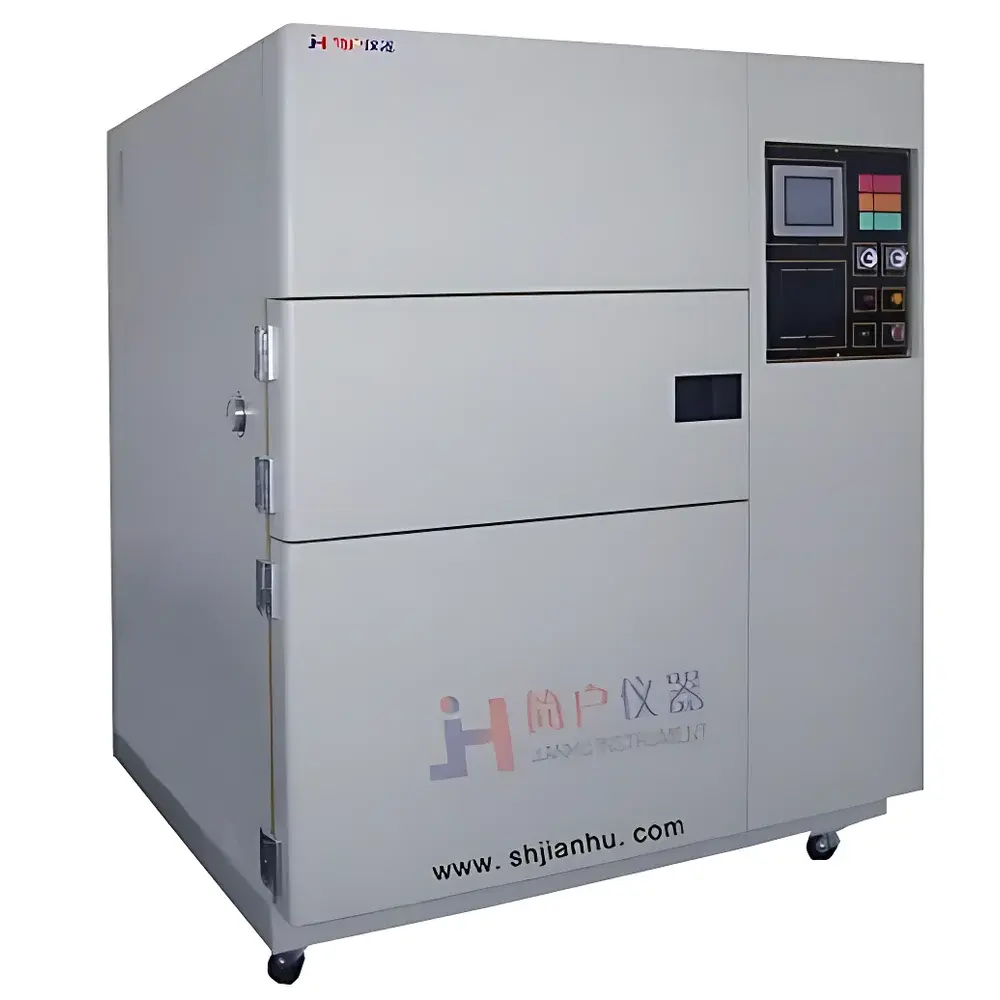
Jianhu JH-B4C Thermal Shock Test Chamber
| Brand | Jianhu |
|---|---|
| Model | JH-B4C |
| Chamber Type | Two-Zone Horizontal Thermal Shock Chamber |
| Internal Dimensions (W×D×H) | 500 × 400 × 400 mm |
| High-Temperature Zone Range | +60 °C to +150 °C |
| Low-Temperature Zone Range | –10 °C to –65 °C |
| Temperature Transition Time (–55 °C ↔ +150 °C) | ≤15 s |
| Control System | PID-based Touchscreen Color LCD Controller |
| Compliance | Meets ASTM D5229, ISO 16750-4, MIL-STD-810H Method 503.5, GB/T 2423.22 |
| Third-Party Calibration | Verified by Shanghai Institute of Measurement and Testing Technology (SIMT) |
| CNAS Lab Deployment | Installed in >500 accredited laboratories nationwide |
| Sample Mounting | Static test specimen configuration with external wiring ports |
Overview
The Jianhu JH-B4C Thermal Shock Test Chamber is an industrial-grade, two-zone horizontal thermal shock system engineered for rapid, repeatable transitions between extreme high- and low-temperature environments. It operates on the principle of physical separation of hot and cold reservoirs—eliminating mechanical movement of test specimens—and employs independent forced-air convection circulation within each zone. This architecture ensures thermal stability, minimizes thermal lag, and delivers high reproducibility across consecutive shock cycles. Designed specifically for reliability validation in mission-critical sectors—including automotive electronics, avionics, semiconductor packaging, and defense-grade components—the JH-B4C supports standardized thermal shock profiles per ASTM D5229 (composite materials), ISO 16750-4 (road vehicles), and MIL-STD-810H Method 503.5 (environmental engineering considerations). Its static sample configuration reduces mechanical stress artifacts during transition, enabling unambiguous correlation between thermal cycling exposure and material degradation mechanisms such as interfacial delamination, solder joint fatigue, or polymer embrittlement.
Key Features
- Two-zone horizontal design with fully isolated hot and cold chambers—no specimen movement required during thermal transition
- PID-controlled temperature regulation with ±0.5 °C uniformity (hot zone) and ±1.0 °C uniformity (cold zone) at steady state
- Touchscreen color LCD controller with intuitive navigation, multi-language interface support (English, Chinese), and real-time graphical trend display
- Configurable cycle initiation: user-selectable start from high-temperature or low-temperature condition
- Integrated safety interlocks including over-temperature cutoff, refrigerant pressure monitoring, and door-open inhibition logic
- External cable access port with silicone-sealed grommet for live-load testing without chamber breach
- Energy-efficient dual-refrigeration circuit architecture optimized for sustained operation at –65 °C
Sample Compatibility & Compliance
The JH-B4C accommodates static mounting of electronic assemblies, PCBs, molded plastic housings, rubber seals, and metallic subassemblies up to 30 kg total mass. Its internal chamber dimensions (500 × 400 × 400 mm) support standard test fixtures compliant with IPC-9701A and JEDEC JESD22-A104E. All thermal shock profiles are traceable to NIST-traceable reference sensors calibrated annually per ISO/IEC 17025 requirements. The system conforms to electromagnetic compatibility (EMC) standards IEC 61000-6-2 and IEC 61000-6-4, and its control firmware supports audit-ready data logging required under GLP and GMP frameworks. Documentation packages include full calibration certificates, uncertainty budgets, and installation qualification (IQ) templates aligned with FDA 21 CFR Part 11 electronic record provisions.
Software & Data Management
The embedded controller logs time-stamped temperature data at 1 Hz resolution, storing ≥10,000 hours of continuous operation history internally. Export options include CSV and PDF report generation with configurable metadata fields (operator ID, test ID, chamber serial number, ambient conditions). Optional Ethernet connectivity enables remote monitoring via Modbus TCP or HTTP API integration into enterprise LIMS or MES platforms. Audit trails capture all parameter changes, user logins, and alarm events with immutable timestamps—fully compliant with 21 CFR Part 11 electronic signature requirements when paired with optional PKI authentication module. Data export files retain original sensor channel identifiers and raw thermocouple voltage readings for post-acquisition reprocessing.
Applications
This chamber is routinely deployed in qualification testing of automotive ADAS modules subjected to under-hood thermal transients; accelerated aging studies of lithium-ion battery cell housings exposed to seasonal ambient extremes; failure analysis of wafer-level chip-scale packages (WLCSP) undergoing coefficient-of-thermal-expansion (CTE) mismatch stress; and environmental screening of military-grade connectors per MIL-C-83536. In R&D labs, it supports DOE-based thermal cycling matrix experiments to quantify Arrhenius acceleration factors for solder joint crack propagation. Its stable thermal baselines also make it suitable for pre-conditioning samples prior to mechanical shock or vibration testing per ISO 16750-3.
FAQ
What is the typical temperature transition time between –65 °C and +150 °C?
Transition time is ≤15 seconds for a 210 °C delta, measured at chamber center per ASTM E1545 protocol.
Does the system support programmable dwell times at each temperature extreme?
Yes—dwell duration is fully adjustable from 1 minute to 999 hours per segment, with up to 999 cycles per program.
Is third-party calibration documentation provided with shipment?
Each unit ships with a SIMT-issued calibration certificate covering all critical sensors, valid for 12 months from date of issue.
Can the controller be integrated into a centralized lab automation network?
Standard Modbus TCP and optional OPC UA interfaces enable seamless integration with SCADA and laboratory information management systems.
What maintenance intervals are recommended for long-term operational integrity?
Compressor oil and refrigerant filter replacement every 24 months; annual verification of chamber uniformity and sensor linearity per ISO 17025 procedures.



