
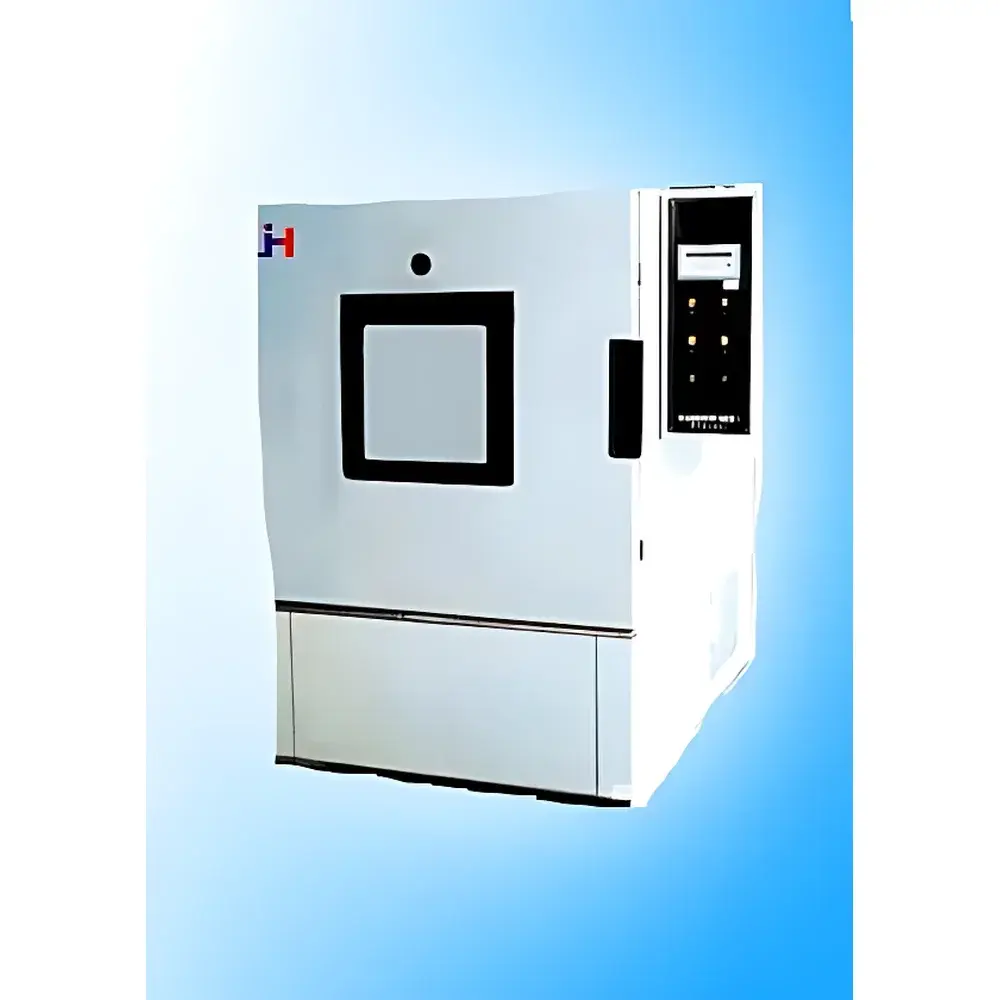
Jianhu JH-LT Series Low Temperature Incubator (Cryogenic Storage Chamber) – R134a Refrigerant
| Brand | Jianhu |
|---|---|
| Origin | Shanghai, China |
| Model | JH-LT Series |
| Refrigerant | R134a (non-ozone-depleting, GWP 1,430) |
| Inner Chamber Material | Mirror-finish stainless steel (AISI 304) |
| Chamber Geometry | Rounded internal corners with radius ≥25 mm |
| Adjustable Shelving | Tool-free removable stainless steel shelves |
| Temperature Range | −10 °C to +10 °C (standard), optional down to −25 °C |
| Control System | PID-based microprocessor controller with fuzzy logic algorithm |
| Cooling Performance | ≥40% faster cooldown vs. conventional R22/R404A systems |
| Noise Level | ≤52 dB(A) at 1 m |
| Safety Features | Independent overtemperature cut-off (optional) |
| Data Interface | 4–20 mA analog output + RS-485 Modbus RTU (optional) |
| Test Port | Ø50 mm access port on left side wall |
| Compliance | Designed per IEC 61000-6-3 (EMC), IEC 61000-6-2 (immunity), and aligned with ISO 17025 environmental monitoring requirements for lab equipment |
Overview
The Jianhu JH-LT Series Low Temperature Incubator is a purpose-engineered environmental test chamber designed for precise, stable, and sustainable temperature-controlled storage of biological samples, reagents, calibration standards, and sensitive materials in research laboratories, quality control facilities, and clinical testing environments. Unlike conventional low-temperature chambers relying on ozone-depleting refrigerants (e.g., R22) or high-global-warming-potential (GWP) blends (e.g., R404A), the JH-LT series utilizes R134a — a zero-ozone-depletion-potential (ODP = 0), ASHRAE-classified A1 refrigerant compliant with EU F-Gas Regulation (EU No. 517/2014) and China’s National Standard GB/T 7778–2017 for refrigerant classification. Its thermodynamic architecture integrates an international-brand hermetic compressor and low-turbulence axial circulation fan, enabling rapid thermal equilibration (≥40% faster cooldown versus legacy R22 systems), reduced energy consumption (typical power draw <1.2 kW at −20 °C hold), and acoustically optimized operation (<52 dB[A] at 1 m). The chamber operates within a standard range of −10 °C to +10 °C; extended-range variants support sustained operation down to −25 °C with enhanced insulation and dual-stage condensation management.
Key Features
- Mirror-finish AISI 304 stainless steel interior with fully radiused corners (R ≥25 mm) — eliminates crevices, prevents microbial accumulation, and supports ISO 14644-1 Class 5 cleanroom-compatible cleaning protocols.
- Advanced PID controller with embedded fuzzy logic algorithm — achieves ±0.3 °C temperature stability (at setpoint) and ≤±0.8 °C uniformity across working volume (per IEC 60068-3-5).
- Modular shelving system — stainless steel trays with friction-fit supports enable tool-free reconfiguration and full chamber accessibility for validation-grade cleaning and sterilization (autoclavable components available upon request).
- Dual-safety architecture — primary temperature control loop supplemented by an independent mechanical overtemperature cut-off switch (optional, configurable between −5 °C and +15 °C), meeting GLP requirement §58.81(c) for failure-mode protection.
- Low-noise thermal management — engineered airflow path minimizes turbulence-induced vibration, critical for long-term cell culture integrity and microplate-based assays.
Sample Compatibility & Compliance
The JH-LT series accommodates standard laboratory containers including 50 mL conical tubes, 15 mL Falcon tubes, cryovials (2 mL, 5 mL), multiwell plates (96-/384-well), and glass serum bottles. Its uniform temperature field (validated per ISO/IEC 17025 Annex A.3 for environmental chambers) ensures reproducible storage conditions required for stability testing per ICH Q5C and USP . The unit complies with electromagnetic compatibility standards IEC 61000-6-2 (immunity) and IEC 61000-6-3 (emission), and its construction meets IP20 ingress protection rating. While not certified for medical device storage under FDA 21 CFR Part 11 out-of-the-box, the optional RS-485 interface supports integration into validated data acquisition systems with audit-trail-capable software (e.g., LabArchives, DeltaTrak Validator).
Software & Data Management
The base controller provides local setpoint adjustment, real-time temperature display, and alarm status indication. For regulated environments, the optional RS-485 Modbus RTU interface enables bidirectional communication with SCADA platforms or LIMS systems. Analog 4–20 mA output delivers continuous temperature signal to strip-chart recorders or PLCs, supporting 21 CFR Part 11-compliant electronic records when paired with validated third-party software. Calibration traceability is maintained via NIST-traceable PT100 sensors (class B, IEC 60751), with factory calibration certificate provided. Annual recalibration intervals are recommended per ISO/IEC 17025 clause 5.5.2.
Applications
- Long-term storage of temperature-sensitive biologics (e.g., enzymes, antibodies, viral vectors) requiring strict −20 °C compliance.
- Stability studies for pharmaceutical intermediates under ICH Q1A(R2) accelerated and intermediate conditions.
- Pre-chilling of analytical instruments (e.g., HPLC autosamplers, mass spectrometer source compartments).
- Controlled cooling of polymer samples prior to tensile or DSC analysis per ASTM D638 and ISO 6892-1.
- Environmental conditioning of electronic components during reliability screening (MIL-STD-810G Method 502.6).
FAQ
Does the JH-LT series use CFCs or HCFCs?
No. It exclusively employs R134a — a hydrofluorocarbon (HFC) with zero ozone depletion potential (ODP = 0) and no chlorine content.
Is the temperature uniformity validated across the entire chamber volume?
Yes. Uniformity is verified using nine calibrated PT100 probes per IEC 60068-3-5; typical deviation is ≤±0.8 °C at steady state.
Can the unit be integrated into a centralized building management system (BMS)?
Yes — via optional RS-485 Modbus RTU or 4–20 mA analog output, supporting interoperability with BACnet/IP gateways.
What maintenance is required for long-term reliability?
Annual inspection of condenser coil cleanliness, refrigerant charge verification, and sensor calibration is recommended per manufacturer guidelines.
Is the chamber suitable for GMP-regulated environments?
It meets core hardware requirements for GMP Annex 15 (qualification) and can be IQ/OQ/PQ validated; full 21 CFR Part 11 compliance depends on connected software architecture.



