
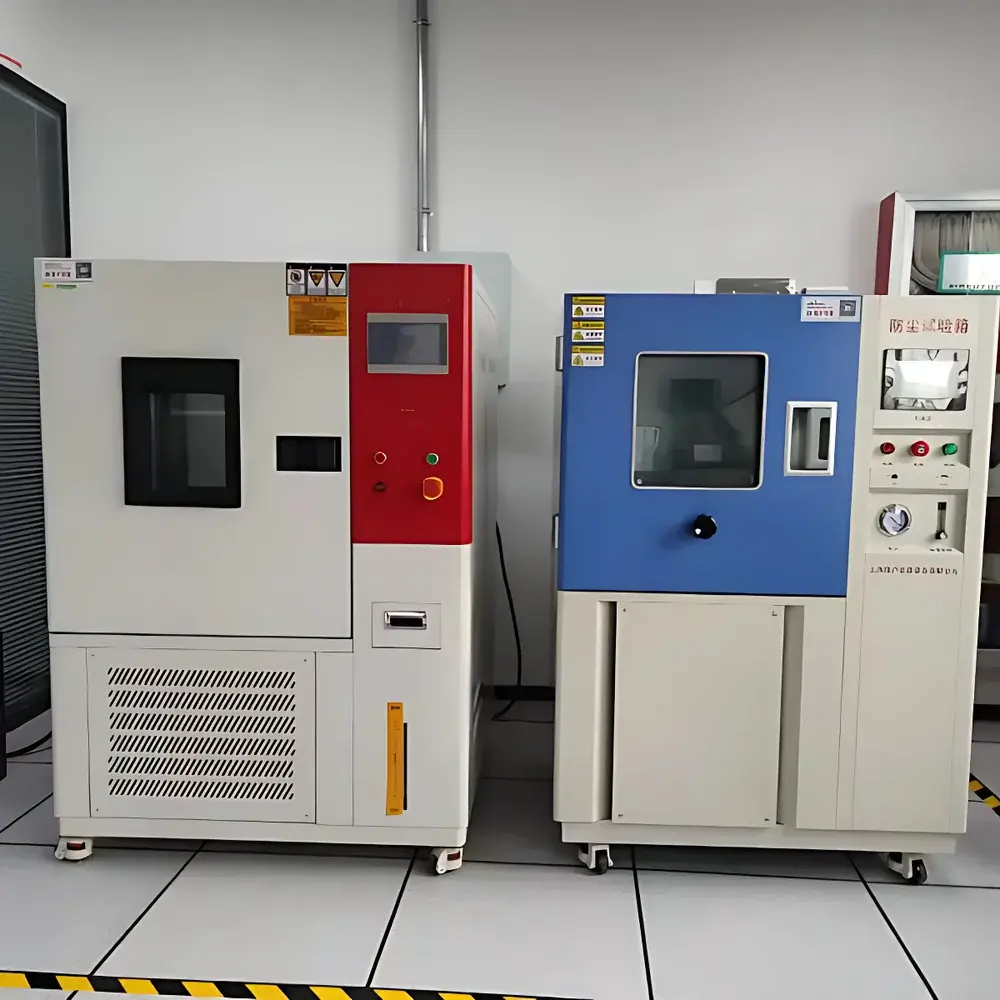
Jianhu JH-OZ-300 Ozone Aging Test Chamber for Wire, Cable & Elastomer Materials
| Brand | Jianhu |
|---|---|
| Origin | Shanghai, China |
| Manufacturer Type | Authorized Distributor |
| Product Category | Domestic |
| Model | JH-OZ-300 |
| Price Range | USD 920 – 9,200 |
Overview
The Jianhu JH-OZ-300 Ozone Aging Test Chamber is an engineered environmental test system designed to evaluate the ozone resistance of polymeric materials—particularly elastomers such as EPDM, NR, SBR, and CR—used in wire insulation, cable sheathing, automotive sealing systems, and industrial rubber components. It operates on the principle of accelerated oxidative degradation: ozone (O₃), a highly reactive triatomic oxygen species, selectively attacks carbon–carbon double bonds in unsaturated polymer chains, initiating chain scission, surface microcracking, and progressive loss of mechanical integrity. Unlike natural outdoor exposure—which may require years to manifest measurable deterioration—the JH-OZ-300 replicates decades of atmospheric aging within controlled, repeatable laboratory conditions. Its core function is not merely environmental simulation, but mechanistic acceleration: combining precise ozone generation (via UV lamp or silent corona discharge), temperature/humidity regulation, and optional dynamic mechanical stress (tensile elongation or cyclic compression) to emulate real-world service conditions where chemical, thermal, and mechanical factors act synergistically.
Key Features
- Stable ozone concentration control from 25 to 1,000 ppm ±10%, adjustable in 1 ppm increments via integrated ozone sensor feedback loop
- Uniform ozone distribution across test chamber volume (≥90% spatial homogeneity per ISO 1431-1 Annex B)
- Programmable temperature range: ambient +10°C to 70°C ±0.5°C; humidity control: 20–80% RH ±3% RH (optional)
- Integrated dynamic stress module supporting static tensile elongation (0–50%) or programmable cyclic deformation (0.1–5 Hz, ±5 mm stroke)
- Corrosion-resistant 304 stainless steel interior with seamless welding and ozone-resistant gasketing (FKM/Viton)
- Real-time ozone monitoring with NIST-traceable electrochemical sensor and data logging at 1-second intervals
- Compliance-ready architecture: audit trail support, user access levels, and electronic signature capability (aligned with FDA 21 CFR Part 11 principles)
Sample Compatibility & Compliance
The JH-OZ-300 accommodates standardized test specimens per ASTM D1149, ISO 1431-1, GB/T 7762, and IEC 60811-505—including dumbbell-shaped strips (Type 1 or 2), O-rings, extruded profiles, and cut sections of finished cables or seals. Specimen mounting fixtures are modular and calibrated for consistent strain application. The system supports full traceability of test parameters against internationally recognized standards for rubber durability assessment. All ozone generation and decomposition pathways meet ISO 1431-3 requirements for residual ozone abatement (<0.1 ppm exhaust). For regulated industries—including automotive Tier 1 suppliers, medical device component manufacturers, and aerospace wiring harness producers—the chamber’s operational documentation, calibration records, and performance verification protocols align with GLP (Good Laboratory Practice) and GMP (Good Manufacturing Practice) frameworks.
Software & Data Management
The embedded control interface runs on a Linux-based real-time OS with a 7-inch capacitive touchscreen and intuitive graphical workflow navigation. Test programs are defined via parameter templates (e.g., “EPDM Automotive Seal – ISO 1431-1 Cycle A”) and include configurable ramp/soak profiles for ozone concentration, temperature, humidity, and mechanical load. All sensor data—including ozone partial pressure, chamber temperature, relative humidity, and elapsed test time—are timestamped and exported in CSV or XML format compliant with LIMS integration. Optional PC software provides advanced analytics: crack initiation time mapping, tensile property retention curves (per ASTM D412), compression set decay modeling (per ASTM D395), and statistical comparison across multiple batches. Audit logs record operator ID, parameter changes, calibration events, and alarm history—retained for ≥12 months with tamper-proof digital signatures.
Applications
- Accelerated validation of EPDM, silicone, and nitrile formulations for automotive door/trunk seals, window channels, and HVAC gaskets
- Qualification of halogen-free flame-retardant (HFFR) compounds used in low-smoke zero-halogen (LSZH) power and data cables
- Raw material screening for anti-ozonant efficacy (e.g., p-phenylenediamine derivatives, waxes, nanofillers)
- Process validation of vulcanization parameters (cure time, temperature, pressure) and their impact on network stability
- Quality conformance testing per OEM specifications (e.g., Ford WSK-M2G224-A2, GMW15634, VW TL226)
- Research into ozone–UV–thermal synergy effects on polymer nanocomposites and bio-based elastomers
FAQ
How does the JH-OZ-300 differentiate between surface-initiated cracking and bulk degradation?
It enables direct correlation between ozone exposure time and crack morphology via periodic visual inspection under 10× magnification (per ISO 1431-1 Clause 8.3), supported by optional digital imaging modules that quantify crack density, length, and orientation using edge-detection algorithms.
Can the chamber be validated for ISO/IEC 17025 accredited laboratories?
Yes—Jianhu provides IQ/OQ documentation packages, third-party calibration certificates for ozone sensors and thermocouples (traceable to NIM, China), and uncertainty budgets compliant with ILAC-G8:2022 requirements.
What maintenance intervals are recommended for sustained ozone concentration accuracy?
Ozone generator lamps require replacement every 6,000 operating hours; electrochemical sensors must be zero-calibrated weekly and span-checked monthly using certified ozone gas standards (NIST SRM 2690).
Is it possible to integrate the JH-OZ-300 into an existing factory MES or QMS platform?
The unit supports Modbus TCP and OPC UA communication protocols; API endpoints are available for custom integration with SAP QM, ETQ Reliance, or Siemens Opcenter Quality modules.
Does the system support multi-chamber synchronized testing for inter-laboratory comparison studies?
Yes—up to four JH-OZ-300 units can be networked under a master controller to ensure identical profile execution, synchronized data acquisition, and centralized reporting for round-robin testing per ISO 5725.



