
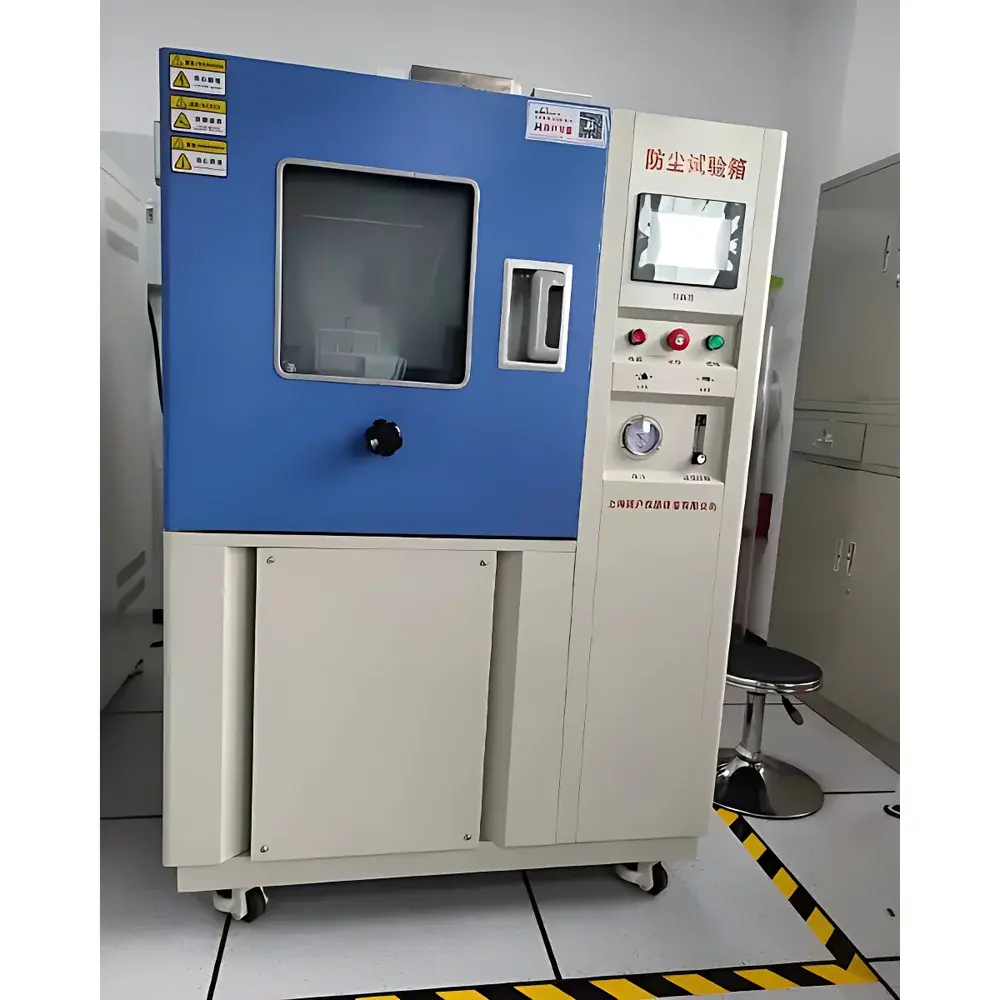
Jianhu JH-SDT Series Stainless Steel Programmable Sand and Dust Test Chamber
| Brand | Jianhu |
|---|---|
| Origin | Shanghai, China |
| Manufacturer Type | Authorized Distributor |
| Model | JH-SDT Series |
| Price Range | USD 1,350 – 13,500 (FOB Shanghai) |
| Sand Composition | 97–99% SiO₂ (quartz sand, angular, graded per IEC 60529 & MIL-STD-810H) |
| Sand Blowing Concentration | 1.1 g/m³ ±0.25 g/m³ to 2.2 g/m³ ±0.5 g/m³ |
| Sand Blowing Velocity | 0–29 m/s (adjustable, laminar-to-turbulent flow control) |
| Dust Concentration | 0.1–10.6 g/m³ ±7% (calibrated gravimetrically) |
| Dust Blowing Velocity | 8.9 m/s ±1.2 m/s (ISO 20623-compliant nozzle array) |
Overview
The Jianhu JH-SDT Series Stainless Steel Programmable Sand and Dust Test Chamber is an engineered environmental simulation system designed to evaluate the ingress protection (IP) performance of enclosures, electronic housings, automotive components, aerospace avionics, and outdoor industrial equipment against airborne particulate contamination. Based on the physical principles of inertial impaction, gravitational settling, and turbulent suspension, the chamber replicates real-world desert, coastal, and industrial dust environments in accordance with internationally recognized test standards—including IEC 60529 (IP5X/IP6X), ISO 20623:2019 (Road vehicles — Environmental conditions and testing for electrical and electronic equipment), MIL-STD-810H Method 510.7 (Sand and Dust), and GB/T 2423.37–2006 (Chinese national standard equivalent). Constructed entirely from electropolished 316 stainless steel, the chamber ensures long-term corrosion resistance, structural integrity under cyclic thermal and mechanical stress, and compliance with cleanroom-compatible maintenance protocols.
Key Features
- Full-programmable test profile execution: independent control of sand/dust concentration, air velocity, exposure duration, dwell time, and cycling sequence via embedded PLC-based controller with Ethernet interface
- Dual-mode particulate delivery system: separate, isolated channels for calibrated sand (angular quartz, D₅₀ ≈ 200 µm) and fine dust (silica-based, D₉₀ < 75 µm), each equipped with mass-flow-controlled pneumatic feeders and NIST-traceable concentration monitoring
- Variable-velocity wind tunnel section: aerodynamically optimized ducting with turbulence-reducing honeycomb flow straighteners and pitot-static arrays enabling precise velocity mapping across the test volume (0–29 m/s, ±0.3 m/s repeatability)
- Stainless steel test chamber interior (≥1.5 mm wall thickness) with integrated HEPA-filtered recirculation and primary exhaust filtration (MERV 16 + cyclonic pre-separator) to maintain operator safety and facility air quality
- Real-time environmental logging: synchronized acquisition of chamber temperature (±0.5°C), relative humidity (±3% RH), differential pressure, particulate mass concentration (via laser scattering sensor), and airflow velocity at multiple spatial points
Sample Compatibility & Compliance
The JH-SDT accommodates samples up to 1,200 mm × 1,000 mm × 1,000 mm (W×D×H) with configurable mounting fixtures (including rotating turntables for 360° exposure). It supports both static and dynamic testing configurations—samples may be powered-on or unpowered during exposure, with optional external power feedthroughs rated to IP67. All operational parameters are traceable to internal calibration records compliant with ISO/IEC 17025 requirements. The system meets GLP audit readiness criteria: full event logging (start/stop, parameter changes, alarms), user-access controls with role-based authentication, and electronic signature capability for test report generation. Documentation includes factory calibration certificates, uncertainty budgets per parameter, and conformance statements for IEC 60529, ISO 20623, and MIL-STD-810H Annex G.
Software & Data Management
The chamber operates under Jianhu’s proprietary TestMaster™ v4.2 software suite, deployed on a ruggedized industrial PC with dual SSD redundancy. Software features include: drag-and-drop test sequence builder with conditional branching; real-time overlay of live sensor data on 3D chamber schematic; automated pass/fail evaluation against user-defined acceptance thresholds per IEC 60529 clause; export of raw time-series datasets in CSV/Excel and standardized test reports in PDF/A-2 format. Audit trail functionality complies with FDA 21 CFR Part 11 requirements, including immutable timestamped logs of all operator actions, parameter modifications, and report generation events. Optional integration with enterprise LIMS or PLM platforms is supported via RESTful API and OPC UA protocol.
Applications
The JH-SDT is routinely deployed in R&D validation labs and QC departments across sectors requiring rigorous particulate ingress verification. Typical use cases include: qualification of IP6K9K-rated automotive lighting modules per ISO 20623; durability assessment of UAV propulsion systems operating in arid regions; verification of military-grade handheld radios (MIL-STD-810H); validation of solar inverter enclosures for Middle East deployment; and reliability screening of railway signaling cabinets exposed to ballast dust. Academic institutions utilize the system for fundamental studies on particle deposition kinetics, filter media efficiency under variable Reynolds numbers, and electrostatic charge accumulation on insulating surfaces under dry particulate flow.
FAQ
What standards does the JH-SDT chamber support out-of-the-box?
It natively supports test profiles for IEC 60529 IP5X/IP6X, ISO 20623:2019 Clause 7, MIL-STD-810H Method 510.7, and GB/T 2423.37–2006. Custom profiles can be imported via XML schema.
Can the chamber operate continuously for extended test durations?
Yes—designed for unattended 72-hour continuous operation with redundant cooling, automatic sand replenishment alerts, and self-diagnostic fault detection.
Is third-party certification available for test reports generated by this system?
Jianhu provides optional UKAS-accredited calibration services and collaborates with ISO/IEC 17025-certified laboratories for witnessed test execution and report notarization.
How is sand particle size distribution verified and maintained?
Each sand batch undergoes sieve analysis per ASTM C136 prior to loading; in-chamber particle size is monitored in real time using integrated laser diffraction (0.1–1,000 µm range) with auto-compensation algorithms.
Does the system include maintenance documentation and spare parts kits?
Yes—comprehensive English-language technical manuals, predictive maintenance schedules, and OEM-sourced consumables kits (nozzles, filters, calibration standards) are included with every shipment.



