
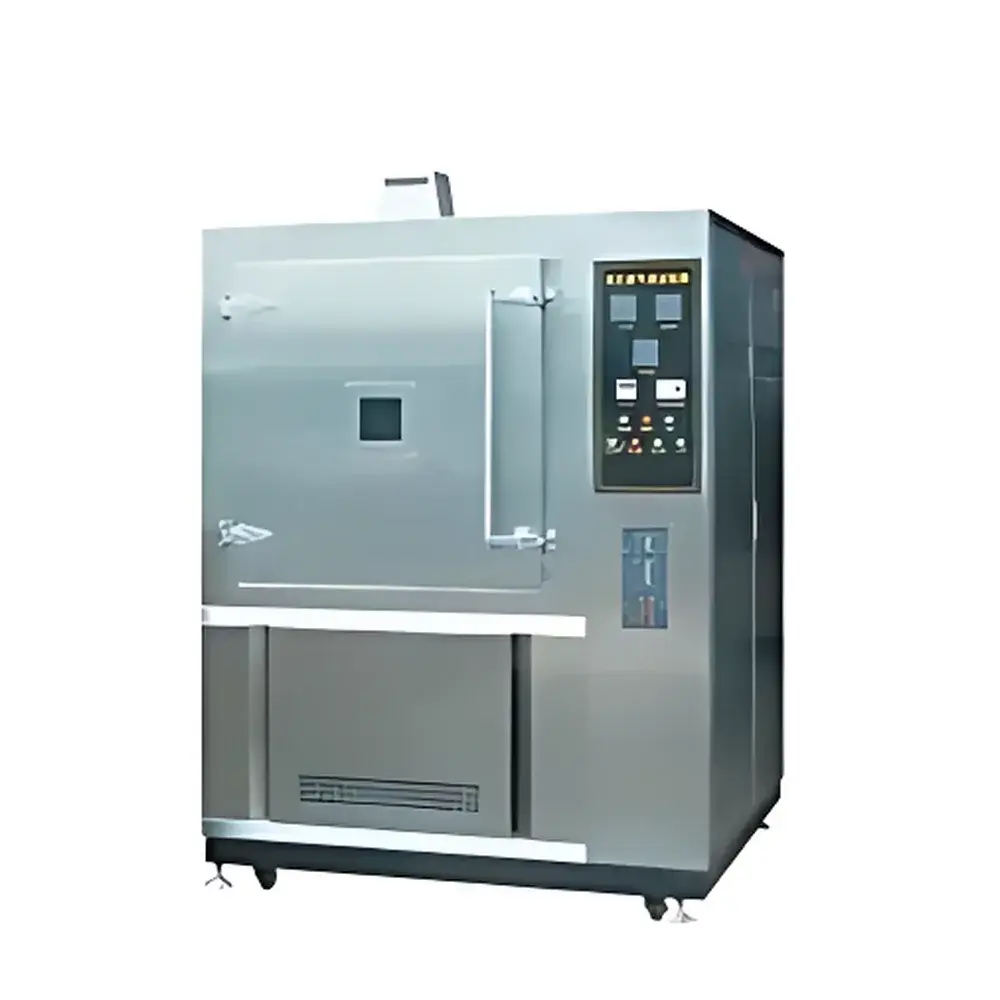
Jianhu JH-SN Xenon Arc Weathering Test Chamber
| Brand | Jianhu |
|---|---|
| Origin | Hubei, China |
| Manufacturer Type | Domestic OEM |
| Country of Origin | China |
| Model | JH-SN |
| Quotation | Available upon request |
| Internal Chamber Dimensions (D×W×H) | 380×500×350 mm |
| Black Panel Temperature Range | 63°C / 100°C ±3°C |
| Humidity Range | 85–98% RH |
| Temperature Uniformity (Empty) | ≤±2°C |
| Temperature Stability (Empty) | ≤±0.5°C |
| Humidity Stability | +2% / −3% RH |
| Xenon Lamp Power | 1.8 kW × 2 lamps |
| Lamp Type | Imported Q-Lab (USA) xenon arc lamps |
| Filter | Single quartz inner filter |
| Spectral Output Range | 290–800 nm |
| Sample Tray Size | 250×450 mm |
| Lamp-to-Sample Distance | 230–280 mm |
| Continuous Rain Duration | 0–9999 min adjustable |
| Intermittent Rain Cycle | 0–240 min adjustable |
| Rain Nozzle Diameter | φ0.8 mm |
| Rain Pressure | 0.12–0.15 MPa |
| Compliance | GB/T 16422.2–1999, GB/T 14522–2008 |
Overview
The Jianhu JH-SN Xenon Arc Weathering Test Chamber is an engineered environmental simulation system designed to replicate the damaging effects of natural sunlight, heat, and moisture on polymeric materials, coatings, textiles, automotive components, and outdoor building products. It employs a controlled xenon arc light source—spectrally filtered to closely match terrestrial solar irradiance (290–800 nm)—to accelerate photodegradation processes under reproducible laboratory conditions. Unlike UV fluorescent or metal halide systems, xenon arc technology delivers full-spectrum irradiation including critical UVA, UVB, visible, and near-infrared bands, enabling realistic assessment of color fading, gloss loss, chalking, cracking, embrittlement, and chemical crosslinking. The chamber integrates precise black panel temperature control (63°C or 100°C ±3°C), high-humidity cycling (85–98% RH), and programmable water spray sequences to simulate diurnal thermal stress, condensation, and rain exposure—all in accordance with internationally recognized weathering standards.
Key Features
- Two high-output 1.8 kW Q-Lab (USA) xenon arc lamps, each rated for ≥1800 hours of stable spectral output, ensuring long-term irradiance consistency and reduced lamp replacement frequency.
- Optimized optical path with a single quartz inner filter to maintain spectral fidelity across the UV–VIS–NIR range while minimizing unwanted IR heating of specimens.
- Microprocessor-based dual-loop PID+SSR temperature and humidity control system, featuring PT100 platinum resistance sensors and 0.1°C resolution for both black panel and chamber air temperature.
- Independent heating (titanium alloy far-infrared heaters), humidification (steam-generation boiler with auto water-level compensation), and irradiation subsystems—preventing cross-interference during complex test profiles.
- Stainless steel (SUS304) interior chamber with A3 steel exterior, electrostatically sprayed finish, and double-layer high-temperature silicone gasket sealing for leak-tight operation and corrosion resistance.
- Programmable rain system with two overhead nozzles (φ0.8 mm orifice), adjustable pressure (0.12–0.15 MPa), and flexible cycle definition—including continuous spray (0–9999 min) or intermittent modes (e.g., 18/102 min or 12/48 min).
- Robust safety architecture: over-temperature cutoff, motor thermal protection, leakage current detection, automatic shutdown on fault detection, and multi-point water shortage alarms.
Sample Compatibility & Compliance
The JH-SN accommodates flat or rigid specimens up to 250×450 mm on its perforated stainless steel sample tray (standard one-tier configuration). Adjustable lamp-to-sample distance (230–280 mm) allows optimization of irradiance intensity per ISO 4892-2 and ASTM G155 requirements. The chamber meets key national standards including GB/T 16422.2–1999 (equivalent to ISO 4892-2) and GB/T 14522–2008 (for mechanical property evaluation after exposure). While not pre-certified to ASTM D4329, D4459, or SAE J2527, its operational parameters—including spectral match, black panel temperature control, humidity regulation, and spray functionality—are fully configurable to align with these protocols when used with appropriate calibration and validation procedures. Routine maintenance, lamp calibration, and filter replacement follow Q-Lab-recommended intervals to sustain measurement traceability.
Software & Data Management
The integrated Korean-manufactured microcomputer controller provides real-time monitoring of irradiance (indirectly via lamp voltage/current stability), black panel temperature, chamber humidity, and spray status. All setpoints and runtime logs are stored internally with timestamped records. Though the base system does not include Ethernet connectivity or GLP-compliant audit trails, it supports manual data export via USB interface for external documentation. For regulated environments requiring 21 CFR Part 11 compliance, third-party SCADA integration or retrofitting with validated data acquisition software is recommended. Calibration certificates for temperature and humidity sensors can be issued upon request, and periodic verification against NIST-traceable references is advised per ISO/IEC 17025 guidelines.
Applications
This chamber serves R&D laboratories, quality assurance departments, and certification bodies evaluating material durability across sectors: automotive interior/exterior trim (dashboards, seals, paints), architectural coatings and sealants, geotextiles and roofing membranes, agricultural films, printed packaging, and aerospace polymer composites. Typical test methods include accelerated aging for colorfastness (ISO 105-B02), gloss retention (ASTM D523), tensile strength degradation (ISO 527), and adhesion failure (ASTM D3359). Its ability to combine UV exposure with thermal cycling and moisture ingress makes it particularly suitable for studying synergistic degradation mechanisms—notably hydrolytic cleavage in polyesters or photo-oxidation in polyolefins.
FAQ
What is the expected service life of the xenon lamps?
Q-Lab xenon lamps installed in the JH-SN typically deliver stable spectral output for approximately 1800 hours under standard operating conditions. Lamp output decay is monitored via voltage and current trends; replacement is recommended when irradiance drops below 80% of initial value.
Can the chamber operate without rain cycles?
Yes—the spray system is fully independent and may be disabled while maintaining irradiation, temperature, and humidity control for dry-heat or light-only exposure protocols.
Is calibration support available for international standards?
Factory calibration reports for temperature and humidity sensors are provided. For ISO/IEC 17025-accredited calibration or irradiance meter traceability, users should engage a local accredited metrology provider using reference instruments calibrated to NIST or PTB standards.
What electrical infrastructure is required?
The unit requires a dedicated AC 220 V ±10%, 50 Hz, three-phase five-wire supply with proper grounding. Ambient operating conditions must remain within 5–35°C and ≤85% RH, with ≥80 cm clearance around all sides for ventilation and service access.



