
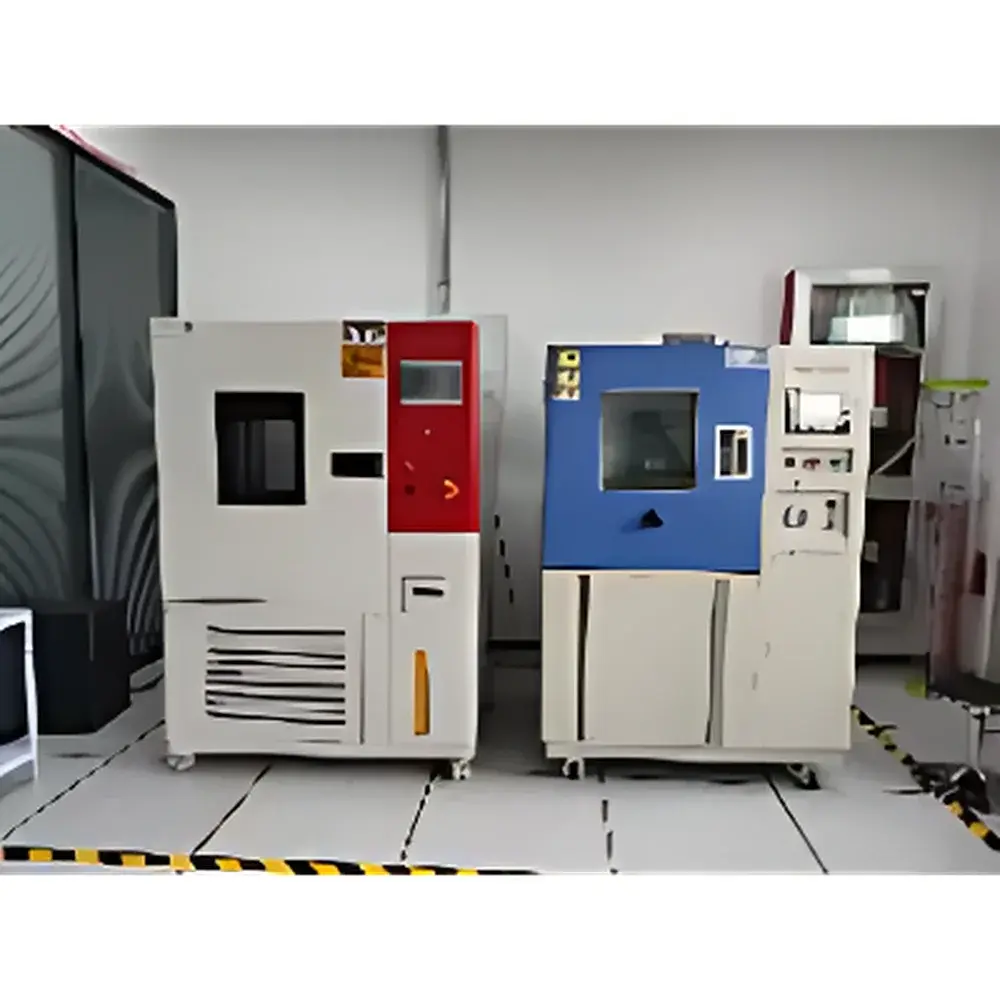
Jianhu JH-TS Series Thermal Shock Test Chamber with 7-inch Capacitive Touchscreen for Electronic Components and PV Modules
| Brand | Jianhu |
|---|---|
| Origin | Shanghai, China |
| Model | JH-TS Series |
| Temperature Range | -60°C to +180°C |
| Control Accuracy | ±0.5°C |
| Touch Interface | 7-inch capacitive touchscreen with multi-touch support and programmable cycling |
| Compliance | GB/T 2423.1, GB/T 2423.2, GB/T 2423.3, IEC 60068-2-1, IEC 60068-2-2, IEC 60068-2-30 |
| Application Scope | Reliability validation of electronic components (e.g., automotive ICs, sensors), photovoltaic modules, PCB assemblies, and encapsulated optoelectronic devices |
| Data Logging | Real-time parameter display, automatic storage of cycle logs and alarm events |
| Structural Design | Dual-chamber thermal shock architecture with forced-air circulation and rapid transition (<15 s between chambers) |
| Humidity Capability (for combined aging variant) | 40–90% RH, UV irradiance 0.8–1.2 W/m² (340 nm) |
| Software | Embedded control firmware with audit-trail-ready event logging (GLP-compliant metadata tagging) |
Overview
The Jianhu JH-TS Series Thermal Shock Test Chamber is an engineered environmental simulation system designed for accelerated reliability assessment of electronic components, photovoltaic (PV) modules, and hermetically sealed devices under extreme temperature transitions. It operates on the principle of dual-chamber thermal shock—separating low-temperature and high-temperature zones with independent refrigeration and heating systems—to induce rapid thermal stress across material interfaces. This methodology aligns with standardized thermal cycling protocols defined in IEC 60068-2-14 and MIL-STD-810H Method 503, enabling precise replication of field-relevant thermal gradients encountered during automotive operation, rooftop PV deployment, or aerospace electronics commissioning. The chamber’s core function is not merely temperature exposure, but controlled *thermal transience*: achieving ≤15-second transfer times between chambers ensures mechanical strain accumulation at solder joints, die attach layers, and laminate interfaces—critical failure mechanisms in miniaturized electronics and bifacial solar cells.
Key Features
- Dual-zone architecture with independently controlled cryogenic (-60°C) and thermal (+180°C) chambers, eliminating cross-contamination and enabling repeatable shock profiles.
- 7-inch industrial-grade capacitive touchscreen interface supporting multi-point gesture navigation, drag-and-drop program sequencing, and real-time waveform visualization of temperature vs. time.
- Programmable thermal cycling up to 1,000 cycles with user-defined dwell times, ramp rates (10–30°C/min), and transition triggers—fully compliant with GB/T 2423.22 and JEDEC JESD22-A104D.
- Integrated humidity and UV irradiation module (optional) for combined environmental aging: 40–90% RH control via steam injection and quartz-filtered UVA-340 lamps delivering 0.8–1.2 W/m² at 340 nm peak wavelength.
- Embedded data logger with timestamped cycle records, alarm history (over-temperature, door open, compressor fault), and CSV export capability via USB port—supporting basic GLP traceability requirements.
- Stainless steel 304 interior with removable shelves, reinforced viewing window with anti-fog coating, and CE-marked safety interlocks meeting EN 61000-6-2/6-4 EMC standards.
Sample Compatibility & Compliance
The JH-TS Series accommodates test specimens up to 500 mm × 500 mm × 500 mm (W×D×H), including full-size PV modules (60/72-cell formats), automotive ECUs, MEMS sensor arrays, and multilayer ceramic capacitors (MLCCs). Its thermal profile fidelity supports qualification per AEC-Q200 for passive components and IEC 61215-2 MQT 11 for PV module thermal cycling. For humidity-UV co-stressing, it satisfies IEC 61215-2 MQT 13 (damp heat + UV) and ISO 4892-3 (plastics exposure). All control firmware includes configurable pass/fail thresholds and automatic shutdown on deviation exceeding ±1.0°C from setpoint—ensuring measurement integrity during extended unattended runs.
Software & Data Management
The embedded controller runs deterministic real-time firmware (RTOS-based), with no external PC dependency. Cycle programs are stored in non-volatile memory with versioned backup. Each test execution generates a structured log file containing: start/end timestamps, chamber temperatures sampled every 2 seconds, door status events, and system error codes. While not FDA 21 CFR Part 11 certified out-of-the-box, the system provides foundational audit trail elements—including operator ID field (manual entry), unique test ID generation, and immutable log files—enabling integration into validated laboratory information management systems (LIMS) where required. Optional RS-485 Modbus RTU output allows connection to SCADA platforms for centralized monitoring.
Applications
- Automotive Electronics: Validation of powertrain control units against cold-start (-40°C) and under-hood thermal soak (125°C) sequences; detection of intermetallic growth and solder fatigue in BGA packages.
- Photovoltaic Module Qualification: Accelerated lifetime modeling per IEC 61215-2, simulating diurnal temperature swings across desert (−20°C to +85°C) and alpine (−30°C to +60°C) climates; correlation to field degradation metrics such as PID susceptibility and encapsulant delamination.
- Consumer Electronics: Stress screening of flexible printed circuits (FPCs) and OLED displays subjected to repeated flex-thermal coupling, revealing adhesive bond degradation prior to field return.
- Medical Device Packaging: Sterility barrier validation through accelerated aging per ASTM F1980, using elevated temperature/humidity profiles to predict shelf-life stability of Tyvek®-sealed trays.
FAQ
What is the minimum dwell time per chamber?
The standard configuration supports dwell times from 10 minutes to 999 hours per zone, adjustable in 1-minute increments.
Can the chamber operate in single-zone mode (only hot or only cold)?
Yes—the system allows independent activation of either chamber for static temperature soak testing without initiating shock transitions.
Is calibration certificate included with shipment?
A factory calibration report (traceable to NIM, China) is provided; optional UKAS-accredited calibration is available upon request.
Does the touch interface support multiple user accounts with permission levels?
No—user access is unrestricted by default; password protection and role-based controls require third-party LIMS integration.
What maintenance intervals are recommended for the refrigeration system?
Compressor oil and filter replacement every 24 months; annual inspection of condenser coils and refrigerant charge verification per GB/T 2423.104.



