
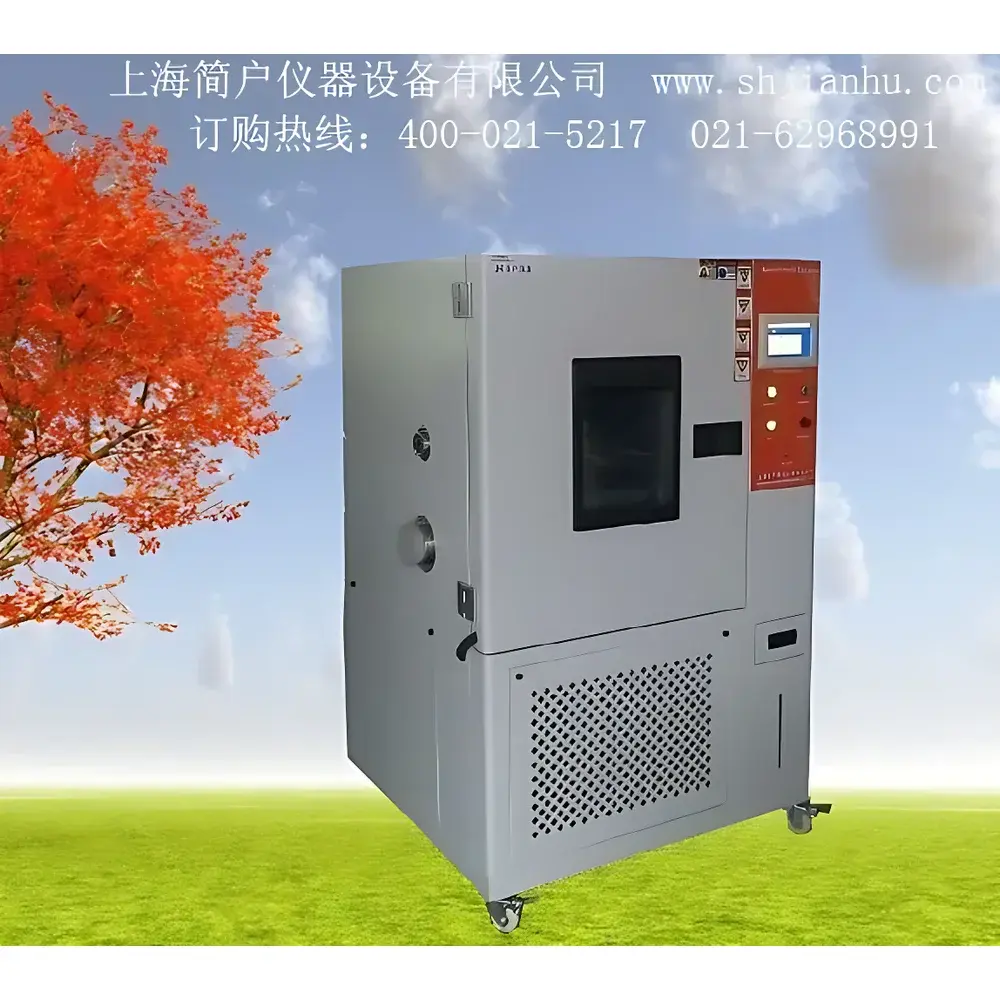
Jianhu JTH/LTH Series Temperature and Humidity Controlled Environmental Test Chamber
| Brand | Jianhu |
|---|---|
| Origin | Shanghai, China |
| Model | JTH/LTH |
| Chamber Construction | Inner chamber – SUS304 stainless steel mirror finish |
| Temperature Range | −70 °C to +150 °C (configurable) |
| Humidity Range | 10 %RH to 98 %RH |
| Control System | Industrial-grade color touchscreen HMI with multi-language support (English/Chinese), 120 programs × 1200 segments, up to 999 cycles |
| Compliance | GB/T 2423.1–2001 (cold), GB/T 2423.2–2001 (dry heat), GB/T 2423.3–1993 (damp heat), IEC 60068-2, JIS C 0021, MIL-STD-810G |
| Cooling System | Dual-stage cascade refrigeration with HFC-404A/HFC-134a eco-friendly refrigerant |
| Humidity Control | PID-controlled steam generator with platinum RTD (Pt100) sensors, nano-filtered pure water supply system |
| Safety Features | Independent over-temperature cutoff, low-water alarm, door interlock, real-time dew point monitoring |
| Interface Options | RS-232 / RS-484 standard ports, optional 4–20 mA analog output, data logging & thermal print capability |
| Optional Accessories | LN2 rapid cooling module, regenerative desiccant dehumidifier (LHC), observation window with inner glass door, 50 mm test port, GLP/GMP-compliant audit trail software (add-on) |
Overview
The Jianhu JTH/LTH Series Temperature and Humidity Controlled Environmental Test Chamber is engineered for precise, repeatable simulation of climatic stress conditions in accordance with international environmental testing standards. It operates on a dual-loop control architecture—separately regulating thermal energy transfer via high-efficiency cascade refrigeration and moisture mass transfer through a steam-based humidification system—enabling independent or synchronized control of temperature (−70 °C to +150 °C) and relative humidity (10–98 %RH). The chamber’s structural integrity derives from CNC-machined A3 steel outer casing with electrostatic powder coating and a seamless SUS304 stainless steel inner chamber fabricated via TIG welding, ensuring corrosion resistance, dimensional stability, and long-term calibration retention under cyclic thermal loading. Its design prioritizes operational safety and metrological reliability: integrated dual-limit temperature protection, real-time dew-point tracking to suppress condensation during transition phases, and a fail-safe water-level management system prevent uncontrolled drift or hardware damage during extended test sequences.
Key Features
- Industrial-grade color touchscreen HMI with embedded multi-language OS (English/Chinese), supporting up to 120 programmable profiles, each comprising 1200 time–temperature–humidity segments and 999 loop repetitions
- Nano-filtration pure water generation system: eliminates dependence on pre-treated laboratory water by removing bacteria, particulates, and dissolved organics directly from municipal supply—reducing operator intervention and eliminating downtime due to feedwater contamination
- Independent thermal and humidity actuation circuits: enables standalone high-temperature bake-out (up to +150 °C), deep-freeze cycling (down to −70 °C), or constant-humidity conditioning at any stable temperature setpoint
- Optimized air distribution: tangential blower assembly with adjustable vane diffusers ensures ±0.5 °C temperature uniformity and ±2 %RH humidity homogeneity across the working volume (per IEC 60068-3-5)
- Real-time graphical curve display: overlays actual vs. setpoint traces for both parameters, with zoom, export (CSV), and event-marking functions for failure root-cause analysis
- Comprehensive safety architecture: independent mechanical over-temperature cutoff, door-open interlock, low-water level alert with auto-shutdown, and refrigerant leak detection sensor (optional)
Sample Compatibility & Compliance
The JTH/LTH chamber accommodates a broad spectrum of physical specimens—from printed circuit boards and automotive ECUs to pharmaceutical packaging and polymer composites—without compromising test fidelity. Its 50 mm diameter access port (standard left-side location) supports external sensor cabling, power feeds, or environmental probes while maintaining chamber integrity. All control algorithms and hardware calibrations comply with traceable metrology requirements under ISO/IEC 17025. Validation documentation—including IQ/OQ protocols, uncertainty budgets per GUM, and factory-as-tested calibration certificates—is provided with each unit. Regulatory alignment includes full conformance to GB/T 2423 series (China), IEC 60068-2 (international), JIS C 0021 (Japan), and MIL-STD-810G Method 507.5 (U.S. DoD). Optional firmware upgrades enable 21 CFR Part 11–compliant electronic signatures, audit trails, and role-based access control for regulated environments operating under GLP or GMP frameworks.
Software & Data Management
The embedded controller runs a deterministic real-time OS with deterministic task scheduling—ensuring microsecond-level timing accuracy for ramp/soak transitions. Data acquisition occurs at 1 Hz resolution for both Pt100 temperature and capacitive humidity sensors, with onboard non-volatile memory retaining 30 days of continuous 1-second logging. Export options include USB flash drive dump (CSV), RS-485 Modbus RTU integration into SCADA platforms, and optional analog 4–20 mA outputs for PLC interfacing. For advanced analytics, the optional Jianhu DataStation Suite provides statistical process control (SPC) charts, Weibull reliability modeling, and automated compliance reporting against predefined test standards. All software modules undergo annual third-party validation and support version-controlled firmware updates with rollback capability.
Applications
This chamber serves critical roles across R&D, quality assurance, and regulatory submission workflows. In electronics manufacturing, it executes temperature cycling (TC0–TC2000 per JEDEC JESD22-A104) and damp heat storage (85 °C/85 %RH per JESD22-A101) to evaluate solder joint fatigue and conformal coating delamination. Automotive suppliers apply it for ISO 16750-4 environmental stress screening of infotainment modules and ADAS sensors. Pharmaceutical firms use it for stability chamber qualification (ICH Q1A–Q5C), accelerated aging of primary packaging, and excipient compatibility studies. Aerospace component vendors rely on its low-humidity capability (<10 %RH) and LN2-assisted rapid cooldown (−70 °C in <15 min) to replicate stratospheric exposure conditions per DO-160 Section 4.
FAQ
What is the minimum achievable humidity level, and how is it sustained below 20 %RH?
The system achieves 10 %RH using a combination of chilled-mirror dew-point control, regenerative desiccant (LHC option), and dynamic vapor pressure modulation—avoiding conventional dry-air purging to maintain thermal stability.
Does the controller support remote monitoring and alarm notification?
Yes—via optional Ethernet/Wi-Fi gateway, enabling SNMP traps, email/SMS alerts on deviation events, and browser-based read-only dashboard access.
Can the chamber be validated for GxP-regulated use?
Yes—factory-installed IQ/OQ documentation, NIST-traceable calibration certificates, and optional 21 CFR Part 11 software package are available upon order.
Is the stainless steel interior electropolished for cleanroom compatibility?
Standard configuration uses mechanically polished SUS304; electropolished finish and VHP-compatible gasket materials are available as custom options.
How often does the nano-filter require replacement, and is maintenance logged?
Filter service interval is 6 months under continuous operation; the HMI automatically logs usage hours and triggers visual/audible alerts prior to expiry.



