
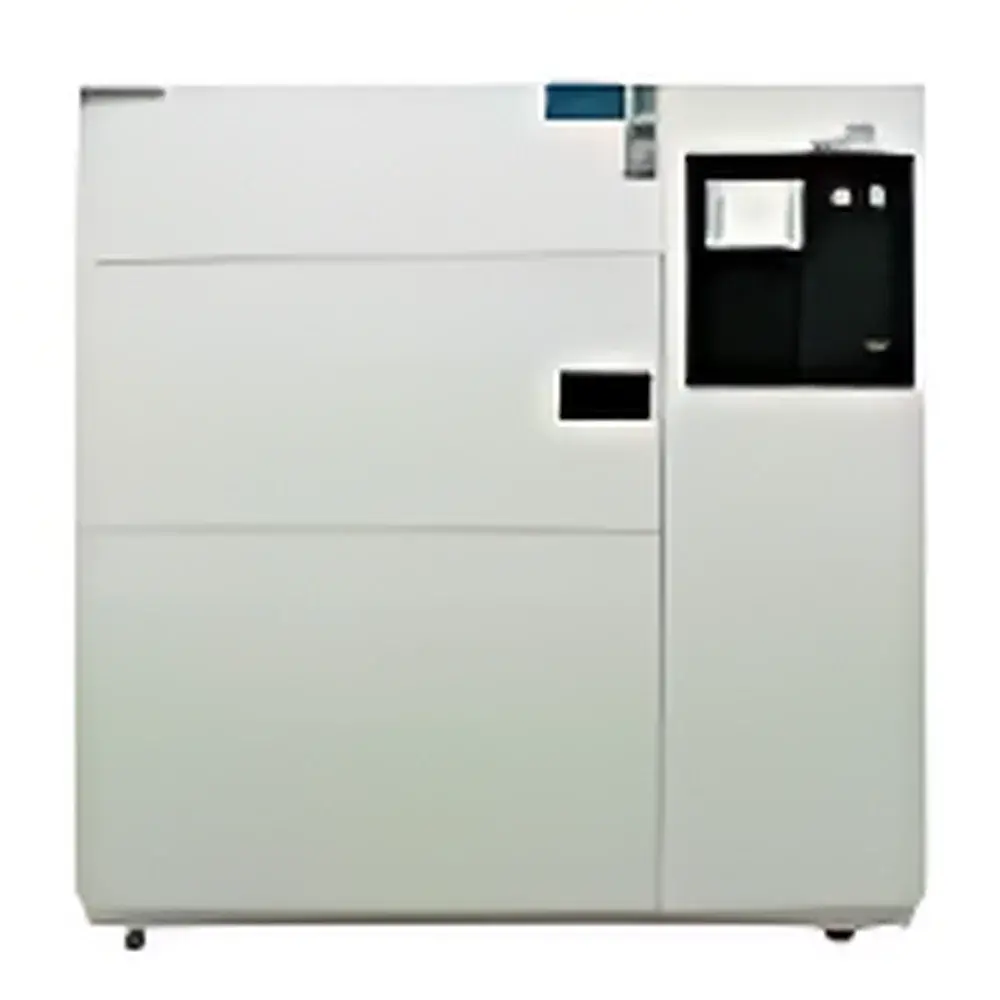
Jianhu LS-A3C Three-Zone Thermal Shock Test Chamber
| Brand | Jianhu |
|---|---|
| Origin | Shanghai, China |
| Model | LS-A3C |
| Internal Chamber Dimensions (W×D×H) | 40×35×30 cm |
| High-Temperature Zone Range | +60 °C to +150 °C |
| Low-Temperature Zone Range | −10 °C to −55 °C |
| Thermal Shock Range Options | −40 °C to +150 °C or −55 °C to +150 °C |
| Transition Time (Hot ↔ Cold) | ≤10 s |
| Cycle Count Setting Range | 1–999 cycles |
| Soak Time per Zone | Programmable up to 999 h 59 min |
| Control Interface | Color TFT LCD Touchscreen Controller with English/Chinese UI |
| Compliance | GJB 150.3-1986, GJB 150.4-1986, GJB 150.5-1986 |
| Configuration | Three-chamber (separate hot chamber, cold chamber, and test chamber) with pneumatic thermal airflow switching |
Overview
The Jianhu LS-A3C Three-Zone Thermal Shock Test Chamber is an engineered environmental stress screening (ESS) system designed for accelerated reliability assessment of electronic components, aerospace hardware, automotive modules, polymer-based assemblies, and military-grade electronics. It implements a true three-chamber architecture—comprising independent high-temperature, low-temperature, and test chambers—to execute rapid, repeatable thermal transitions without mechanical movement of the test specimen. This configuration eliminates thermal lag and ensures precise, reproducible shock profiles in accordance with MIL-STD-810G Method 503.5 and equivalent national defense standards. Unlike two-chamber designs relying on mechanical shuttle mechanisms, the LS-A3C utilizes high-efficiency pneumatic air-path switching to deliver controlled thermal energy transfer, minimizing thermal inertia and enabling sub-10-second transition times between extreme temperature zones. The system is calibrated to maintain ±0.5 °C temperature uniformity within the test chamber during steady-state soak periods and supports programmable ramp rates, dwell durations, and cycle sequencing essential for failure mode analysis and qualification testing.
Key Features
- Three-zone segregated chamber design (hot / cold / test) ensuring zero specimen motion during thermal cycling — critical for solder joint integrity verification and microstructural stability assessment
- Pneumatic thermal airflow switching mechanism with ≤10-second hot-to-cold and cold-to-hot transition time, validated per IEC 60068-2-14 requirements
- High-precision PID-controlled temperature regulation across all zones, with real-time deviation monitoring and auto-tuning capability
- 7-inch full-color TFT LCD touchscreen controller supporting dual-language (English/Chinese) interface, intuitive waveform programming, and on-screen execution status visualization
- 96 preloaded test profiles compliant with GJB 150.3–150.5 (Chinese Military Standard), plus user-defined profile creation and storage
- Programmable cycle count (1–999), soak duration (00:00:01 to 999:59:59), and start condition selection (hot-first or cold-first initiation)
- Automatic defrost scheduling and scheduled start/stop functionality for unattended operation during extended qualification runs
- Integrated safety interlocks including over-temperature cut-off, refrigerant pressure monitoring, and door-open inhibition during active cycling
Sample Compatibility & Compliance
The LS-A3C accommodates specimens up to 40 cm (W) × 35 cm (D) × 30 cm (H) within its stainless-steel test chamber, with optional through-wall feedthrough ports for external power, signal, or sensor cabling. Its design supports both rigid and flexible substrates—including PCBs, BGA packages, ceramic capacitors, elastomeric seals, and composite laminates—without imposing mechanical stress during thermal transients. The chamber meets structural and operational requirements of GJB 150.3-1986 (High Temperature), GJB 150.4-1986 (Low Temperature), and GJB 150.5-1986 (Temperature Shock), and is routinely deployed in GLP-compliant laboratories conducting qualification per MIL-HDBK-344 and IPC-9701. While not certified to ISO/IEC 17025 for accredited calibration, it provides traceable temperature validation via NIST-traceable Pt100 sensors installed at multiple spatial locations per IEC 60068-3-5.
Software & Data Management
The embedded controller logs time-stamped temperature data from all three chambers at user-selectable intervals (1–60 seconds), storing up to 10,000 hours of continuous acquisition internally. Export is supported via USB 2.0 to CSV or Excel-compatible formats for post-test statistical analysis (e.g., Weibull distribution fitting, Arrhenius modeling). Optional RS-485 or Ethernet connectivity enables integration into centralized lab management systems (LIMS) and supports remote monitoring via Modbus TCP. Audit trail functionality records operator login events, parameter modifications, and emergency stop triggers—aligning with basic FDA 21 CFR Part 11 expectations for electronic record integrity where local regulatory interpretation permits. No cloud-based telemetry or proprietary software installation is required; all configuration and reporting are self-contained within the onboard interface.
Applications
- Qualification of surface-mount technology (SMT) assemblies under JEDEC J-STD-020 moisture sensitivity level (MSL) preconditioning protocols
- Validation of thermal interface materials (TIMs) and encapsulants for coefficient of thermal expansion (CTE) mismatch mitigation
- Accelerated life testing of automotive ECUs subjected to under-hood thermal cycling per SAE J2223
- Failure analysis of MEMS devices experiencing thermo-mechanical fatigue at die-attach interfaces
- Material compatibility screening for cryogenic-to-ambient reflow scenarios in satellite payload subsystems
- Reliability screening of medical device PCBs prior to ISO 13485 certification audits
FAQ
What is the difference between two-chamber and three-chamber thermal shock configurations?
A two-chamber system moves the test specimen mechanically between hot and cold zones, introducing vibration, positional uncertainty, and longer transition times. The LS-A3C’s three-chamber design keeps the specimen stationary while redirecting conditioned air—reducing mechanical stress and improving repeatability.
Does the LS-A3C support automated data export for quality documentation?
Yes. Temperature logs are stored internally and exportable via USB to CSV format. Timestamped files include chamber identifiers, setpoints, actual readings, and alarm flags—suitable for internal QA reports and regulatory submissions.
Can the controller be configured for non-standard thermal profiles?
Yes. Users may define custom soak durations, transition sequences, and cycle counts beyond standard military profiles. Up to 96 unique programs can be saved and recalled without firmware modification.
Is third-party calibration support available?
Jianhu provides factory calibration certificates traceable to national metrology institutes. For ISO/IEC 17025-accredited calibration, users must engage an accredited external laboratory using the chamber’s built-in sensor access points and documented uncertainty budgets.
What maintenance intervals are recommended for long-term operational stability?
Compressor oil and refrigerant levels should be verified annually; air filters require cleaning every 3 months; and thermal insulation integrity should be inspected biannually per preventive maintenance checklist included in the technical manual.



