
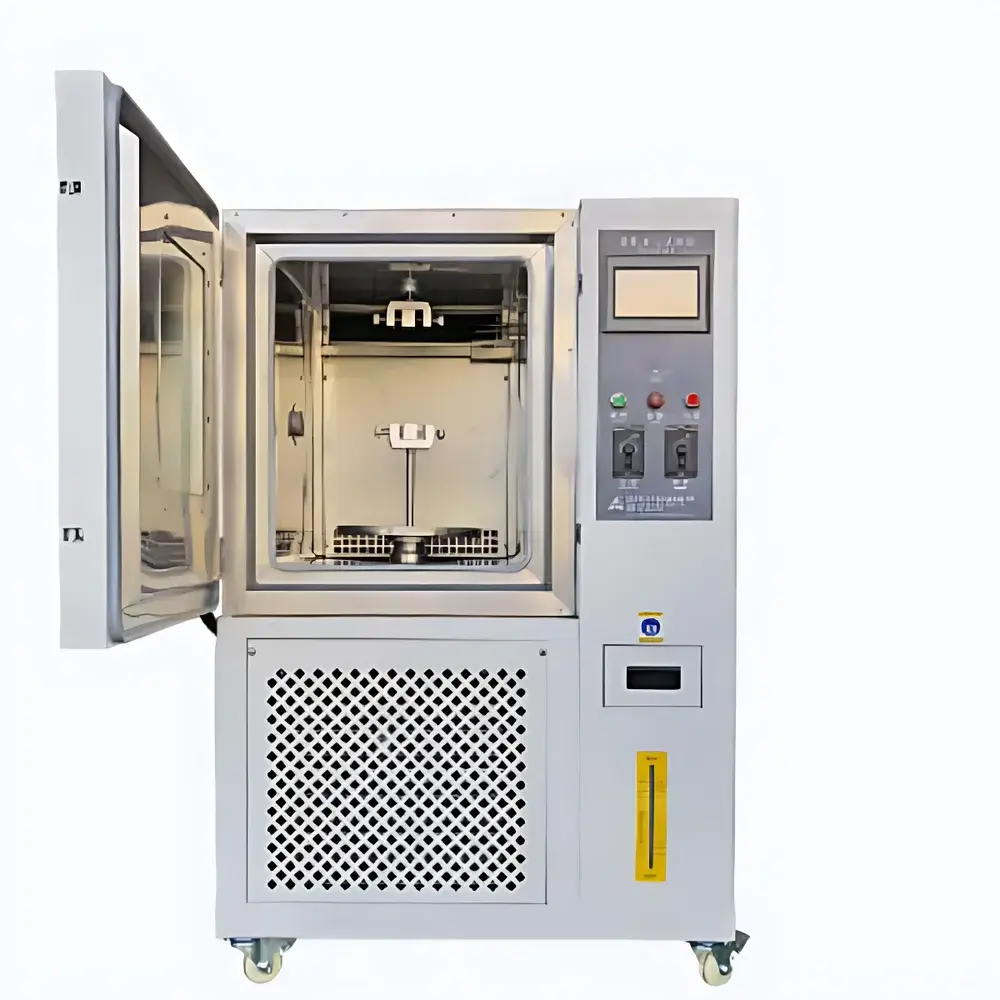
Jianhu Ozone Aging Test Chamber – Dual-Mode Static & Dynamic Environmental Test System
| Brand | Jianhu |
|---|---|
| Origin | Shanghai, China |
| Manufacturer Type | Authorized Distributor & OEM Partner |
| Product Category | Domestic (PRC-Made) |
| Model | JH-OZT Series |
| Price Range | USD 920 – 92,000 (FOB Shanghai) |
Overview
The Jianhu Ozone Aging Test Chamber (JH-OZT Series) is an engineered environmental test system designed to evaluate the oxidative degradation resistance of elastomeric and polymeric materials—particularly silicone, polyurethane, butyl rubber, and thermoplastic elastomers—under controlled, accelerated ozone exposure. It operates on the principle of accelerated aging via precisely regulated ozone generation (via UV lamp or corona discharge), combined with programmable temperature control and optional mechanical stress application. Unlike passive static exposure chambers, the JH-OZT Series integrates dual-mode functionality: static testing for baseline oxidation kinetics assessment, and dynamic testing using motorized tensile fixtures that simulate real-world cyclic strain (e.g., thermal expansion/contraction, wind-induced flexing in photovoltaic module edge seals). This multi-stress coupling enables reproducible simulation of field-relevant failure mechanisms—including microcrack initiation at vulnerable chain-saturated sites, surface embrittlement, and interfacial adhesion loss—thereby supporting predictive lifetime modeling per IEC 61215-2, ASTM D1149, ISO 1431-1, and UL 1703 Annex G requirements.
Key Features
- Dual operational modes: Static ozone exposure and dynamic mechanical stress testing (tensile/compression cycling) within the same chamber
- Ozone concentration control range: 25–1000 ppm ±5% (calibrated via built-in electrochemical ozone sensor with NIST-traceable verification)
- Temperature regulation: –10°C to +70°C, ±0.5°C uniformity across working volume
- UV-enhanced ozone generation: Optional 254 nm low-pressure mercury lamp array for synergistic photo-oxidative acceleration
- Modular stress fixture interface: Compatible with standardized dumbbell specimens (ASTM D412) and custom-mounted PV sealant bead samples
- Corrosion-resistant 304 stainless steel interior; double-sealed observation window with anti-fog coating
- Integrated data logging: Real-time ozone ppm, chamber temperature, and cycle count recorded at user-defined intervals (1 s to 60 min)
Sample Compatibility & Compliance
The JH-OZT Series accommodates standard test specimens per ASTM D1149 (rubber), ISO 1431-1 (elastomers), and IEC 61215-2 MQT 18 (PV encapsulant and sealant validation). It supports flat-sheet, extruded bead, and laminated cross-section samples up to 300 mm × 300 mm × 50 mm. All chamber materials comply with RoHS Directive 2011/65/EU and meet CE marking requirements for electromagnetic compatibility (EN 61326-1) and safety (EN 61010-1). The system architecture supports GLP-compliant operation: audit trails, user access levels, electronic signatures, and 21 CFR Part 11–ready software modules are available upon configuration. Calibration certificates for ozone sensors and temperature probes are provided with each unit and conform to ISO/IEC 17025-accredited traceability protocols.
Software & Data Management
The embedded controller features a 7-inch capacitive touchscreen HMI with multilingual UI (English, German, Japanese, Simplified Chinese). Firmware supports automated test sequencing—including ramped ozone profiles, temperature hold steps, and synchronized stress actuation cycles—with exportable CSV and XML datasets. Optional PC-based JianhuTest Suite v4.2 enables advanced analysis: crack density quantification via image thresholding (compatible with USB microscope feeds), Arrhenius-based lifetime extrapolation, and Weibull distribution fitting for failure probability modeling. All raw logs include timestamped metadata (operator ID, calibration status, sensor drift alerts), satisfying internal QA documentation requirements and external third-party audit readiness per ISO 9001:2015 Clause 8.5.2.
Applications
- Photovoltaic module R&D: Accelerated validation of edge sealants, backsheet adhesives, and junction box potting compounds under IEC 61215-2 MQT 18 conditions
- Automotive elastomer qualification: Testing of door seals, hose gaskets, and NVH dampers per SAE J2236 and GMW15635
- Aerospace polymer screening: Evaluation of silicone-based thermal interface materials and fuel system O-rings per AMS 2772
- Medical device packaging: Stability assessment of ethylene oxide–sterilized pouch seal integrity under ozone-rich storage environments
- Academic research: Mechanistic studies on ozone-induced chain scission vs. crosslinking in unsaturated polymers using FTIR or DMA correlation
FAQ
How does dynamic mode differ from conventional static ozone testing in predicting real-world PV sealant failure?
Dynamic mode applies controlled uniaxial strain (±5% to ±20% elongation, 0.01–1 Hz frequency) while maintaining target ozone concentration and temperature. This replicates thermomechanical fatigue experienced by edge seals during diurnal cycling—inducing preferential crack propagation along stress-concentrated domains. Static tests alone often underestimate time-to-failure by 3–5× compared to field data; dynamic testing reduces this deviation to <15% when validated against 5-year outdoor exposure in high-ozone zones (e.g., Houston, TX or Beijing urban sites).
Can the JH-OZT Series be integrated into an existing LIMS or MES environment?
Yes. The controller supports Modbus TCP/IP and OPC UA (UA Profile Embedded) communication protocols. Preconfigured drivers are available for LabWare LIMS, Thermo Fisher SampleManager, and Siemens Opcenter Execution. All exported datasets include UUIDs, instrument IDs, and ISO 8601 timestamps to ensure bidirectional traceability.
What maintenance is required to sustain ozone concentration accuracy over extended operation?
Ozone generator lamps require replacement every 6,000 operating hours; corona electrodes need cleaning every 1,000 hours using isopropyl alcohol and lint-free swabs. The electrochemical ozone sensor is factory-calibrated and includes automatic zero-point compensation; annual recalibration against a certified ozone transfer standard (e.g., NIST SRM 2690b) is recommended for GLP/GMP applications.



