
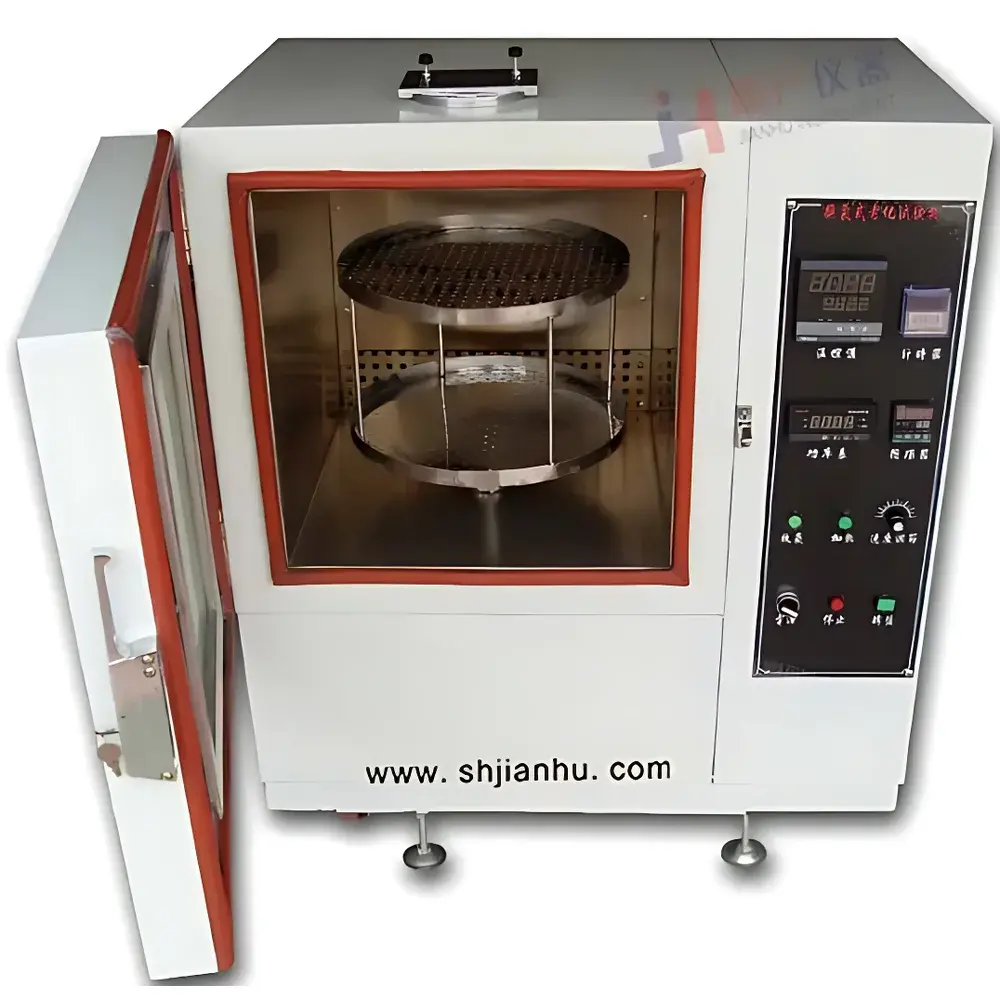
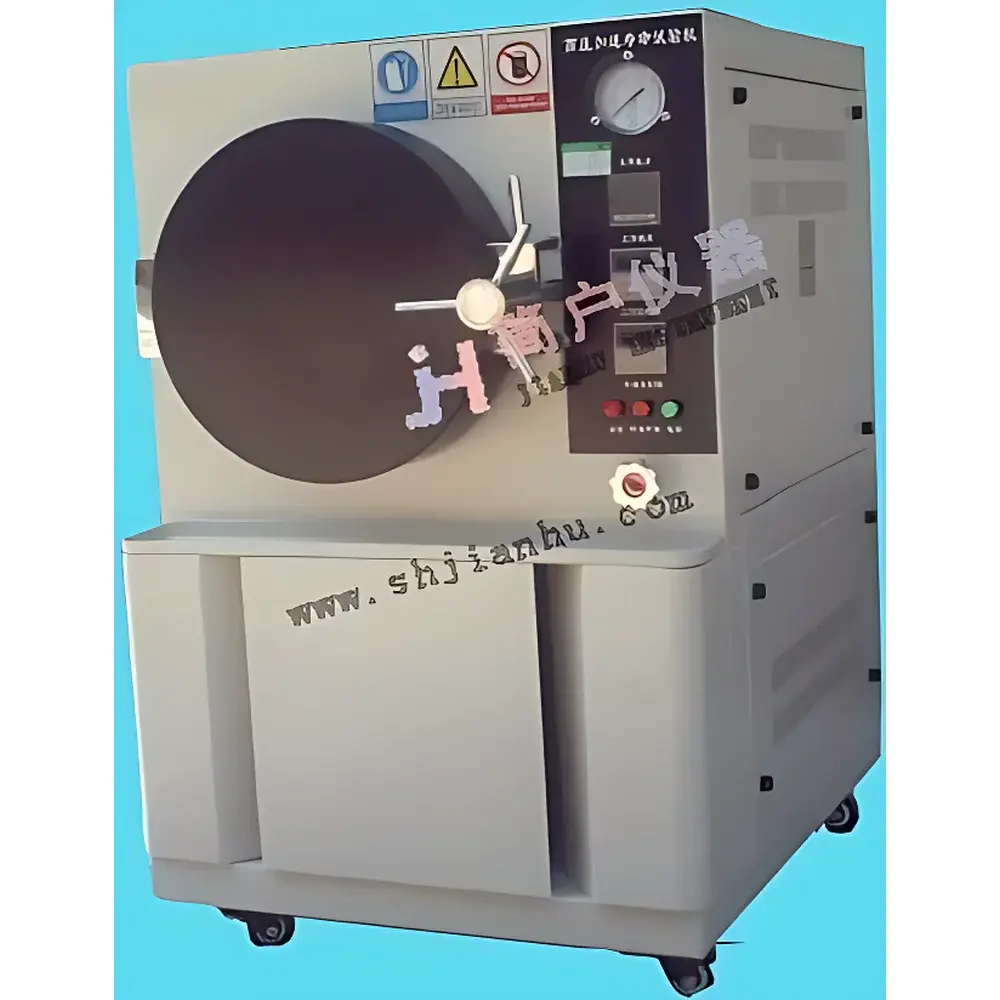
Jianhu PCT-250 / PCT-300 / PCT-400 / PCT-500 / PCT-600 High-Pressure Accelerated Aging Test Chamber
| Brand | Jianhu |
|---|---|
| Origin | Jiangsu, China |
| Model | PCT Series |
| Temperature Range | +100°C to +132°C (saturated steam) |
| Humidity Range | 100% RH (saturated vapor) |
| Pressure Range | 0.5–2.0 kg/cm² (gauge), max safety capacity 3.5 kg/cm² |
| Time Setting Range | 0–999 h |
| Temperature Uniformity | ±2.0°C |
| Control Accuracy | ±0.5°C |
| Resolution | 0.1°C |
| Heating Time (RT → 132°C) | ≤35 min |
| Pressurization Time (0 → 2.0 kg/cm²) | ≤40 min |
| Internal Chamber Shape | Cylindrical |
| Construction Material | Stainless Steel (SUS304) |
| Safety Features | Vacuum pre-purge, auto-pressure release, over-pressure limit cutoff, dry-out cycle, auto-refill system |
| Compliance | ASTM D3574, IEC 60068-2-66, JIS C 0068, ISO 16750-4, MIL-STD-810H, NACE TM0177, UL 746C, CNS 12239 |
Overview
The Jianhu PCT Series High-Pressure Accelerated Aging Test Chambers are engineered for reliability validation of electronic components, encapsulated semiconductor devices, PCB assemblies, and hermetic packaging under accelerated stress conditions. These chambers operate on the principle of saturated steam pressurization—combining elevated temperature, 100% relative humidity, and controlled overpressure to accelerate moisture diffusion into microstructures, thereby simulating years of field exposure in days or weeks. Unlike conventional thermal aging or damp heat testing, PCT leverages the thermodynamic properties of saturated water vapor at subcritical pressures (0.5–2.0 kg/cm² gauge) to drive rapid moisture ingress through material interfaces, dielectric layers, and seal boundaries. This methodology is standardized across major international qualification protocols including JEDEC JESD22-A102, A110, and A118, as well as automotive-grade standards such as ISO 16750-4 and AEC-Q200.
Key Features
- Cylindrical stainless-steel inner chamber (SUS304) with seamless arc-welded construction, designed per ASME BPVC Section VIII Div. 1 guidelines for pressure containment and condensate management.
- Patented self-sealing gasket system: utilizes differential pressure-induced compression—increasing sealing force proportionally with internal pressure—extending gasket service life by up to 3× versus conventional static compression seals.
- Integrated vacuum pre-purge cycle prior to test initiation removes ambient air and particulates (<1 µm filtration), ensuring contaminant-free saturated vapor environment and eliminating oxygen-induced oxidation artifacts.
- Microprocessor-based PID controller with independent real-time monitoring of saturated steam temperature, chamber pressure, and elapsed time; resolution of 0.1°C and ±0.5°C control accuracy.
- Auto-refill water reservoir system maintains uninterrupted test continuity without manual intervention; integrated pressure relief valve ensures fail-safe depressurization at test completion.
- Dry-out mode activates post-test to evacuate residual moisture and prevent condensation-related corrosion or electrical leakage during cooldown.
- Over-pressure protection via dual-stage mechanical limit switch and digital pressure cut-off at 3.5 kg/cm²—exceeding operational range by ≥75% for robust safety margin.
Sample Compatibility & Compliance
The PCT Series accommodates a wide range of sample geometries—from discrete SMD packages (QFN, BGA, SOIC) and wafer-level assemblies to multi-layer ceramic capacitors, MEMS sensors, and automotive ECUs. Internal cylindrical dimensions (e.g., PCT-250: Ø25×30 cm internal; PCT-600: Ø65×70 cm internal) support vertical stacking while minimizing dead volume and thermal stratification. All models comply with internationally recognized reliability testing standards, including but not limited to: ASTM D3574 (foam aging), IEC 60068-2-66 (damp heat, accelerated), JIS C 0068 (humidity resistance), ISO 16750-4 (road vehicles—electrical loads), MIL-STD-810H Method 507.6 (highly accelerated life testing), and NACE TM0177 (sulfide stress cracking). Data logging and event timestamps meet GLP/GMP traceability requirements when paired with optional audit trail software modules.
Software & Data Management
Standard configuration includes an embedded controller with local LCD interface and non-volatile memory for storing up to 100 test profiles and 30 days of time-stamped operational logs (temperature, pressure, duration). Optional RS-485/Modbus RTU or Ethernet TCP/IP communication enables integration into centralized lab management systems (LIMS) or MES platforms. When configured with FDA 21 CFR Part 11-compliant firmware, the system supports electronic signatures, role-based access control, and immutable audit trails—essential for regulated industries including medical device manufacturing and aerospace component qualification. Exportable CSV data files include calibrated sensor readings, alarm events, and system status flags aligned to ISO/IEC 17025 documentation practices.
Applications
- Qualification of plastic-encapsulated microcircuits (PEMs) per MIL-PRF-38535 and JEDEC J-STD-020.
- Failure analysis root cause determination for popcorning, wire bond lift-off, and delamination in flip-chip and stacked-die packages.
- Validation of conformal coating integrity and moisture barrier effectiveness on flex PCBs and hybrid assemblies.
- Accelerated corrosion testing of solder joints, contact plating, and passivation layers under combined thermal-hygro-mechanical stress.
- Reliability screening for EV battery management systems (BMS), ADAS radar modules, and power electronics exposed to high-humidity underhood environments.
- Material compatibility studies for encapsulants, underfills, and molding compounds used in automotive lighting and infotainment units.
FAQ
What is the maximum allowable operating pressure, and how is overpressure protection implemented?
The PCT Series is rated for continuous operation up to 2.0 kg/cm² (gauge), with a certified safety margin of 3.5 kg/cm². Dual redundant protection includes a programmable digital pressure cutoff and a mechanical pressure relief valve calibrated to open at 3.5 kg/cm² ±0.1 kg/cm².
Does the chamber support automated vacuum purging before pressurization?
Yes—each test cycle begins with a vacuum evacuation step (≤100 mbar abs) followed by filtered air reintroduction (<1 µm particulate retention) to eliminate oxygen and contaminants prior to steam generation.
Can test parameters be exported for regulatory submission (e.g., ISO 13485, IATF 16949)?
With optional Part 11-compliant firmware, all logged data—including timestamps, operator IDs, calibration records, and alarm histories—are exportable in tamper-evident CSV format with cryptographic hash verification.
Is the temperature uniformity validated per IEC 60068-3-5?
Yes—temperature distribution is verified annually using NIST-traceable PT-100 probes at nine spatial locations; uniformity remains within ±2.0°C across the working volume at 132°C.
How is water quality managed to prevent scaling or sensor drift?
The system requires deionized water (conductivity <1 µS/cm); built-in level sensors and conductivity monitoring trigger maintenance alerts if feedwater purity falls below specification.
Related Products



