
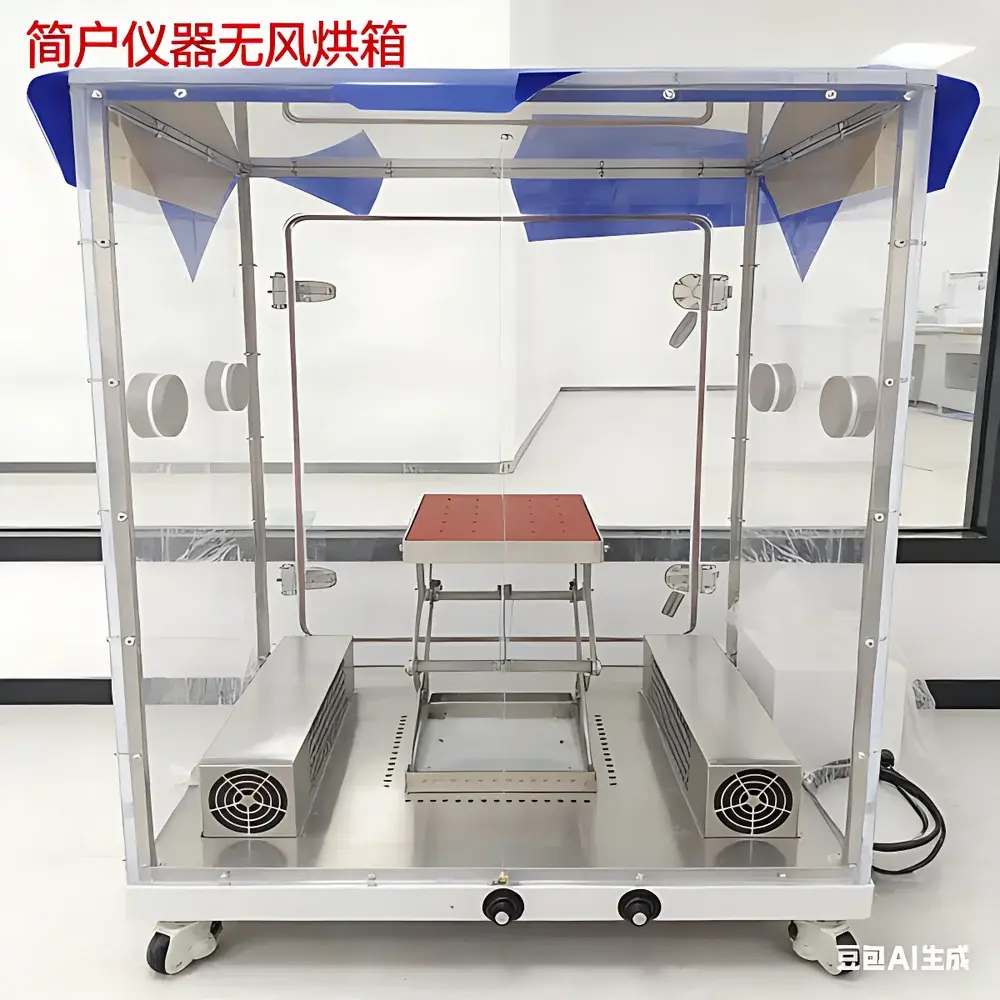
Jianhu TOP-Series Natural Convection Transparent Temperature Chamber
| Brand | Jianhu |
|---|---|
| Origin | Shanghai, China |
| Manufacturer Type | Direct Manufacturer |
| Product Category | Domestic |
| Model | JH-TC-NAT-PRO Series |
| Price Range | USD 900 – 9,000 |
| Instrument Type | Upright |
| Condensation Method | Air-Cooled |
| Temperature Range | 15–45°C |
| Humidity Range | 30–98% RH |
| Temperature Uniformity | ≤ ±2°C |
| Temperature Fluctuation | ±1°C (High Temp), ±2°C (Low Temp) |
| Humidity Uniformity | ≤ ±3% RH |
| Humidity Fluctuation | ±3% RH |
| Heating Rate | 1.0–3.0°C/min |
| Interior Dimensions | Customizable per client specification |
Overview
The Jianhu TOP-Series Natural Convection Transparent Temperature Chamber is an engineered environmental test system designed specifically for applications requiring thermally stable, airflow-free conditions. Unlike forced-air chambers that rely on internal fans to homogenize temperature—introducing convective disturbances that compromise measurement fidelity—this chamber operates exclusively via natural convection. Heat transfer occurs solely through buoyancy-driven air movement, eliminating mechanical turbulence and preserving the intrinsic thermal boundary conditions of sensitive samples. This principle aligns with ISO 16750-4 (road vehicles), JEDEC JESD22-A108 (accelerated moisture resistance), and ASTM E145 (standard specification for gravity-convection and forced-ventilation ovens), where unforced thermal environments are mandated for reliability validation. The chamber’s transparent front panel—constructed from high-strength, low-thermal-conductivity tempered borosilicate glass—enables real-time optical observation without thermal or pressure perturbation, supporting in situ analysis of phase transitions, thermal expansion, delamination, or electrochemical failure modes.
Key Features
- Natural convection architecture: No internal fans or blowers; thermal uniformity achieved via optimized heater/cooler placement, graded thermal mass distribution, and multi-zone passive airflow guidance.
- Optically transparent front chamber: ≥92% visible light transmittance; rated for continuous operation across full temperature range; integrated anti-fog coating and dual-seal frame for humidity integrity.
- Precision climate control: Dual PID-controlled heating/cooling loops with adaptive gain scheduling ensure stable setpoint maintenance under dynamic load conditions.
- Customizable interior geometry: Modular insulation panels and configurable mounting rails support non-standard sample configurations—including oversized battery modules, multi-layer PCB stacks, or optomechanical assemblies.
- Robust thermal insulation: Triple-layer vacuum-insulated walls with aerogel composite core reduce thermal bridging and external ambient influence, achieving ≤0.5°C/h drift during 72-h stability tests.
- Compliance-ready hardware interface: Standard RS-485 (Modbus RTU) and optional Ethernet/IP ports enable seamless integration into GLP/GMP-compliant data acquisition networks.
Sample Compatibility & Compliance
The chamber accommodates a broad spectrum of physically diverse specimens—including semiconductor packages (QFN, BGA, SiC MOSFETs), prismatic and pouch-format lithium-ion battery cells, polymer-based optical components, and microfluidic diagnostic cartridges—without inducing extraneous thermal gradients or mechanical stress. Its natural convection design satisfies critical requirements outlined in IEC 60068-2-1 (cold), IEC 60068-2-2 (dry heat), and USP (pharmaceutical packaging stability). For regulated industries, the system supports audit-ready operation: event logs record all setpoint changes, alarm triggers, and calibration interventions with timestamped, user-identifiable entries compliant with FDA 21 CFR Part 11 Annex 11 principles. Optional IQ/OQ documentation packages are available for qualification under GMP or ISO/IEC 17025 laboratory accreditation frameworks.
Software & Data Management
Jianhu’s proprietary ChamberControl™ software provides deterministic, deterministic real-time monitoring and closed-loop control via Windows-based host PC or embedded touchscreen HMI. The platform records temperature/humidity profiles at ≤1-second intervals, stores raw sensor data (Pt100 RTDs, capacitive RH sensors) with NIST-traceable calibration metadata, and exports CSV/Excel-compatible reports aligned with ASTM E29 (significant digits) and ISO/IEC 17025 clause 7.7 (data integrity). Audit trails include operator ID, action type, timestamp, and pre/post-value deltas—fully searchable and exportable for regulatory review. Remote access is enabled via TLS 1.2-secured HTTPS, supporting secure off-site oversight without compromising local network security policies.
Applications
- Semiconductor reliability testing: High-temperature operating life (HTOL), early-life failure screening (ELF), and thermal impedance mapping (e.g., junction-to-case Rth) using T3Ster-compatible interfaces.
- Battery thermal management validation: Passive thermal runaway propagation studies, electrolyte volatility assessment, and separator shrinkage kinetics under controlled RH.
- Optical material characterization: Refractive index drift vs. temperature, lens focal shift quantification, and anti-reflective coating durability under cyclic humidity exposure.
- Pharmaceutical packaging stability: Accelerated aging per ICH Q1A(R2), including moisture permeation rate (MPR) evaluation of blister foil laminates.
- Advanced materials R&D: Polymer crystallinity evolution, shape-memory alloy recovery behavior, and ceramic matrix composite microcrack initiation thresholds.
FAQ
Does this chamber meet ISO/IEC 17025 calibration traceability requirements?
Yes—each unit ships with factory calibration certificates referencing NIST-traceable standards; on-site recalibration services include uncertainty budgets per ISO/IEC 17025 clause 6.4.
Can the chamber operate continuously at 45°C and 98% RH without condensation on optical surfaces?
Yes—the double-glazed observation window incorporates active edge heating and dew-point monitoring to prevent surface condensation across the full operational envelope.
Is non-standard interior dimension customization subject to extended lead time or NRE charges?
Standard customization (up to ±30% volume change) incurs no NRE fee; lead time extends by 5–7 business days. Complex geometries (e.g., asymmetric partitions, integrated gas purge manifolds) require engineering review.
How is thermal uniformity validated across the working volume?
Per IEC 60068-3-5, 9-point sensor mapping is performed at three vertical levels (top/mid/bottom) at 25°C, 40°C, and 45°C; final uniformity report is included with delivery documentation.
Does the system support automated test sequencing for multi-step environmental profiles?
Yes—ChamberControl™ includes scriptable profile engines supporting up to 99 segments with conditional branching, dwell logic, and external trigger inputs (e.g., from power analyzers or DAQ systems).



