
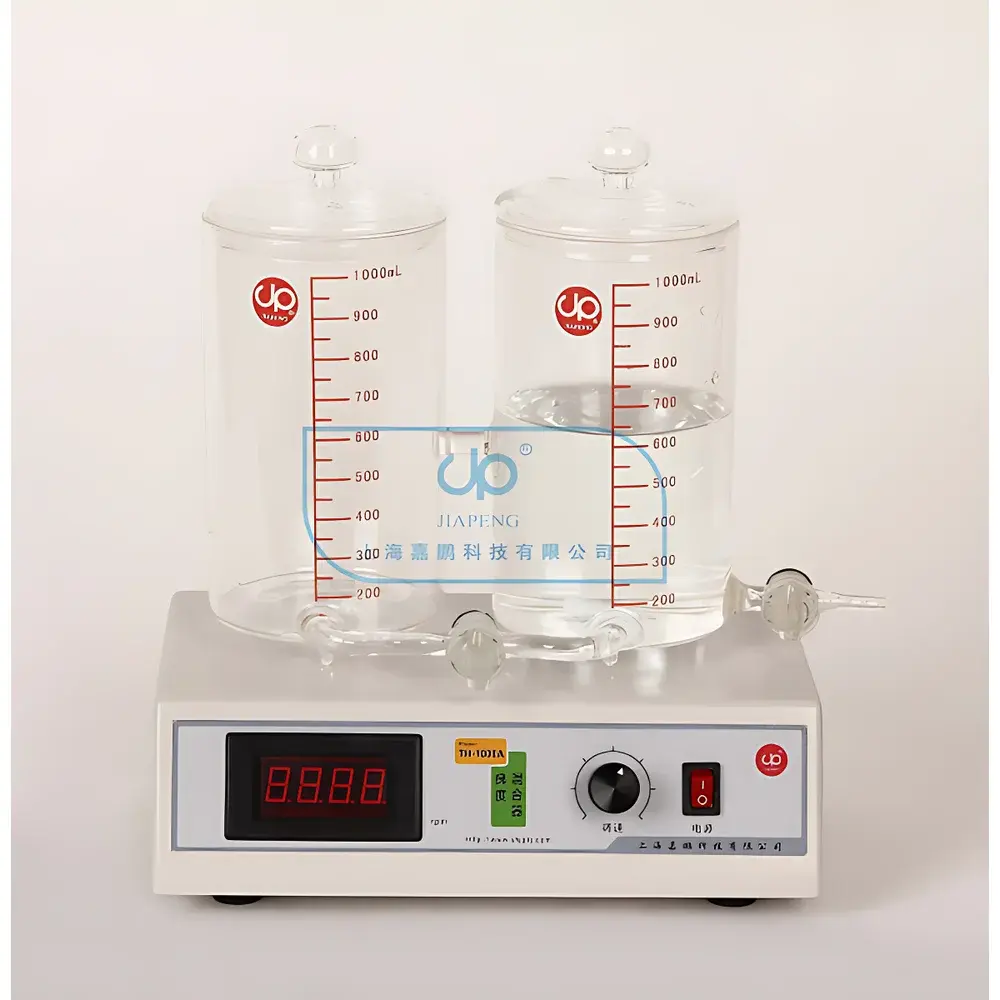
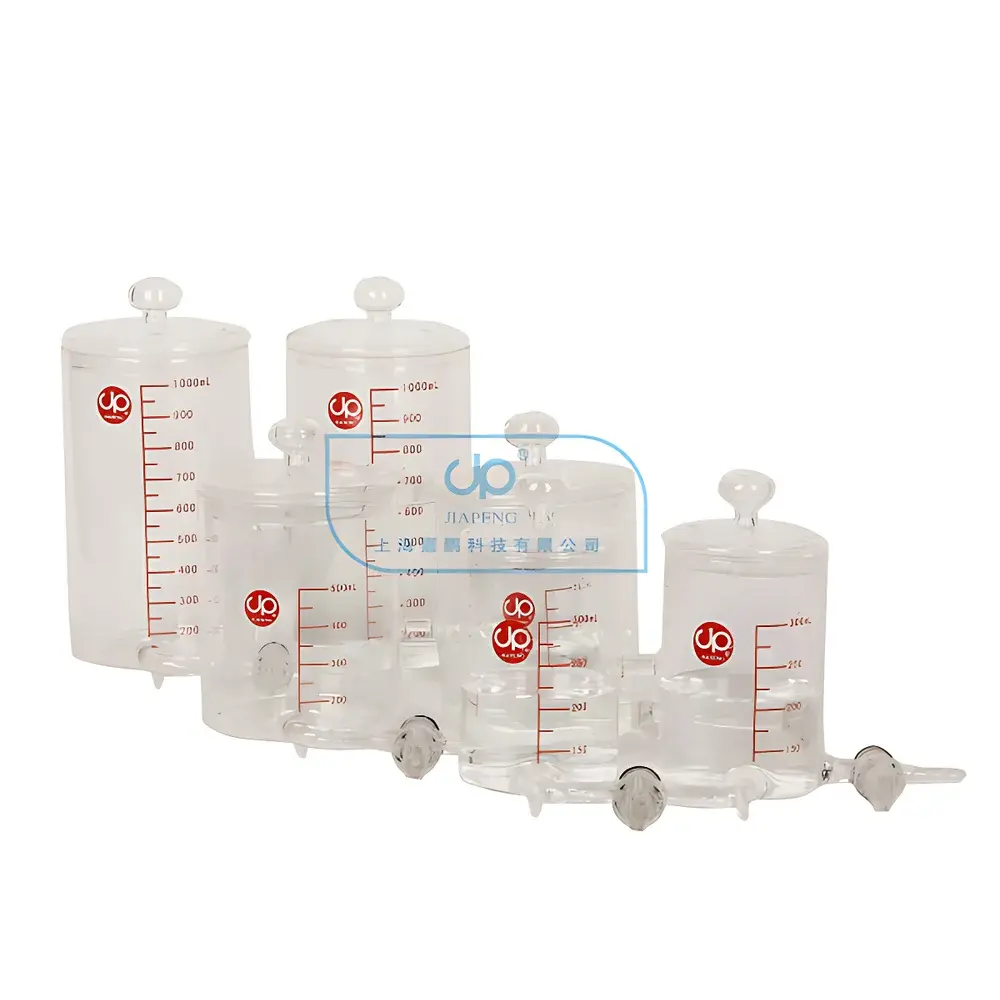
Jiapeng TH-1000A Gradient Mixer
| Brand | Jiapeng |
|---|---|
| Model | TH-1000A |
| Gradient Volume Capacity | 2000 mL |
| Gradient Profile Type | Linear |
| Solvent Compatibility | Organic Solvent–Resistant Construction |
| Display | LED Digital Speed Indicator |
| Power Supply | AC 220 V, 50/60 Hz |
| Dimensions (L×W×H) | 270 × 170 × 90 mm |
| Net Weight | 1.2 kg |
| Application Class | Laboratory Gradient Generation System for Chromatography & Fractionation |
| Instrument Type | Magnetic Stirrer–Integrated Gradient Mixer |
| Maximum Stirring Volume (as stirrer mode) | 1000 mL |
Overview
The Jiapeng TH-1000A Gradient Mixer is an electromechanically controlled laboratory instrument engineered for precise, reproducible generation of linear solvent concentration gradients in analytical and preparative separation workflows. Operating on the principle of dual-reservoir proportional flow control, it enables continuous, time-synchronized mixing of two immiscible or miscible solutions—typically a stock (“concentrated”) solution and a diluent—through synchronized peristaltic or gravity-fed delivery into a common output stream. Unlike fixed-ratio mixers, the TH-1000A maintains dynamic equilibrium between reservoir levels during operation, ensuring constant volumetric flow rates and stable gradient slope over time. Its design supports applications requiring high chemical resistance, including reversed-phase HPLC method development, column equilibration, protein purification buffer exchange, and gradient elution in open-column chromatography. The device does not incorporate active temperature regulation or rotational speed feedback control; its mixing function is decoupled from thermal management, distinguishing it from thermostatted magnetic stirrers or programmable gradient pumps.
Key Features
- 2000 mL total gradient capacity—optimized for medium-scale preparative separations and multi-hour gradient runs without manual intervention
- Linear gradient profile generation with adjustable slope via calibrated flow rate controls; no software programming required
- Chemically inert fluid pathway construction—validated compatibility with common organic solvents including acetonitrile, methanol, chloroform, and ethyl acetate
- Integrated LED digital display showing real-time mixing speed (RPM equivalent), enabling visual confirmation of operational status and repeatability across experiments
- Dual-mode functionality: operates as a standalone gradient mixer or as a magnetic stirrer (when used with a sealed magnetic stirring bar placed in either reservoir vessel)
- Compact benchtop footprint (270 × 170 × 90 mm) and lightweight chassis (1.2 kg) facilitate integration into fume hoods, glove boxes, or mobile lab setups
- No internal microprocessor or firmware—designed for mechanical reliability, minimal maintenance, and long-term stability under routine lab conditions
Sample Compatibility & Compliance
The TH-1000A is intended for use with aqueous and organic liquid phases commonly employed in chromatographic and extraction protocols. Reservoir vessels are compatible with standard glass or PTFE-lined containers (not supplied). It meets general safety requirements for Class I laboratory electrical equipment per IEC 61010-1:2010. While not certified to ISO/IEC 17025 or FDA 21 CFR Part 11, its mechanical simplicity ensures traceability of gradient parameters through operator-recorded settings and timed flow calibration. For GLP/GMP environments, users are advised to document initial reservoir volumes, flow rate settings, and elapsed run time as part of raw data records. No regulatory certification is claimed for medical device, in vitro diagnostic, or pharmaceutical manufacturing use.
Software & Data Management
The TH-1000A operates without embedded software, firmware, or digital connectivity. All parameter adjustments—including flow balance, output rate, and gradient initiation—are performed manually via front-panel knobs and verified visually using the LED digital indicator. This architecture eliminates cybersecurity risks, software validation burdens, and version-control dependencies. Data integrity relies on procedural documentation: users must log initial volumes, observed mixing speed, ambient temperature, and elapsed time in laboratory notebooks or LIMS-integrated electronic records. For laboratories requiring audit trails, integration with external flow meters or timed video capture is recommended to support retrospective verification of gradient fidelity.
Applications
- HPLC and flash chromatography method scouting—rapid screening of eluent strength gradients for compound resolution optimization
- Size-exclusion or ion-exchange column conditioning where stepwise or linear buffer composition changes are required
- Extraction protocol development involving pH-controlled or polarity-gradient solvent systems
- Educational demonstrations of mass transfer kinetics, diffusion-limited mixing, and solvent front propagation
- Preparative natural product isolation workflows where reproducible fraction collection depends on consistent gradient shape
- Buffer exchange in protein sample preparation prior to electrophoresis or mass spectrometry analysis
FAQ
Can the TH-1000A generate nonlinear (e.g., concave or convex) gradients?
No—the device is mechanically constrained to linear gradient profiles only. Nonlinear gradients require external flow controllers or programmable pump systems.
Is the unit compatible with corrosive acids or strong bases?
It is rated for organic solvents and neutral aqueous solutions. Prolonged exposure to concentrated mineral acids, alkalis, or oxidizers may degrade seals and housing materials; consult material compatibility charts before use.
Does the TH-1000A include a built-in timer or automatic shut-off?
No—timing and endpoint determination are manual responsibilities of the operator.
Can it be used with syringe pumps or HPLC systems?
Yes—as a passive gradient generator upstream of a pump or injector, provided backpressure remains below 0.5 bar and tubing connections are leak-tight.
What calibration standards are recommended for verifying gradient accuracy?
Users should perform volumetric flow calibration using graduated cylinders and stopwatch measurements at multiple speed settings; refractive index or conductivity monitoring of mixed streams provides secondary verification.



