
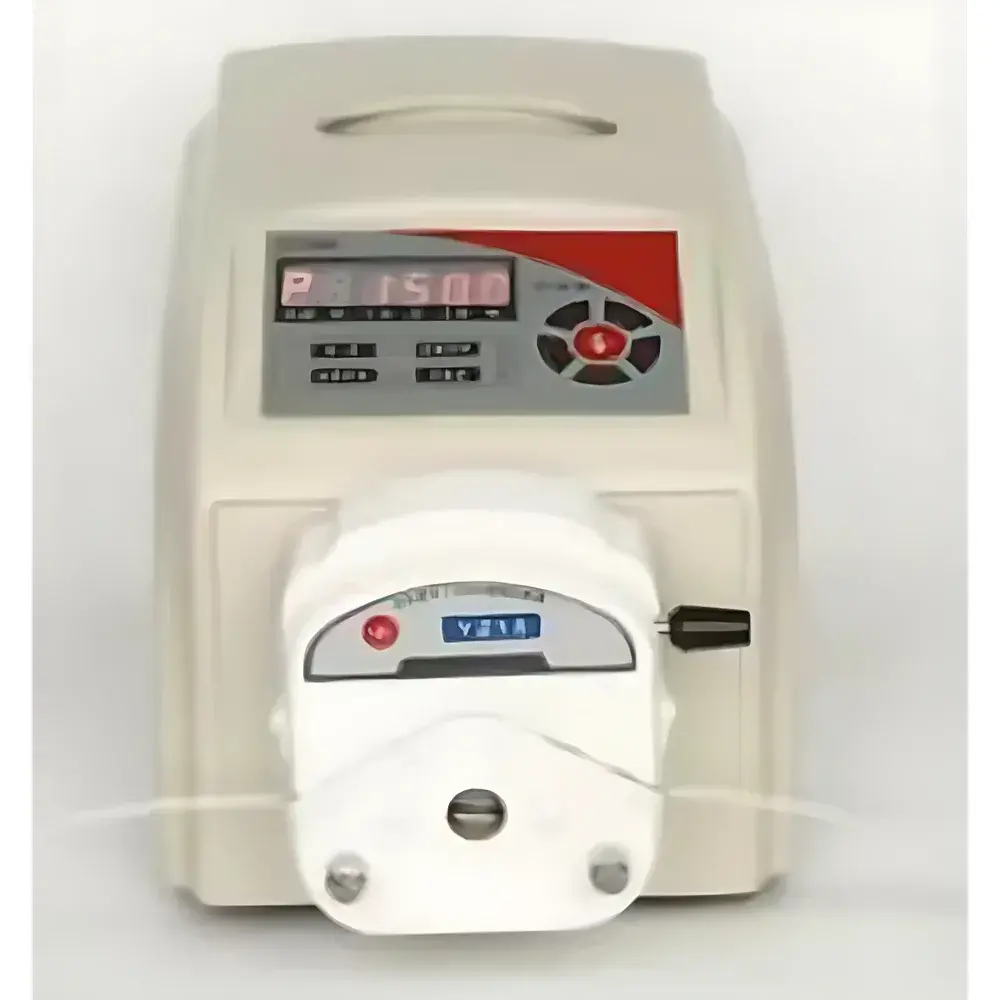
Jiapeng BT-100SD Precision Peristaltic Pump
| Brand | Jiapeng |
|---|---|
| Origin | Shanghai, China |
| Model | BT-100SD |
| Pump Head Type | YZ15 |
| Flow Rate Range | 1–14,500 mL/h |
| Speed Range | 0.1–150 rpm (adjustable in 0.1 rpm increments) |
| Pressure Rating | ≥3 kg/cm² |
| Tube Compatibility | Ø1×4 mm, Ø3×6 mm, Ø4.5×7 mm |
| Flow Accuracy | ±1% |
| Display | 4.5-inch HD capacitive touchscreen with real-time flow/speed/status visualization |
| Control Interface | USB port for PC software control |
| Timing Functions | Run timer (1 s–9 h 59 min 59 s), Sleep timer (1 s–9 h 59 min 59 s), Fill/Empty mode |
| Calibration Function | User-accessible flow calibration routine |
| Housing Material | Titanium-alloy core with 316 stainless steel rollers |
| Power Supply | AC 220 V, 50/60 Hz |
| Dimensions (W×D×H) | 330 × 170 × 170 mm |
| Weight | 3.56 kg |
Overview
The Jiapeng BT-100SD Precision Peristaltic Pump is an engineered solution for reproducible, pulse-minimized fluid delivery in analytical and preparative laboratory workflows. Based on the peristaltic principle—where rollers compress flexible tubing to displace fluid without contacting the medium—the BT-100SD delivers contamination-free, low-shear transfer ideal for sensitive biological samples, reagents, and chromatographic mobile phases. Designed for integration into liquid chromatography systems—including nucleic acid/protein detection units and automated fraction collectors—the pump supports both continuous flow and precisely timed dispensing operations. Its microstepping motor drive (256-step subdivision) ensures smooth rotational motion, minimizing flow pulsation and mechanical noise while maintaining high positional repeatability across extended operation cycles.
Key Features
- 4.5-inch high-resolution capacitive touchscreen interface with intuitive Chinese-language UI, displaying real-time flow rate (mL/h), rotational speed (rpm), direction status, and operational mode.
- High-precision stepper motor with 0.1 rpm resolution and bidirectional rotation capability—enabling reversal for system priming, backflushing, or sample recovery.
- Titanium-alloy chassis and 316 stainless steel rollers ensure long-term dimensional stability and corrosion resistance when handling aqueous buffers, organic solvents, and mildly aggressive reagents.
- Integrated USB interface allows full remote control via Windows-based configuration software, supporting script-driven sequencing, parameter logging, and firmware updates.
- Onboard memory retains all active settings—including speed, direction, timer values, and calibration offsets—after power cycling, eliminating manual reconfiguration between sessions.
- Dedicated “Full-Speed” key enables rapid tube priming, line purging, or reservoir emptying without navigating menus.
- User-accessible flow calibration function permits correction of volumetric output against gravimetric or volumetric standards, improving long-term accuracy to ±1% across the full 1–14,500 mL/h range.
Sample Compatibility & Compliance
The BT-100SD accommodates a broad spectrum of standard peristaltic tubing sizes—including inner diameters of 1.0 mm (Ø1×4 mm), 3.0 mm (Ø3×6 mm), and 4.5 mm (Ø4.5×7 mm)—ensuring compatibility with Tygon®, PharMed®, and Norprene® formulations commonly used in GLP-compliant labs. Its pressure rating of ≥3 kg/cm² (≈294 kPa) supports operation in moderate-backpressure environments typical of inline filters, narrow-bore columns, or multi-port valve manifolds. While not certified to IEC 61000-6-2/6-3 or UL 61010-1 out-of-the-box, the device meets fundamental electrical safety requirements for Class I laboratory equipment operating at 220 V AC. When deployed within validated chromatography workflows, it supports audit trails when paired with compliant data acquisition software adhering to FDA 21 CFR Part 11 principles (e.g., electronic signatures, change tracking, and secure storage).
Software & Data Management
The BT-100SD communicates via virtual COM port over USB 2.0, enabling seamless integration with third-party lab automation platforms (e.g., LabVIEW, Python PySerial, or MATLAB). The native Windows application provides synchronized control of run duration, sleep intervals, and directional toggling—critical for unattended overnight fraction collection. All timer parameters (run time: 1 s–9 h 59 min 59 s; sleep time: same range) are stored with millisecond resolution and persist through firmware resets. Flow calibration coefficients are saved non-volatilely and applied automatically during subsequent operation. Exportable log files include timestamped entries for speed, direction, elapsed runtime, and error flags—facilitating traceability in QA/QC documentation and method validation reports.
Applications
- Automated fraction collection in gel filtration, ion exchange, and affinity chromatography setups.
- Controlled reagent addition in kinetic assays, enzymatic reaction monitoring, and titration systems.
- Continuous sampling for online UV-Vis or conductivity detectors coupled with HPLC or FPLC instruments.
- Media perfusion in cell culture bioreactors requiring low-shear, sterile fluid transfer.
- Calibration fluid delivery in metrology labs performing volumetric verification of pipettes and burettes.
- Process development support for pharmaceutical downstream purification, including buffer exchange and pool dilution steps.
FAQ
What tubing sizes are officially supported by the YZ15 pump head?
The YZ15 head is mechanically optimized for tubing with outer diameters of 4 mm, 6 mm, and 7 mm—corresponding to nominal inner diameters of 1.0 mm, 3.0 mm, and 4.5 mm respectively. Standardized designations include #13, #14, #16, #17, #18, #19, and #25 per USP Class VI tubing nomenclature.
Does the BT-100SD support external TTL or analog triggering?
No. The device lacks dedicated digital I/O or 0–10 V analog input ports. Synchronization with external hardware (e.g., fraction collectors) is achieved exclusively via its USB-hosted command protocol or optional relay-controlled start/stop signals enabled through firmware configuration.
Can flow accuracy be improved beyond ±1%?
Yes—by performing regular gravimetric calibration using NIST-traceable balances and certified volumetric flasks, users can refine the internal flow coefficient table. Accuracy improvements to ±0.5% are achievable under controlled temperature and viscosity conditions (e.g., water at 20 °C).
Is the touchscreen interface compatible with glove use in biosafety cabinets?
The capacitive screen requires direct skin contact or specialized conductive styluses; standard nitrile or latex gloves will not register input. For cabinet-integrated installations, remote USB control from an adjacent workstation is recommended.
What maintenance intervals are recommended for roller and tubing replacement?
Under continuous operation at ≤100 rpm with silicone tubing, rollers typically require inspection every 6 months. Tubing lifespan varies significantly with chemical compatibility and pressure load—users should replace tubing upon visible flattening, cracking, or flow deviation exceeding ±2%.



