
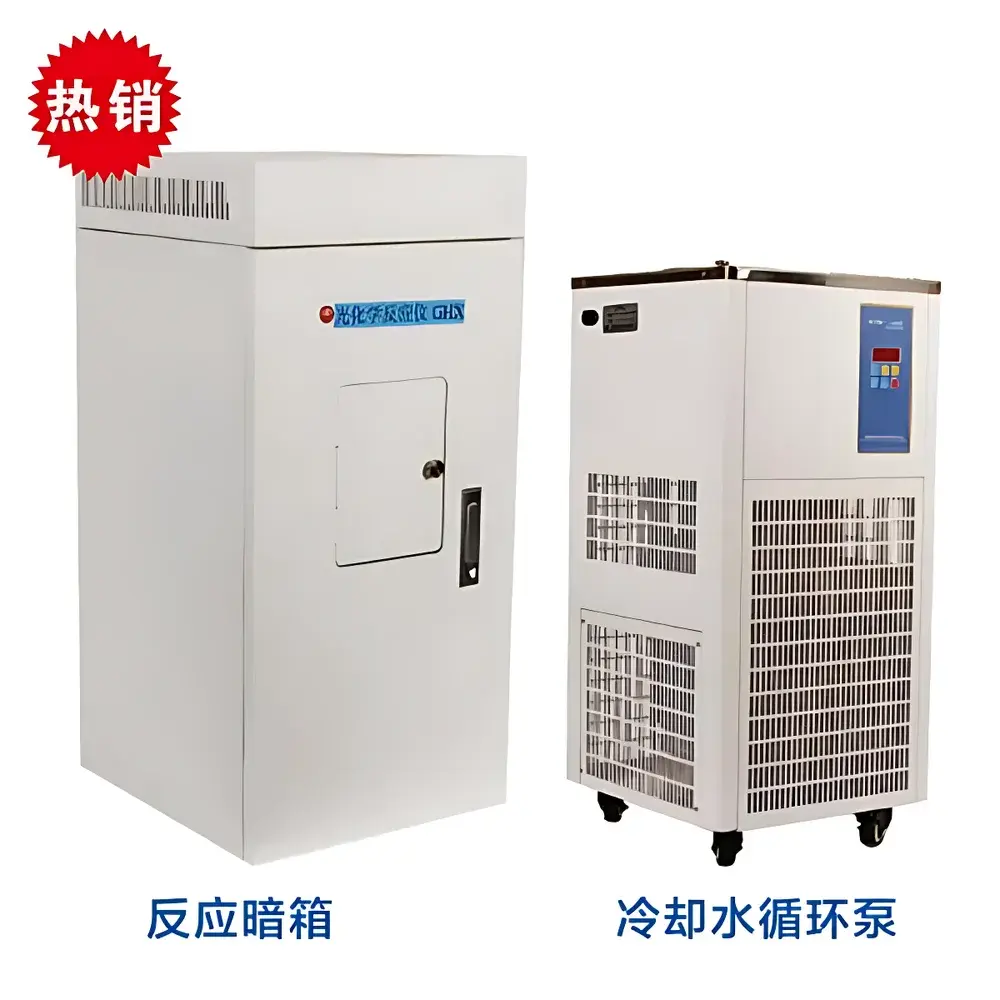
Jiapeng GHX-V Photochemical Reactor
| Brand | Jiapeng |
|---|---|
| Origin | Shanghai, China |
| Model | GHX-V |
| Light Source Type | Mercury Lamp |
| Irradiation Mode | Internal Illumination |
| Power Control Range | 100–1200 W (continuously adjustable) |
| Lamp Options | 300/500/1000 W Mercury Lamp (selectable), 300/500/1000 W Xenon Lamp (selectable), 500 W Metal Halide Lamp |
| Sample Capacity | 8 parallel positions |
| Quartz Tube Volume | 30 mL or 50 mL (customizable) |
| Quartz Cold Finger | Φ70 × 380 mm |
| Reaction Vessel Options | 250 / 500 / 1000 / 2000 / 3000 mL |
| Filter Wheel | 16-position, dual 8-slot filter holder |
| Filter Transmission Geometry | Perpendicular incidence |
| Stirring Speed (per tube) | 0–1800 rpm (stepless) |
| Rotation Period per Tube | 0–9999 s (stepless) |
| Magnetic Stirrer Temp. Range | Ambient to 300 °C |
| Timer Range | Up to 999 min |
| Cryogenic Circulator | Cooling Capacity >1000 W, Temp. Control Range: −20 to 100 °C |
Overview
The Jiapeng GHX-V Photochemical Reactor is an engineered platform for controlled, reproducible photochemical experimentation under ultraviolet (UV) and near-visible irradiation. It operates on the principle of homogeneous or heterogeneous photocatalysis—where photon absorption by a photosensitizer (e.g., TiO₂) or direct substrate excitation initiates bond cleavage, radical formation, or redox transformations. Designed for laboratory-scale mechanistic studies, the GHX-V supports quantitative analysis of reaction kinetics, quantum yield determination, and transient species trapping via in situ or offline sampling. Its modular architecture accommodates both static and dynamic reaction configurations—including gas-phase photolysis, liquid-phase batch reactions, and slurry-based photocatalytic degradation—making it suitable for fundamental photochemistry, environmental remediation research (e.g., pollutant mineralization), and synthetic photochemistry workflows.
Key Features
- Integrated eight-position rotating reaction station (BSZ-8) enabling dual-axis motion: individual magnetic stirring per tube combined with orbital rotation around a central lamp axis—ensuring uniform photon flux distribution across all samples.
- Modular light source compatibility: supports interchangeable mercury, xenon, and metal halide lamps (300–1000 W), each with continuous power regulation (100–1200 W total system range) and real-time current/voltage monitoring via front-panel digital meters.
- Optically optimized dark chamber with radiation-shielded interior lining, sliding UV-blocking shutter, hinged observation window, and dedicated ventilation and coolant routing ports.
- Dual-stage thermal management: high-transmission fused quartz cold finger (Φ70 × 380 mm) coupled with an external low-temperature circulating chiller (−20 to 100 °C, >1000 W cooling capacity) for precise isothermal control during exothermic or temperature-sensitive photoreactions.
- Programmable microprocessor controller with stepwise timing, adjustable stir speed (0–1800 rpm), and independent rotation period setting (0–9999 s per tube); large LCD interface displays operational parameters and status icons.
- Standardized optical filtration system: two 8-slot filter holders accommodating up to 16 certified interference or bandpass filters (including UVC, UVB, UVA, and visible-range options), mounted for perpendicular beam incidence to minimize angular deviation and spectral distortion.
Sample Compatibility & Compliance
The GHX-V accepts standard quartz reaction tubes (30 mL or 50 mL) and larger jacketed vessels (250–3000 mL), compatible with aqueous, organic, and biphasic media. Its design conforms to general laboratory safety standards for UV containment (IEC 62471 photobiological safety classification) and electrical operation (GB/T 18268.1). While not pre-certified for GMP or GLP environments, the system supports traceable experimental conditions required for method validation under ISO/IEC 17025-compliant laboratories. All quartz components meet ASTM F796 specifications for high-purity fused silica transmission (>90% from 190–2500 nm). The absence of proprietary software lock-in allows integration into LIMS or ELN platforms via RS232/USB interfaces for audit-ready data logging.
Software & Data Management
The GHX-V operates via embedded firmware without cloud dependency or vendor-specific drivers. All operational parameters—including lamp power setpoint, stir speed, rotation interval, timer duration, and temperature setpoint—are locally stored and recalled per user profile. Real-time analog outputs (0–5 V) are available for external DAQ systems to record voltage/current waveforms, correlating lamp aging or thermal drift with kinetic data. Optional Python-compatible API enables automated sequence execution (e.g., multi-wavelength screening with filter wheel indexing) and timestamp-synchronized acquisition when paired with spectrophotometers or GC-MS systems. No FDA 21 CFR Part 11 compliance is natively implemented; however, full parameter logs can be exported as CSV for manual audit trail reconstruction.
Applications
- Quantitative photocatalytic degradation kinetics of organic contaminants (e.g., dyes, pharmaceuticals, endocrine disruptors) using TiO₂ or g-C₃N₄ under simulated solar or monochromatic UV irradiation.
- Determination of actinometric quantum yields via chemical actinometry (e.g., potassium ferrioxalate or Aberchrome 540) across defined wavelength bands.
- Photoinduced C–H activation, [2+2] cycloadditions, and metallaphotoredox catalysis under inert or controlled-atmosphere conditions (N₂, O₂, Ar).
- Time-resolved radical trapping experiments using spin traps (e.g., DMPO, TEMPO) followed by EPR or LC-MS analysis.
- Photostability assessment of APIs and cosmetic ingredients per ICH Q1B guidelines using controlled UV exposure profiles.
FAQ
What lamp types are supported, and can they be changed without tools?
The GHX-V accepts mercury, xenon, and metal halide lamps via standardized socket interfaces. Lamp replacement requires only basic hand tools (included) and adherence to quartz handling protocols to avoid surface contamination.
Is the rotation speed synchronized across all eight positions?
No—each reaction tube rotates independently at user-defined intervals (0–9999 s per revolution), allowing differential irradiation dosing within a single run.
Can the system operate under inert atmosphere?
Yes—reaction vessels may be sealed with septa or fitted with gas inlet/outlet ports; the dark chamber includes dedicated tubing pass-throughs for purge gas lines.
Are calibration certificates provided for optical output?
Factory calibration of electrical input (W) and radiometric output (mW/cm²) is not included; users are advised to perform in situ radiometric calibration using NIST-traceable UV sensors prior to quantitative work.
Does the chiller unit integrate directly with the reactor’s temperature feedback loop?
The external cryogenic circulator operates in open-loop mode; temperature setpoint is manually adjusted based on internal probe readings—closed-loop PID control is not implemented in the base configuration.




