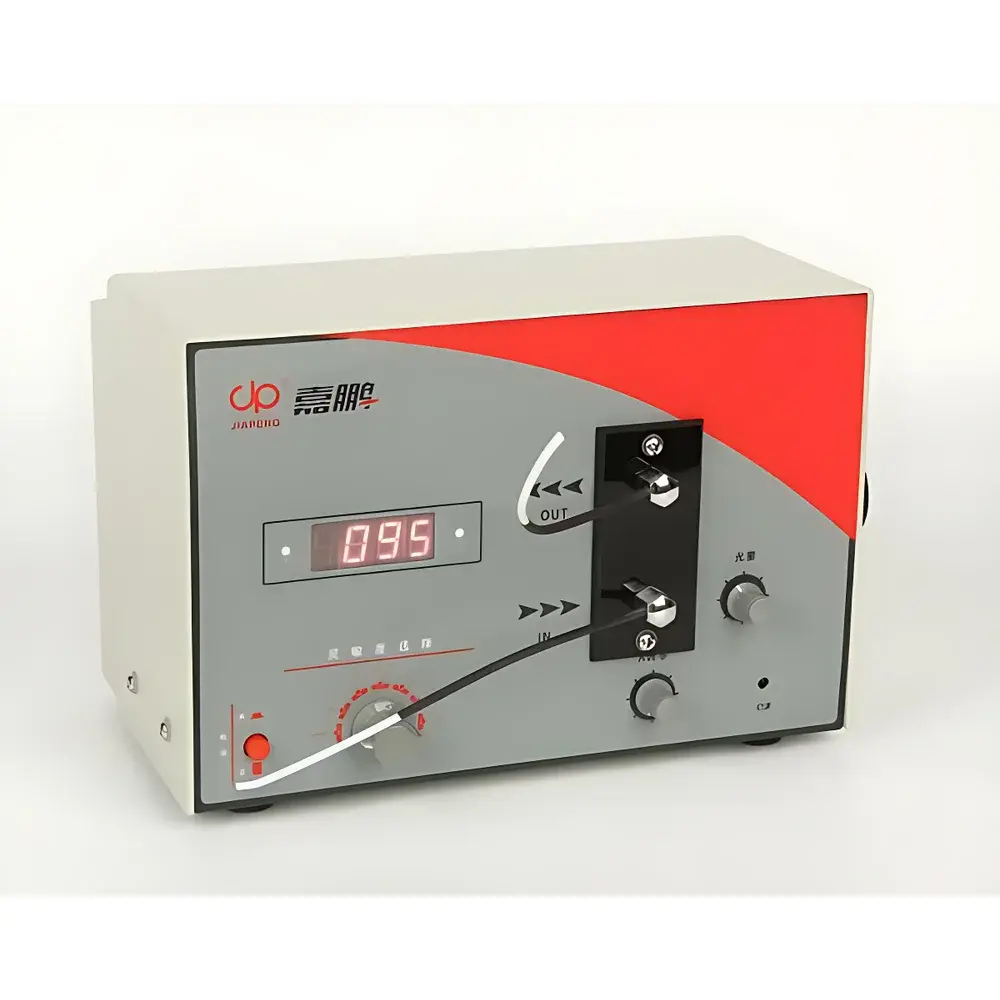
Jiapeng HD-97-1 UV Detector
| Brand | Jiapeng |
|---|---|
| Origin | Shanghai, China |
| Model | HD-97-1 |
| Detection Wavelengths | 220 nm, 254 nm, 280 nm, 340 nm |
| Flow Cell | 100 µL volume, 3 mm path length |
| Absorbance Range | 0.05 A to 2 A (7 ranges) |
| Wavelength Accuracy | ±1 nm |
| Compatibility | GE/AKTA-compatible column interfaces |
| Purification Principle | Ion Exchange Chromatography (IEX) |
| Gradient Type | Linear |
| Display | LED, triple-channel OD readout (A₂₂₀, A₂₅₄, A₂₈₀) |
Overview
The Jiapeng HD-97-1 UV Detector is a benchtop absorbance-based analytical instrument engineered for real-time monitoring of biomolecular elution profiles during liquid chromatography purification workflows. It operates on the principle of ultraviolet–visible (UV-Vis) spectrophotometry, measuring optical density (OD) at discrete, fixed wavelengths—220 nm (peptide bond backbone), 254 nm (nucleic acid aromatic bases), 280 nm (aromatic amino acids: Trp, Tyr, Phe), and 340 nm (background reference or solvent correction)—to enable selective quantification of proteins, nucleic acids, enzymes, and peptides in flowing eluate streams. Designed for integration into low-to-medium pressure chromatography systems—including ion exchange (IEX), gel filtration (SEC), and hydrophobic interaction (HIC) setups—the HD-97-1 delivers stable baseline performance with minimal drift, supporting reproducible detection down to 48 µg/mL for standard proteins under defined flow conditions. Its 3 mm path length, 100 µL flow cell provides optimal signal-to-noise ratio for routine lab-scale purification while maintaining compatibility with common column hardware via standardized GE/AKTA-style fittings.
Key Features
- Fixed-wavelength UV detection at four biologically relevant wavelengths: 220 nm, 254 nm, 280 nm, and 340 nm—enabling simultaneous dual- or triple-wavelength monitoring for differential quantification and baseline correction.
- Triple-channel LED display showing real-time absorbance values (A220, A254, A280) without external software; eliminates latency in method optimization during column development.
- Seven-step absorbance range selection (0.05 A to 2 A) with automatic zeroing and gain adjustment—ensuring linear response across dilute and concentrated fractions.
- Optimized flow cell design: 3 mm optical path length, 100 µL internal volume—engineered for low dispersion, rapid equilibration, and minimal hold-up volume to preserve chromatographic resolution.
- Stable solid-state UV source with uniform spectral output and <5 min baseline stabilization time—reducing downtime between runs and improving throughput consistency.
- Native mechanical and electrical interface compatibility with peristaltic and piston-driven pumps (flow range: 0.5–900 mL/h or 1–14,500 mL/h), as well as fraction collectors and chart recorders.
Sample Compatibility & Compliance
The HD-97-1 supports aqueous and organic-aqueous mobile phases commonly used in protein and nucleic acid purification, including buffers containing up to 50% acetonitrile or 20% methanol. It is routinely deployed in academic core facilities and industrial R&D labs for method scouting, process development, and QC release testing of purified biologics. While not certified to ISO/IEC 17025 or FDA 21 CFR Part 11 out-of-the-box, its analog output (0–1 V or 0–5 V) and TTL-compatible trigger signals permit integration into validated chromatography data systems (CDS) that support audit trails, electronic signatures, and GLP/GMP-compliant reporting. The instrument conforms to IEC 61010-1 safety standards for laboratory electrical equipment and meets CE marking requirements for electromagnetic compatibility (EMC) and low-voltage directive compliance.
Software & Data Management
The HD-97-1 operates as a standalone detector with no embedded firmware-based data storage. Raw analog absorbance outputs are intended for acquisition by external devices—including chart recorders, analog-to-digital converters (ADCs), or third-party chromatography software platforms such as Unicorn (Cytiva), Chromeleon (Thermo Fisher), or open-source tools like OpenChrom or LabChart. For full traceability, users are advised to configure their CDS to log timestamped A-value streams from all three channels alongside pump pressure, fraction collector triggers, and system temperature. Optional RS-232 or USB-to-serial adapters (user-supplied) enable ASCII-based command-response communication for basic remote control (e.g., wavelength selection, range switching) in custom Python or LabVIEW environments.
Applications
- Real-time monitoring of protein elution during IEX purification—identifying peak symmetry, pooling windows, and carryover between runs.
- Quantitative assessment of nucleic acid yield and purity (A260/A280 and A260/A230 ratios inferred via dual-wavelength correlation).
- Method development for monoclonal antibody (mAb) purification workflows, including capture, intermediate, and polishing steps.
- Verification of enzyme activity fractions post-chromatography by coupling UV traces with downstream functional assays.
- Educational use in undergraduate biochemistry and molecular biology laboratories for teaching chromatographic theory, Beer–Lambert law application, and biomolecule separation principles.
FAQ
Does the HD-97-1 support variable wavelength scanning or spectral acquisition?
No. It is a fixed-wavelength detector optimized for discrete, high-stability OD measurement—not a scanning spectrophotometer.
Can the flow cell be replaced with a micro-volume or capillary variant?
Yes. Alternate flow cells (e.g., 20 µL, 1 mm path) are available as optional accessories but require recalibration and may affect linearity at higher absorbance ranges.
Is the detector compatible with HPLC or UHPLC systems?
It is designed for low-pressure FPLC and gravity-fed or peristaltic-pump systems (≤5 bar). Direct integration with high-pressure HPLC/UHPLC requires an external pressure regulator and pulse dampener.
What is the typical warm-up time required before stable baseline operation?
Under ambient lab conditions (20–25°C), baseline stabilization is achieved within 4–6 minutes after power-on, verified by ≤0.002 A/h drift over 30 minutes.
How is wavelength accuracy validated and maintained?
Wavelength calibration is factory-set using NIST-traceable holmium oxide and didymium filters; end-users should perform annual verification using certified reference standards per ISO 17025-aligned internal procedures.