
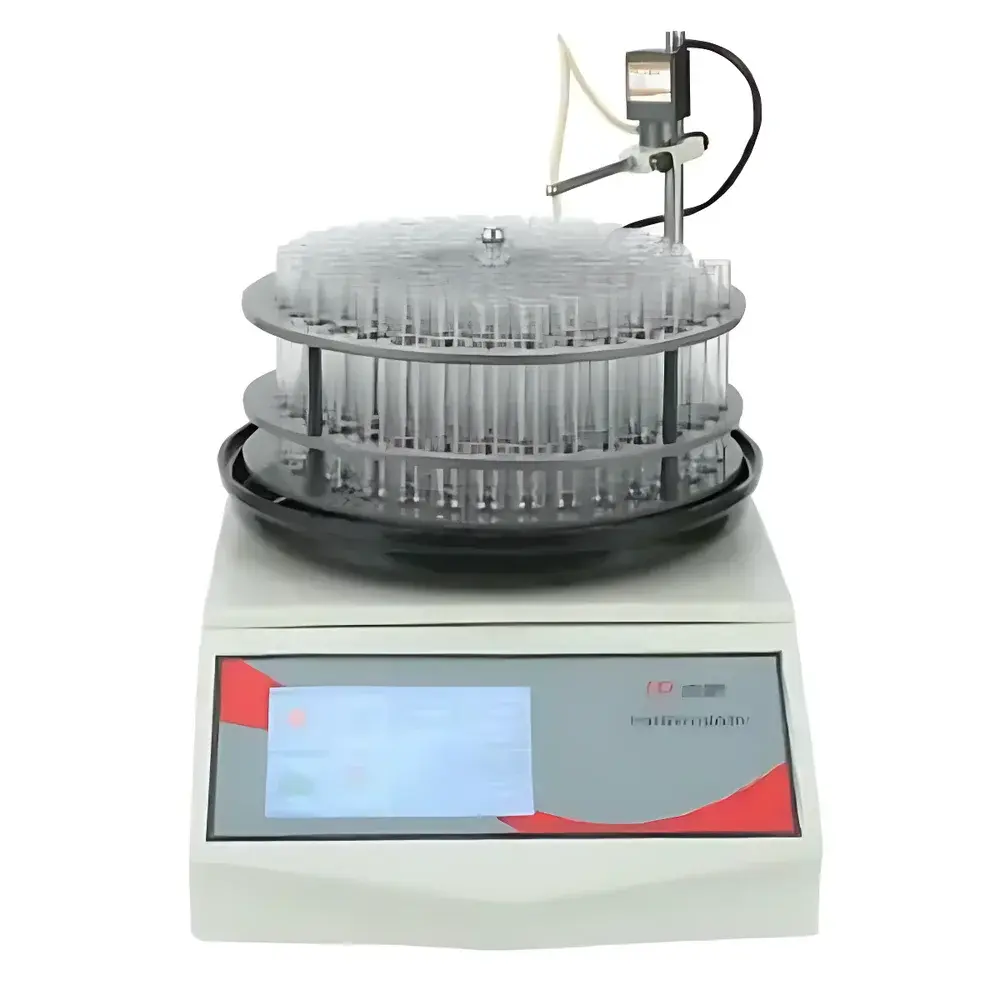
Jiapeng JP-FCD100 Automated Fraction Collector
| Brand | Jiapeng |
|---|---|
| Model | JP-FCD100 |
| Type | Liquid-phase Fraction Collector |
| Collection Modes | Time-based, Drop-counting, UV/absorbance Threshold-triggered |
| Tube Capacity | 100 × 12 mL |
| Touchscreen | 5.5-inch capacitive LCD |
| Timing Range | 1 s – 199 h 59 min 59 s |
| Drop Count Range | 1–9999 drops |
| Threshold Range | ±6 AU (requires external UV detector) |
| Peak Trigger Input | 0–100 mV analog signal |
| Delay Volume Compensation | Software-configurable |
| Valve Type | PEEK fluidic solenoid valve (organic solvent compatible) |
| Continuous Operation | >200 hours |
| Power Supply | AC 220 V, 50/60 Hz |
| Dimensions (W×D×H) | 265 × 390 × 390 mm |
| Weight | 8.35 kg |
Overview
The Jiapeng JP-FCD100 Automated Fraction Collector is an engineered solution for precise, reproducible fractionation in medium- and low-pressure liquid chromatography workflows. Designed for integration into preparative biochemistry and pharmaceutical purification systems, it operates on a deterministic collection logic governed by three primary triggering mechanisms: time-based elution profiling, volumetric drop counting, and real-time UV/absorbance threshold detection. Its core architecture leverages a microprocessor-controlled fluidic path with a chemically inert PEEK solenoid valve—ensuring compatibility with common organic mobile phases (e.g., acetonitrile, methanol, THF) and eliminating carryover or leakage during valve actuation. Unlike manual or semi-automated alternatives, the JP-FCD100 implements programmable delay volume compensation, enabling synchronization between detector signal output and physical tube switching—a critical requirement for accurate peak-centered collection in gradient HPLC or flash chromatography applications.
Key Features
- 5.5-inch capacitive touchscreen interface with intuitive graphical workflow builder—supports multi-step method programming without external software
- Digitally indexed circular tube rack (100-position, 12 mL capacity per tube), enabling unambiguous tube identification and traceability
- Triple-mode collection logic: user-defined time intervals, calibrated drop counts (1–9999), and analog absorbance threshold triggers (±6 AU, requires external UV-Vis detector)
- Software-configurable delay volume offset to compensate for system dwell volume between detector flow cell and collector valve outlet
- High-reliability PEEK solenoid valve rated for >200 hours of continuous operation and resistant to aggressive solvents including chlorinated hydrocarbons and esters
- RS-232/COM port for hardware-level synchronization with peristaltic or piston-driven pumps and UV detectors—enabling closed-loop trigger coordination
- Compact footprint (265 × 390 × 390 mm) optimized for benchtop deployment in GMP-aligned prep labs and academic core facilities
Sample Compatibility & Compliance
The JP-FCD100 is validated for use with aqueous buffers, polar organic solvents, and mixed mobile phases typical in reversed-phase, ion-exchange, and size-exclusion chromatography. Its PEEK fluid path complies with USP Class VI biocompatibility standards and exhibits no measurable leachables under ISO 10993-12 extraction conditions. While not certified as 21 CFR Part 11 compliant out-of-the-box, its deterministic event logging (timestamped tube switch events, trigger source identification, and parameter audit trail) supports GLP/GMP documentation requirements when paired with validated third-party LIMS or chromatography data systems (CDS). The device meets IEC 61010-1 safety standards for laboratory electrical equipment and is CE-marked for EMC and low-voltage directive compliance.
Software & Data Management
Operation is fully self-contained via embedded firmware; no host PC is required for basic function execution. All method parameters—including start/stop tube indices, collection mode selection, delay volume, and trigger thresholds—are stored in non-volatile memory with version-stamped change logs. An optional RS-232 interface permits bidirectional communication with external chromatography workstations (e.g., Chromeleon, Empower, or custom LabVIEW applications), allowing real-time status reporting (current tube number, elapsed time, active trigger state) and remote method upload. Audit trails record every tube-switching event with millisecond-resolution timestamps and associated trigger type—facilitating retrospective analysis and regulatory review.
Applications
- Purification of recombinant proteins and monoclonal antibodies via FPLC or AKTA-compatible low-pressure systems
- Isolation of natural product fractions from crude plant extracts using flash chromatography
- Collection of metabolite peaks in preparative HPLC for structural elucidation (NMR, MS)
- Process development in biopharmaceutical downstream processing where fraction identity and integrity must be maintained across batches
- Educational laboratories requiring robust, entry-level fraction collection with industrial-grade reliability and serviceability
FAQ
Does the JP-FCD100 support integration with third-party UV detectors?
Yes—it accepts analog input signals (0–100 mV) from any standard UV-Vis detector with TTL or voltage-level trigger output. Threshold sensitivity is adjustable in 0.01 AU increments.
Can collection delay volume be calibrated empirically?
Yes—users may enter a measured dwell volume (in mL or seconds) to shift the tube-switching command relative to the detector signal peak maximum.
Is the tube rack autoclavable?
No—the polycarbonate rack is not autoclave-rated; however, it is compatible with 70% ethanol, isopropanol, and alkaline cleaning solutions per manufacturer guidelines.
What is the minimum detectable drop volume for drop-counting mode?
Drop calibration is system-dependent and requires empirical validation using the connected pump and tubing configuration; the instrument registers discrete pulse events from the pump’s encoder or optical sensor.
Does the unit include validation documentation?
Factory test reports (including valve cycle verification, timing accuracy verification, and power supply stability testing) are provided with each shipment; IQ/OQ protocols are available upon request for regulated environments.





