
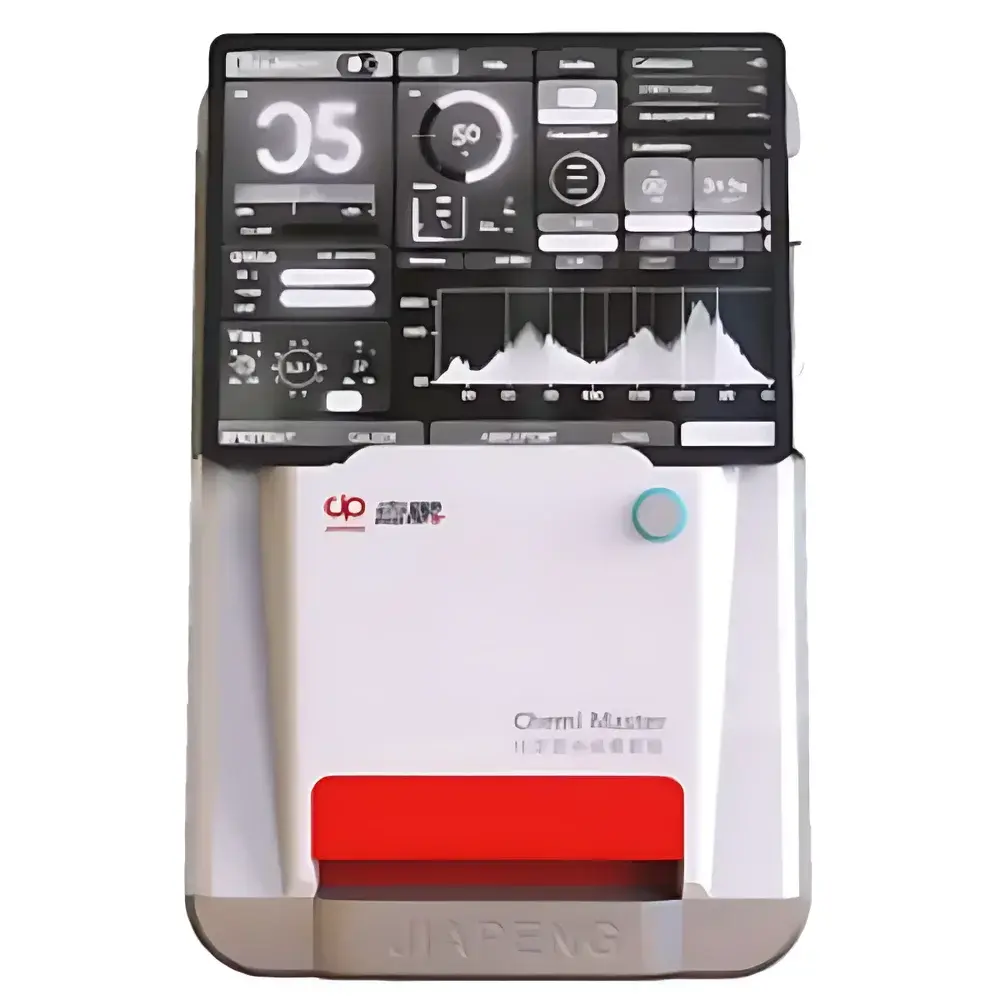
Jiapeng JP-K4600Plus Miniature Chemiluminescence Imaging System
| Brand | Jiapeng |
|---|---|
| Origin | Shanghai, China |
| Model | JP-K4600Plus |
| Instrument Type | Chemiluminescence Gel Imaging System |
| CCD Resolution | 3000 × 3000 (9 MP) |
| Bit Depth | 16-bit |
| Dynamic Range | 4.8 OD |
| CCD Sensor Size | 4/3-inch |
| Detection Sensitivity | 4.8 OD at 16-bit grayscale (0–65,535) |
| Signal-to-Noise Ratio | ≥56 dB |
| Lens | Motorized Optical Zoom 8–48 mm (6× zoom ratio) |
| Cooling Temperature | −45 °C (ΔT ≈ −65 °C vs. ambient) |
| Pixel Size | 5.4 µm × 5.4 µm |
| Pixel Binning Options | 1×1 to 8×8 |
| Quantum Efficiency | >75% |
| Dark Current | <0.0005 e⁻/pixel/s |
| White Light Source | Top-mounted, uniform illumination |
| Imaging Area | 10 cm × 8.8 cm |
| Sample Stage | Motorized drawer-type, 11 cm × 11 cm active area |
| Power Supply | AC 220 V, 50/60 Hz |
| Dimensions (W×D×H) | 295 × 245 × 450 mm |
| Weight | 5 kg |
Overview
The Jiapeng JP-K4600Plus Miniature Chemiluminescence Imaging System is a dedicated, compact benchtop instrument engineered for high-sensitivity detection and quantitative analysis of chemiluminescent and bioluminescent signals in molecular biology workflows. It operates on the principle of photon capture via a deep-cooled scientific CMOS sensor (SONY IMX533CLK-D), optimized for low-light imaging with minimal thermal noise. Unlike general-purpose gel documentation systems, the JP-K4600Plus is purpose-built for Western blotting, nucleic acid hybridization, and reporter gene assays—where signal intensity is inherently weak and dynamic range is critical. Its integrated optical path, thermoelectric cooling architecture, and precisely calibrated white light transilluminator enable reproducible acquisition across diverse substrate chemistries—including ECL, ECL Plus, SuperSignal West Femto, CDP-Star, CSPD, LumiGlo, and Western Lightning—without requiring external darkroom infrastructure.
Key Features
- Deep-cooled 4/3-inch scientific sensor operating at −45 °C (up to 65 °C below ambient), suppressing dark current to <0.0005 e⁻/pixel/s for extended exposure stability
- High quantum efficiency (>75%) and large pixel pitch (5.4 µm) maximize photon collection efficiency under ultra-low-light conditions
- Motorized optical zoom lens (8–48 mm, 6× ratio) with F/0.95 aperture ensures optimal light throughput and field-of-view flexibility for both mini-gels and full-size blots
- 11 × 11 cm motorized drawer-style sample stage enables hands-free loading and precise positioning; compatible with standard cassette-based Western blot membranes and Petri dishes
- Top-mounted uniform white LED illuminator (not UV) supports post-chemiluminescence documentation of stained gels or Ponceau S–stained membranes without cross-contamination risk
- User-configurable auto-shutdown timer (0–60 min) for light sources reduces ambient stray light interference and extends LED service life
- Anti-scatter sample platform minimizes internal reflection artifacts, enhancing contrast and quantitation linearity across the entire imaging area (10 × 8.8 cm)
Sample Compatibility & Compliance
The JP-K4600Plus accommodates standard Western blot membranes (PVDF, nitrocellulose), SDS-PAGE gels, agarose gels, microplates (6–96-well), and luminescent cell culture plates. Its optical design conforms to ISO 15195:2019 guidelines for analytical instrument validation in life science laboratories. While not FDA 21 CFR Part 11–certified out-of-the-box, the system supports audit-trail-enabled software configurations compliant with GLP/GMP documentation requirements when deployed with validated acquisition protocols. All hardware components meet IEC 61010-1 safety standards for laboratory electrical equipment. No UV radiation source is present—eliminating ozone generation and photodamage concerns associated with traditional UV transilluminators.
Software & Data Management
Bundled acquisition and analysis software provides real-time preview, multi-channel overlay (chemiluminescence + white light), background subtraction, region-of-interest (ROI) quantification, and lane/profile analysis. Raw image data are saved in lossless TIFF format with embedded EXIF metadata (exposure time, binning mode, lens focal length, temperature). Export options include CSV for spreadsheet integration and annotated PDF reports suitable for publication or regulatory submission. The software architecture supports user-defined SOP templates, instrument calibration logs, and version-controlled protocol archiving—facilitating traceability in QA/QC environments. Optional network deployment enables centralized instrument management across multi-user lab networks.
Applications
- Quantitative Western blot densitometry using ECL-based substrates with linear dynamic range up to 4.8 optical density units
- Detection of low-abundance phosphoproteins and post-translational modifications via enhanced chemiluminescent reagents
- Bioluminescent reporter assays (e.g., luciferase, GFP-luc fusions) in live-cell or lysate formats
- Chemiluminescent in situ hybridization (CISH) and dot-blot membrane analysis
- Validation of CRISPR/Cas9 editing efficiency through luminescent repair-reporter constructs
- High-throughput screening of kinase inhibitors using luminescent ADP-Glo or similar assay chemistries
FAQ
What is the minimum detectable signal level for horseradish peroxidase (HRP)-conjugated antibodies?
The system achieves reliable detection at sub-femtogram levels of HRP on nitrocellulose under optimized ECL conditions—typically corresponding to ≤50 fg of target protein per band when combined with high-efficiency substrates and 5–10 min exposures.
Can the JP-K4600Plus perform fluorescence imaging?
No—it lacks excitation light sources and emission filters required for fluorescence; it is exclusively configured for chemiluminescence, bioluminescence, and reflected white-light imaging.
Is the cooling system maintenance-free?
Yes—the thermoelectric (Peltier) cooler requires no refrigerant refills or mechanical compressors; routine cleaning of external vents every 6 months is recommended to maintain thermal efficiency.
How is calibration verified during routine use?
A built-in ND filter wheel and certified step tablet (NIST-traceable grayscale) allow daily verification of linearity, dynamic range, and pixel uniformity per ISO/IEC 17025–aligned lab practices.
Does the system support remote operation?
Yes—via Ethernet or Wi-Fi connection, enabling control, image transfer, and real-time monitoring from Windows/macOS workstations within the same LAN subnet.




