
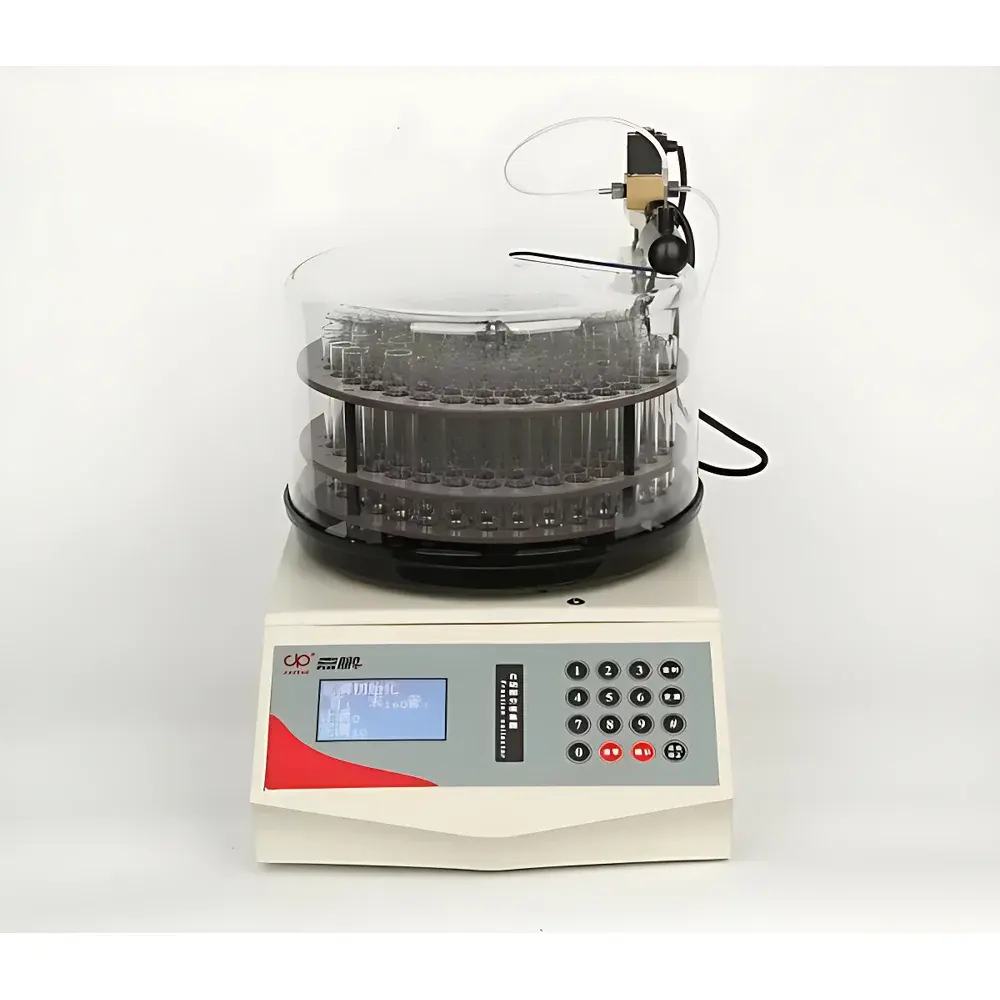
Jiapeng SBS-100 Automatic Fraction Collector with LCD Display
| Brand | Jiapeng |
|---|---|
| Origin | Shanghai, China |
| Model | SBS-100 |
| Fraction Collection Type | Liquid-phase |
| Collection Modes | Time-based, Drop-counting, Peak-triggered |
| Tube Capacity | 12 mL per tube |
| Number of Tubes | 100-position circular rack |
| Time Range | 1 s – 199 h 59 min 59 s |
| Drop Count Range | 1–9999 drops |
| Peak Detection Input | 0–100 mV analog signal |
| Display | Large blue-backlit Chinese-language LCD |
| Power Supply | AC 220 V, 50/60 Hz |
| Dimensions (W×D×H) | 265 × 390 × 390 mm |
| Weight | 8.35 kg |
| Data Retention After Power Loss | ≥10 years |
| Continuous Operation Time | >200 hours |
| Housing Material | ABS polymer, injection-molded, fully enclosed |
| Compliance | Designed for GLP-compliant chromatography workflows in R&D and pilot-scale purification |
Overview
The Jiapeng SBS-100 Automatic Fraction Collector is an entry-level, microprocessor-controlled liquid-phase fraction collector engineered for integration into medium- and low-pressure liquid chromatography (LC) and column chromatography systems. It operates on three primary collection modes—time-based, drop-counting, and peak-triggered—enabling precise, reproducible fractionation of eluent streams during biomolecule purification, natural product isolation, or synthetic compound separation. The device employs a 100-position circular tube rack with engraved numeric labeling for unambiguous tube identification, eliminating positional ambiguity during post-collection handling. Its core architecture centers on a robust ABS polymer housing, CNC-molded for dimensional stability and chemical resistance, and features a human-centered 35° inclined control panel to reduce operator fatigue during extended use. Unlike high-throughput or analytical-grade collectors, the SBS-100 is purpose-built for preparative-scale laboratories where reliability, ease of parameter configuration, and compatibility with legacy peristaltic or constant-flow pumps are prioritized over ultra-fast switching or multi-channel parallelism.
Key Features
- Triple-mode collection logic: programmable time intervals (1 second to 199 hours, 59 minutes, 59 seconds), discrete drop counting (1–9999 drops per fraction), and analog peak detection (0–100 mV input range)
- Large blue-backlit Chinese-language LCD display with high contrast and wide viewing angle for clear real-time status monitoring under ambient lab lighting
- Digitally labeled circular tube rack—each position marked with a permanent, laser-etched numeral for error-free tube identification and retrieval
- Non-volatile memory retains all user-defined parameters—including start/stop tube indices, timing presets, and drop thresholds—for ≥10 years without power
- External trigger interface via RS-232-compatible COM port, enabling direct synchronization with peristaltic pumps (e.g., Keebio models) or UV/VIS detectors
- Modular tube rack design allows interchangeability between standard 12 mL round-bottom tubes; no alignment jigs or calibration required when swapping racks
- Stable continuous operation capability exceeding 200 hours, validated under nominal load conditions (ambient temperature, 50% duty cycle)
Sample Compatibility & Compliance
The SBS-100 is compatible with common chromatographic solvents including water, methanol, acetonitrile, chloroform, ethyl acetate, and dilute aqueous buffers (pH 2–12). Its fluid path components—including optional Keebio solenoid valves—are rated for repeated exposure to organic solvents when configured with solvent-resistant tubing and gaskets (e.g., PTFE, FEP, or chemically inert silicone variants). While not certified to IEC 61010-1 or UL 61010B as a standalone safety-rated instrument, its electrical design conforms to Class I protection requirements for laboratory equipment operating at 220 V AC, 50/60 Hz. The device supports Good Laboratory Practice (GLP) documentation workflows through deterministic parameter logging and non-erasable runtime timestamps. It does not provide FDA 21 CFR Part 11-compliant electronic signatures or audit trails; however, its deterministic behavior and parameter persistence align with internal SOPs for preparative chromatography in academic, biotech, and contract research settings.
Software & Data Management
The SBS-100 operates autonomously via front-panel controls and embedded firmware—no host PC or proprietary software is required for basic operation. All configuration data (tube count, mode selection, timing/drop thresholds, start/stop positions) is stored in EEPROM and survives power interruption. Optional serial communication enables external logging via third-party terminal emulators or custom Python/Node-RED scripts using ASCII command sets (e.g., “T=60” to set 60-second interval). Raw collection metadata—including elapsed time, current tube index, and trigger event type—is accessible via real-time polling but not exported in structured formats (e.g., CSV or JSON). For regulated environments requiring traceability, users must implement manual logbook entries or integrate the collector into broader LIMS ecosystems via hardware-triggered GPIO signals or detector analog output coupling.
Applications
- Desalting and buffer exchange of protein samples via gel filtration chromatography
- Isolation of active fractions from plant extracts using silica or C18 flash chromatography
- Fractionation of oligonucleotide synthesis cleavage mixtures prior to HPLC purification
- Collection of enzyme assay eluates for kinetic profiling across pH or substrate gradients
- Pilot-scale purification of monoclonal antibody fragments following Protein A capture
- Automated sampling in continuous-flow reaction monitoring setups coupled with inline UV detection
FAQ
Does the SBS-100 support USB or Ethernet connectivity?
No. Communication is limited to RS-232 (COM port) for external triggering and basic parameter readback.
Can it be used with HPLC systems operating above 10 bar?
It is designed for low-to-medium pressure applications (<5 bar); use with high-pressure HPLC requires a pressure-decay interface or back-pressure regulator.
Is the LCD display customizable to English language?
No. The firmware and UI are fixed to Chinese-language text rendering.
What tube dimensions are supported in the 100-position rack?
Standard 12 mL round-bottom culture tubes (15–17 mm OD, ≤100 mm height); custom racks for other formats are not available.
How is peak-triggered collection calibrated?
Users manually set a voltage threshold (0–100 mV) corresponding to baseline-subtracted detector output; no auto-calibration or slope-based triggering is implemented.





