
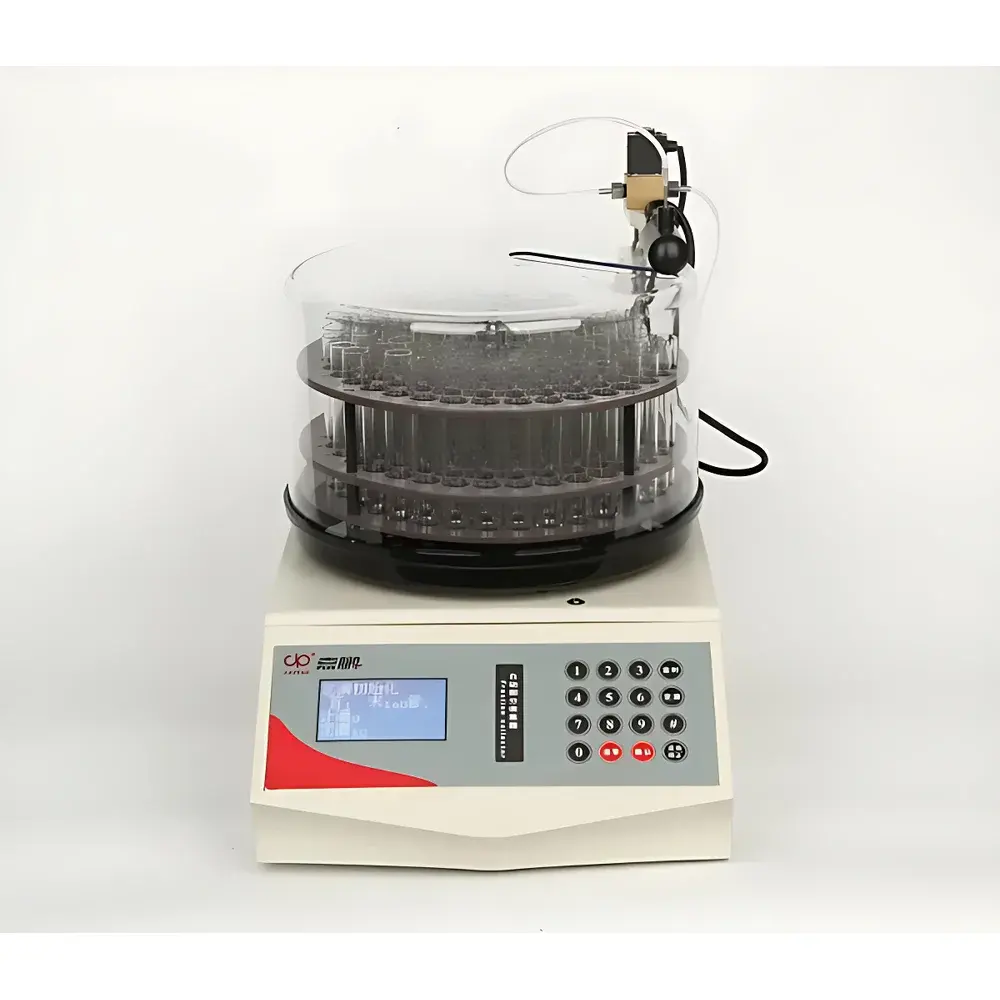
Jiapeng SBS-160 Automatic Fraction Collector with LCD Display
| Brand | Jiapeng |
|---|---|
| Origin | Shanghai, China |
| Model | SBS-160 |
| Fraction Capacity | 160 × 5 mL tubes |
| Timing Range | 1 s – 199 h 59 min 59 s |
| Droplet Counting Range | 1–9999 drops |
| Peak Trigger Range | 0–100 mV (for SBS-100 variant |
| Display | Large blue-backlit Chinese LCD |
| Power Supply | AC 220 V, 50/60 Hz |
| Dimensions (W×D×H) | 265 × 390 × 390 mm |
| Weight | 8.35 kg |
| Data Retention After Power Loss | ≥10 years |
| Continuous Operation Time | >200 hours |
| Housing Material | ABS plastic (injection-molded, fully enclosed) |
| Tube Rack | Circular, digitally numbered (1–160), compatible with standard 12 × 75 mm or 13 × 100 mm test tubes |
| External Trigger Interface | RS-232 COM port for synchronized control with peristaltic pumps (e.g., Keebio constant-flow pumps) |
| Valve Type | Solenoid-actuated fluid cutoff valve (optional solvent-resistant version available) |
Overview
The Jiapeng SBS-160 Automatic Fraction Collector is a precision-engineered chromatography accessory designed for medium-to-low pressure preparative liquid chromatography workflows in academic research laboratories, biopharmaceutical process development, and quality control environments. Operating on the principle of programmable fractionation—based on time, droplet count, or external analog voltage triggers—the instrument interfaces directly with UV/Vis detectors, fraction-trigger modules, or peristaltic pumps to execute reproducible, unattended collection of eluent fractions. Its microcontroller-based architecture ensures stable timing resolution down to 1 second and precise droplet discrimination across a 1–9999 range, supporting robust method transfer between analytical and preparative scales. The device complies with fundamental laboratory instrumentation design standards for electromagnetic compatibility (EMC), electrical safety (IEC 61010-1), and mechanical durability under continuous operation (>200 hours). While not certified for GMP manufacturing environments out-of-the-box, its data retention capability (≥10 years post-power-loss), non-volatile parameter storage, and deterministic tube indexing make it suitable for GLP-aligned documentation practices when integrated into validated chromatographic systems.
Key Features
- 160-position circular tube rack with engraved numeric labeling (1–160), enabling unambiguous identification and retrieval without manual alignment or barcode scanning
- Triple-mode collection logic: programmable time-based intervals (1 s – 199 h 59 min 59 s), drop-counted acquisition (1–9999 drops per fraction), and external analog signal triggering (via optional DB9 RS-232 interface)
- Large blue-backlit Chinese-language LCD display with high-contrast characters optimized for ambient lab lighting conditions and extended operator visibility
- Full-enclosure housing fabricated from high-impact ABS polymer via single-shot injection molding—resistant to mechanical stress, chemical splashes, and routine disinfectants
- Ergonomic 35° angled control panel reducing neck strain during prolonged operation; tactile membrane keypad with audible feedback
- Non-volatile memory preserving all user-defined parameters—including start/stop tube numbers, timing profiles, and droplet thresholds—for over a decade without battery backup
- Interchangeable tube trays accommodating standard 12 × 75 mm or 13 × 100 mm glass or polypropylene tubes (5 mL nominal volume per position)
Sample Compatibility & Compliance
The SBS-160 supports aqueous, organic, and mixed-solvent mobile phases commonly used in reversed-phase, ion-exchange, and size-exclusion chromatography. Its standard solenoid-driven fluid cutoff valve is rated for water, methanol, acetonitrile, and buffer solutions; an optional chemically resistant valve variant is available for aggressive solvents including chloroform, THF, and DMSO. The instrument does not include integrated pressure monitoring or flow sensing but relies on upstream pump stability and detector output synchronization for reliable peak-based collection. It meets IEC 61326-1 (EMC for laboratory equipment) and IEC 61010-1 (safety requirements for electrical equipment for measurement, control, and laboratory use). Though not FDA 21 CFR Part 11 compliant by default, audit trails can be generated externally via serial logging when paired with compliant data acquisition software.
Software & Data Management
The SBS-160 operates as a standalone hardware controller with no embedded operating system or network connectivity. All configuration is performed locally via the front-panel interface. Parameter sets—including tube numbering schemes, collection modes, delay offsets, and trigger thresholds—are stored in EEPROM and survive power cycling. For traceability, users may log collection events manually or integrate the RS-232 port into third-party LabVIEW, Python (PySerial), or MATLAB scripts to timestamp and archive fraction metadata. When used with Keebio peristaltic pumps featuring TTL/RS-232 output, the system supports closed-loop coordination for consistent dwell-time alignment across runs—critical for method scalability and inter-laboratory reproducibility.
Applications
- Purification of recombinant proteins and monoclonal antibodies via FPLC or ÄKTA-compatible low-pressure systems
- Isolation of natural product fractions from crude plant extracts using column chromatography
- Preparative HPLC fraction harvesting for structural elucidation (NMR, MS) and bioactivity screening
- Quality assurance sampling in small-molecule API synthesis workflows
- Teaching laboratory exercises in separation science, emphasizing retention time correlation and fraction yield calculation
- Automated collection in gradient elution protocols where peak broadening necessitates fine-grained temporal segmentation
FAQ
Does the SBS-160 support peak-triggered collection?
No—the SBS-160 model lacks analog input circuitry for real-time UV or conductivity signal integration. Peak-trigger functionality is only available on the SBS-100 variant (0–100 mV range). For peak-based workflows, users must employ external hardware triggers or synchronize via pump/detector RS-232 handshaking.
Can I use non-standard tube sizes?
Yes—the circular rack accepts any tube with outer diameter ≤14 mm and height ≤105 mm, provided mechanical stability is maintained during collection cycles. Custom inserts are available upon request.
Is firmware upgrade capability supported?
No—the device uses fixed-function microcontroller firmware. Functional updates require hardware revision or replacement.
What maintenance is required?
Annual inspection of solenoid valve actuation, cleaning of tube tray grooves, and verification of timing accuracy against a calibrated stopwatch are recommended. No lubrication or calibration certificates are supplied.
How is data integrity ensured during extended runs?
All operational parameters and collection logs reside in write-protected EEPROM. Power interruption does not erase settings or interrupt ongoing collection sequences; the unit resumes from the last completed tube index upon restart.





