
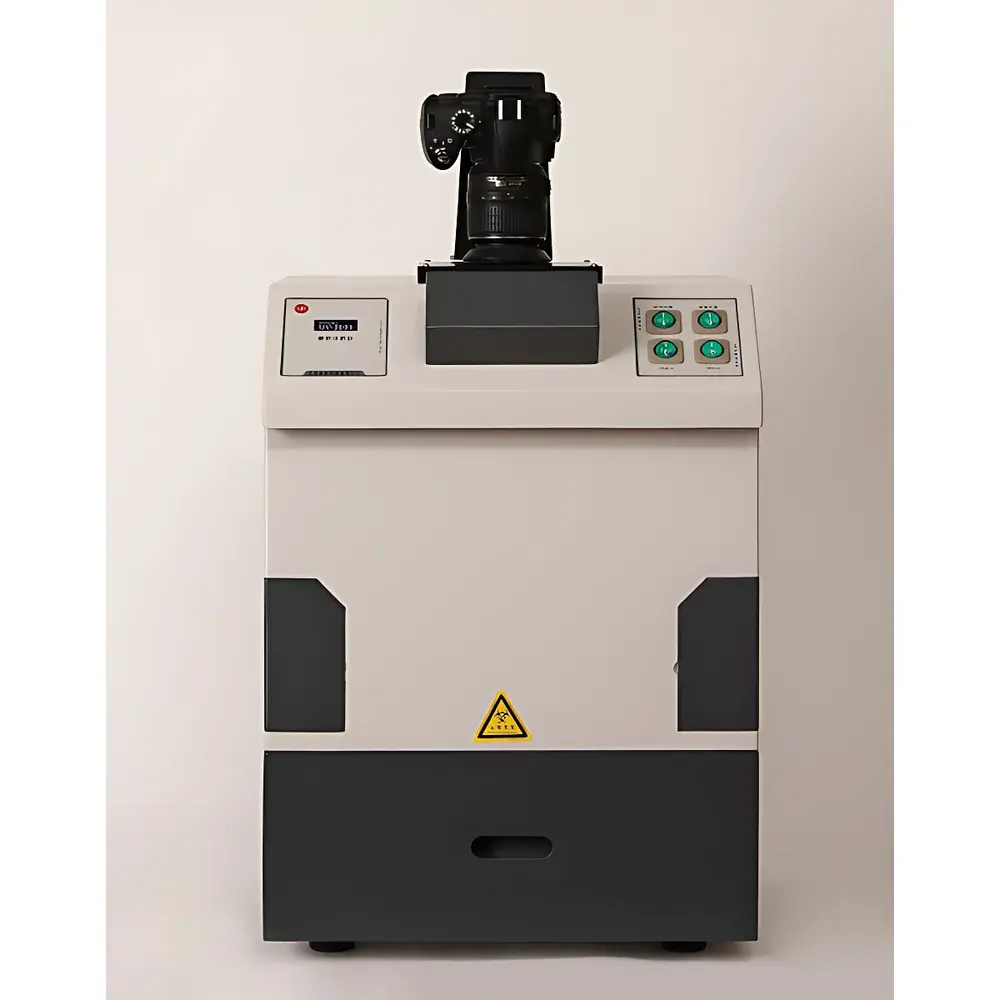
Jiapeng UV-3000 High-Intensity UV Transilluminator and Gel Cutter
| Brand | Jiapeng |
|---|---|
| Origin | Shanghai, China |
| Model | UV-3000 |
| Instrument Type | Darkroom-style transilluminator |
| Wavelength Modes | Multi-wavelength (transmission: 302 nm |
| reflection | 254 nm & 365 nm) |
| UV Lamp Count | 12 × 8 W tubes |
| Transmission Filter Size | 200 × 250 mm |
| Reflection Filter Area | 200 × 50 mm (dual-side) |
| Transmission Illuminated Area | 200 × 250 mm |
| White Light Panel Size | 210 × 260 mm |
| White Light Source | 4 W LED panel |
| Input Power | AC 220 V, 50/60 Hz |
| UV Intensity at 20 cm | ≥20 µW/cm² |
| Compliance | JJF 1936–2021 (National Verification Regulation for UV Analyzers) |
| Dimensions (L×W×H) | 420 × 355 × 580 mm |
| Net Weight | 10 kg |
Overview
The Jiapeng UV-3000 High-Intensity UV Transilluminator and Gel Cutter is an integrated darkroom-style instrument engineered for precise visualization, documentation, and excision of nucleic acid and protein bands in agarose and polyacrylamide gels. It operates on the principle of ultraviolet-induced fluorescence—where ethidium bromide (EtBr), SYBR Safe, GelRed, or other nucleic acid intercalating dyes absorb UV photons and emit visible light upon excitation. The UV-3000 delivers three discrete excitation wavelengths: 302 nm for optimal DNA/RNA band detection under transmission mode, and dual-side 254 nm and 365 nm reflection modes for applications requiring higher-energy excitation (e.g., UV shadowing of proteins, visualization of non-fluorescent compounds, or UV-sensitive dye alternatives). Its 12 × 8 W high-output UV lamps ensure rapid lamp ignition (<5 s), uniform irradiance across the full 200 × 250 mm transilluminated area, and stable output over extended operation—critical for reproducible band quantification and low-exposure-time photography.
Key Features
- Triple-wavelength UV illumination system: 302 nm (transmission), 254 nm & 365 nm (dual-side reflection) — enabling flexible assay selection based on dye compatibility and sensitivity requirements.
- Full-enclosure ABS polymer darkbox with UV-blocking viewing window and dual side-access ports — eliminates ambient light interference and ensures operator safety during gel handling.
- Automatic UV shutoff mechanism: Integrated drawer sensor deactivates all UV lamps when the sample tray is extended — preventing unintended UV exposure and extending lamp service life.
- Dedicated DSLR mounting interface with adjustable camera bracket — compatible with Canon, Nikon, Sony, and other major DSLR/mirrorless systems for consistent, repeatable gel documentation.
- Integrated white-light LED panel (4 W, 210 × 260 mm) — supports Coomassie- or silver-stained protein gel imaging without UV switching or external lighting.
- Active thermal management: Built-in cooling fan maintains stable lamp output and prevents thermal drift during prolonged use (>30 min continuous operation).
- Compliance-ready design: Manufactured in accordance with JJF 1936–2021—the national metrological verification regulation for UV analyzers in China—ensuring traceable intensity calibration and performance validation protocols.
Sample Compatibility & Compliance
The UV-3000 accommodates standard electrophoretic formats including 10 × 10 cm, 15 × 15 cm, and 20 × 20 cm gels. Its 200 × 250 mm transmission field supports oversized mini-gels and custom slab gels. The instrument is routinely deployed in laboratories adhering to GLP and ISO/IEC 17025 frameworks, where documentation integrity and measurement traceability are mandatory. While not FDA 21 CFR Part 11–certified out-of-the-box, its hardware-based shutter control, fixed optical path, and absence of software-mediated intensity modulation support audit-ready manual SOP execution. All UV filters meet ISO 10140-3 spectral attenuation standards for >99% UVC blocking at 200–280 nm, and the viewing window complies with EN 170:2002 UV-protection classification.
Software & Data Management
The UV-3000 is a hardware-centric platform with no embedded operating system or proprietary acquisition software. Imaging workflows rely on standard third-party tools: ImageLab (Bio-Rad), AlphaView SA (ProteinSimple), or open-source alternatives such as Fiji/ImageJ. Camera trigger synchronization is achieved via manual shutter release or wired remote; no USB/HDMI video streaming is supported. All intensity specifications—including calibrated 302 nm irradiance (≥20 µW/cm² at 20 mm working distance)—are verified using NIST-traceable UV radiometers per JJF 1936–2021 Annex B. Lab managers may integrate the unit into LIMS environments via documented SOPs covering lamp age tracking, filter replacement intervals (recommended every 1,200 operational hours), and annual intensity verification.
Applications
- Nucleic acid gel documentation: Rapid detection and photography of EtBr-, SYBR Gold-, or GelGreen-stained DNA/RNA fragments post-electrophoresis.
- PCR product verification: Confirmation of amplicon size, specificity, and presence of primer dimers or nonspecific bands.
- DNA fingerprinting and RFLP analysis: High-contrast visualization of restriction-digested fragments for genotyping and forensic applications.
- Protein detection via UV shadowing: Direct visualization of unstained proteins on nitrocellulose or PVDF membranes using 254 nm reflection.
- Thin-layer chromatography (TLC) and paper chromatography: Compound localization using UV-active tags or native fluorescence under 254/365 nm.
- Gel excision guidance: Precision cutting of target bands using included stainless-steel scalpel and interchangeable blades—minimizing cross-contamination and UV degradation of downstream samples.
FAQ
What safety certifications does the UV-3000 comply with?
It conforms to JJF 1936–2021 (China National Verification Regulation) and incorporates EN 170-compliant UV-blocking acrylic for the observation window. No CE or UL listing is provided; institutional EH&S review is recommended prior to deployment.
Can the UV-3000 be used for SYBR Safe staining?
Yes—302 nm transmission provides optimal excitation efficiency for SYBR Safe, SYBR Gold, and similar dyes. Avoid prolonged 254 nm exposure with these dyes to prevent photobleaching.
Is the white light panel suitable for quantitative densitometry?
The 4 W LED panel delivers uniform illumination for qualitative imaging; however, for quantitative Coomassie-stained gel analysis, external calibrated light boxes with diffused optics are recommended.
How often should the UV filters be replaced?
Transmissive and reflective filters maintain >95% spectral transmission for 1,200 hours under typical lab usage. Replacement is advised if visible clouding, scratches, or measurable irradiance drop (>15%) occurs during routine verification.
Does the unit include a radiometer for intensity validation?
No—radiometric verification requires a separate NIST-traceable UV-A/UV-C sensor (e.g., ILT950UV or Sper Scientific 850020). Calibration procedures are detailed in the user manual per JJF 1936–2021 Section 6.3.



