
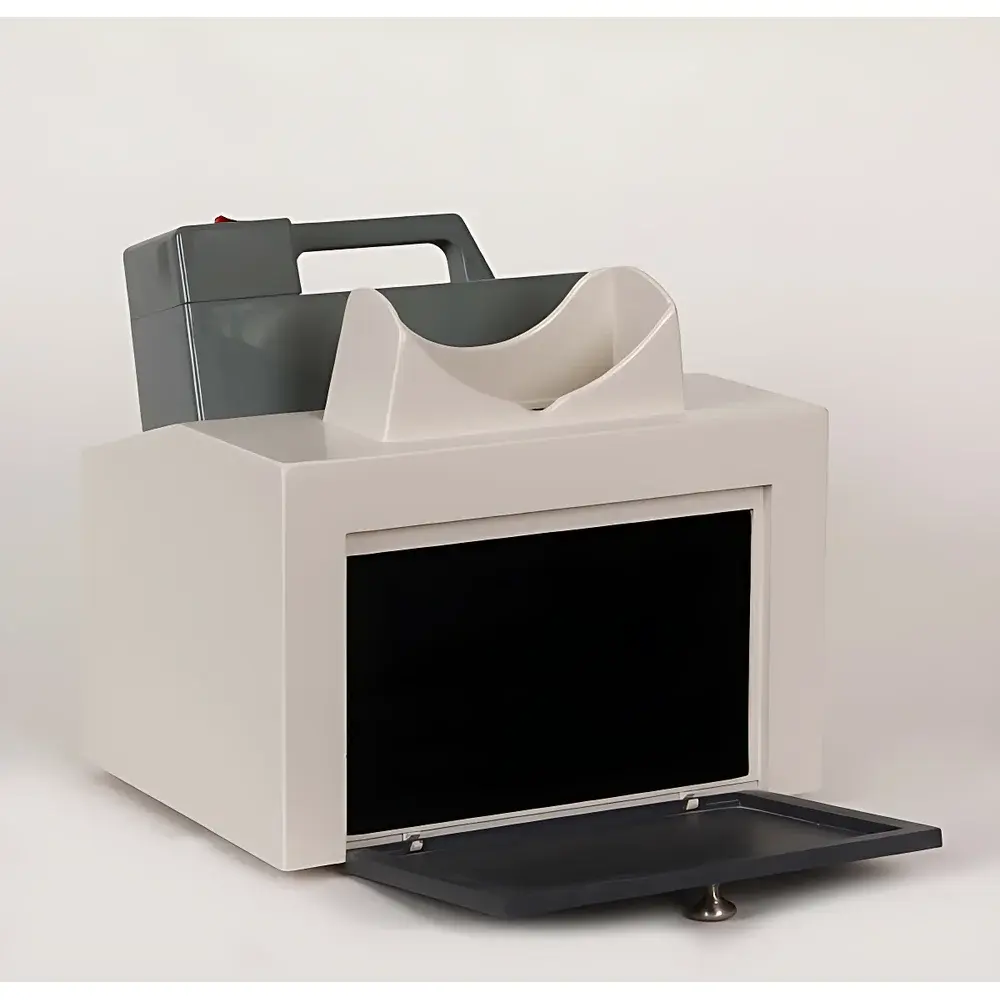
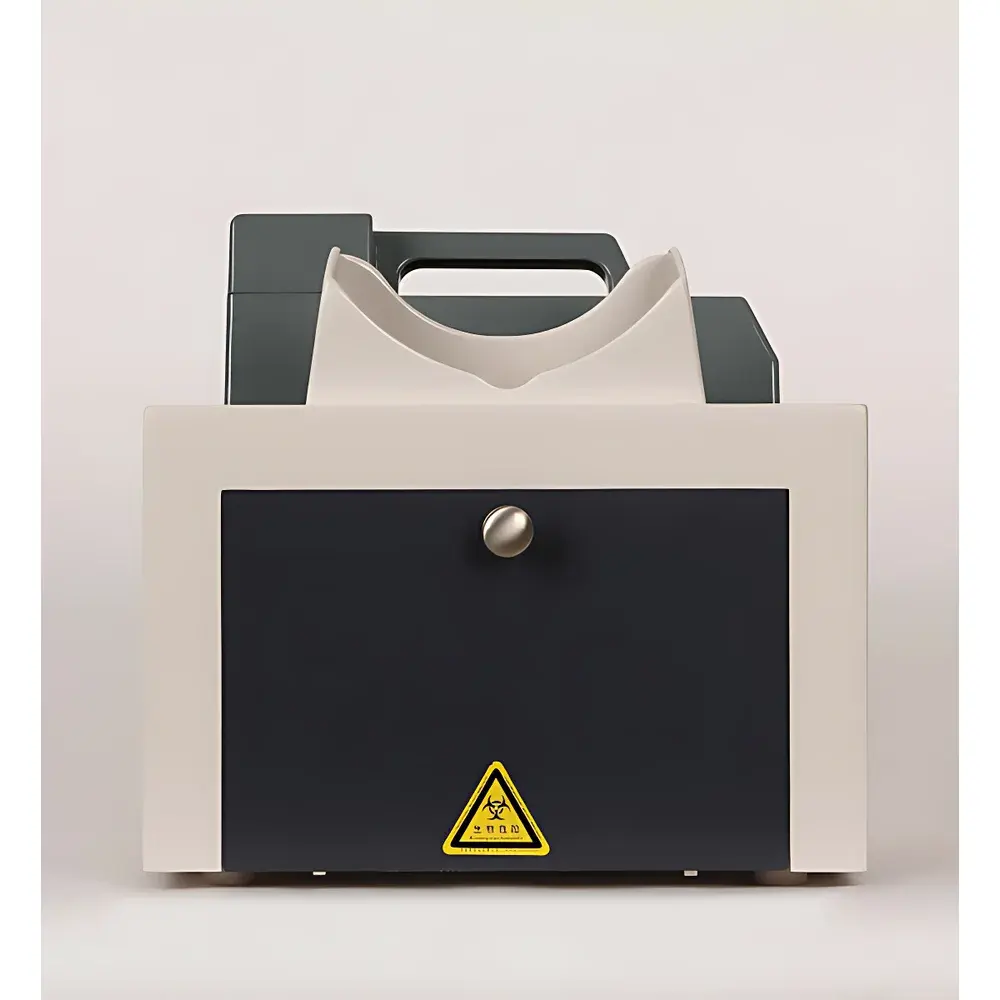
Jiapeng UV-A Portable Darkroom UV Transilluminator
| Brand | Jiapeng |
|---|---|
| Origin | Shanghai, China |
| Model | UV-A |
| Instrument Type | Darkroom-style |
| Wavelengths | 254 nm & 365 nm (dual-band) |
| UV Filter Dimensions | 200 × 50 mm |
| UV Lamps | 8 W × 2 (low-pressure mercury vapor lamps) |
| Power Consumption | 20 W |
| UV Intensity | ≥20 µW/cm² at 20 cm distance from lamp surface |
| Input Voltage | AC 220 V, 50/60 Hz |
| Dimensions (L×W×H) | 340 × 270 × 265 mm |
| Net Weight | 2.0 kg |
| Compliance | JJF 1936–2021 “Verification Regulation for Ultraviolet Analyzers” (drafting enterprise) |
| Patents | ZL202221777391.4, ZL202222383825.9 |
Overview
The Jiapeng UV-A Portable Darkroom UV Transilluminator is a compact, CE-compliant benchtop instrument engineered for safe and reliable visualization of nucleic acids and proteins under ultraviolet illumination. It operates on the principle of fluorescence excitation—where ethidium bromide (EtBr), SYBR® Safe, GelRed®, or other UV-excitable dyes intercalated into DNA/RNA or bound to proteins absorb UV photons at 254 nm or 365 nm and re-emit visible light in the orange-red or green spectrum. The dual-wavelength configuration enables flexible optimization: 254 nm offers higher sensitivity for standard EtBr-stained gels, while 365 nm minimizes photodamage to DNA during gel documentation and excision, preserving sample integrity for downstream cloning or sequencing. Its integrated darkroom enclosure eliminates ambient light interference and incorporates a high-transmission, scratch-resistant UV filter window (200 × 50 mm) that blocks >99.9% of harmful UVC (<230 nm) and UVB radiation while transmitting only the designated 254 nm and 365 nm bands—ensuring both operator safety and imaging fidelity.
Key Features
- Portable darkroom architecture with fully enclosed ABS polymer housing—lightweight (2.0 kg), ergonomic, and injection-molded for structural rigidity and chemical resistance.
- Dual-band UV excitation: independently switchable 254 nm and 365 nm low-pressure mercury lamps (8 W × 2), each with calibrated spectral output per IEC 62471 photobiological safety standards.
- Optimized optical path: precision-ground quartz filter window ensures uniform irradiance distribution across the 200 × 50 mm active area; measured intensity ≥20 µW/cm² at 20 cm working distance (per JJF 1936–2021).
- Integrated safety controls: rocker switch with labeled dual-position actuation, automatic lamp cutoff upon lid opening (mechanical interlock), and UV-blocking acrylic viewing window meeting EN 170:2002 requirements for UV filters.
- Compliance-ready design: developed in alignment with national metrological verification protocol JJF 1936–2021; certified as drafting enterprise for said regulation; registered utility patents for mechanical shielding and thermal management (ZL202221777391.4, ZL202222383825.9).
Sample Compatibility & Compliance
The UV-A transilluminator supports standard electrophoretic formats including agarose and polyacrylamide gels (up to 15 × 15 cm), SDS-PAGE minigels, Western/Northern blot membranes, TLC plates, microtiter plates (96-/384-well), and Petri dishes. Its 365 nm mode is compatible with UV-safe dyes (e.g., SYBR® Gold, GelGreen®) and reduces thymine dimer formation in DNA fragments—critical for recovery of intact amplicons post-excision. All electrical and optical components conform to IEC 61010-1 (Safety Requirements for Electrical Equipment for Measurement, Control, and Laboratory Use) and IEC 60598-1 (Luminaire Safety). The unit is intended for use in GLP-compliant laboratories; though not 21 CFR Part 11–certified out-of-box, its stable output and mechanical traceability support audit-ready documentation when paired with calibrated radiometers and logbooks.
Software & Data Management
As a standalone hardware platform, the UV-A requires no proprietary software or drivers. It functions as an illumination source compatible with all third-party gel documentation systems—including CCD-based imagers (e.g., Bio-Rad ChemiDoc™, Azure Biosystems Sapphire™), smartphone adapters (with UV-pass lens filters), and digital SLR setups. For quantitative analysis, users may integrate it with open-source tools such as ImageJ/Fiji using standardized exposure protocols. Built-in lamp stability ensures consistent pixel intensity values across repeated acquisitions—enabling semi-quantitative band densitometry when combined with reference ladders and internal controls. No firmware updates or cloud connectivity are implemented, preserving data sovereignty and minimizing cybersecurity surface area.
Applications
- Visualization and documentation of DNA/RNA bands in agarose and native PAGE gels.
- Excision of target fragments under long-wave UV (365 nm) to minimize DNA degradation during cloning workflows.
- Fluorescent detection of protein bands in Coomassie- or SYPRO Ruby–stained SDS-PAGE gels.
- Qualitative assessment of PCR product integrity and multiplex amplification specificity.
- Monitoring of thin-layer chromatography (TLC) separations using fluorescent tags or derivatized compounds.
- Routine inspection of UV-curable resins, counterfeit document verification, and forensic latent print development (with appropriate dyes).
FAQ
Is the UV-A transilluminator suitable for DNA extraction after gel excision?
Yes—its 365 nm mode significantly reduces UV-induced crosslinking and strand breakage compared to 254 nm, improving recovery yields for TA/Blunt-end cloning and Sanger sequencing.
Does it meet international safety standards for laboratory UV devices?
It complies with JJF 1936–2021 (China National Metrology Institute), IEC 62471 (Photobiological Safety), and IEC 61010-1 (Electrical Safety); UV filter performance aligns with EN 170:2002.
Can it be used with SYBR® Safe and other non-toxic dyes?
Yes—both 254 nm and 365 nm wavelengths efficiently excite SYBR® Safe, GelRed®, and GelGreen®; optimal sensitivity is achieved at 365 nm with reduced background autofluorescence.
What maintenance is required for long-term lamp stability?
Lamps should be replaced every 1,000–1,500 hours of cumulative operation; avoid frequent on/off cycling to extend service life. Clean the filter window regularly with lint-free wipes and isopropanol.
Is calibration traceable to national standards?
Radiometric calibration is supported via optional NIST-traceable UV radiometers (e.g., International Light IL1700); instrument-level verification follows JJF 1936–2021 procedures published by the Shanghai Institute of Measurement and Testing Technology.





