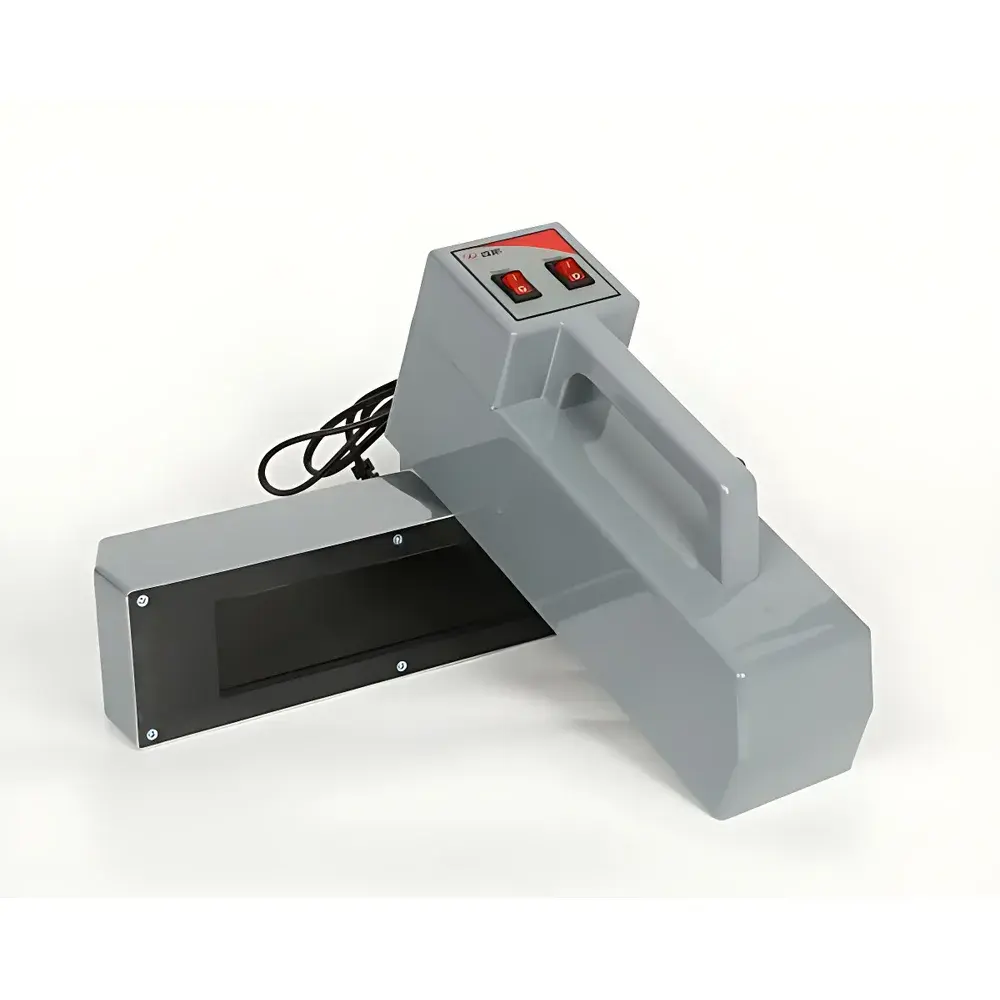
Jiapeng ZF-5 Portable Dual-Wavelength UV Transilluminator
| Brand | Jiapeng |
|---|---|
| Origin | Shanghai, China |
| Model | ZF-5 |
| Instrument Type | Portable (Handheld) |
| Wavelength Options | 254 nm & 365 nm (or 302 nm) |
| UV Filter Dimensions | 200 × 50 mm |
| UV Lamps | 8 W × 2 |
| UV Intensity | ≥20 µW/cm² at 20 cm distance |
| Input Power | AC 220 V, 50/60 Hz |
| Dimensions (L×W×H) | 280 × 80 × 120 mm |
| Weight | 0.7 kg |
| Compliance | JJF 1936–2021 (National Verification Regulation for UV Analyzers) |
| Patents | ZL202221777391.4, ZL202222383825.9 |
Overview
The Jiapeng ZF-5 Portable Dual-Wavelength UV Transilluminator is a compact, handheld instrument engineered for rapid, on-demand visualization of nucleic acids and proteins in gel electrophoresis, thin-layer chromatography (TLC), and blotting applications. It operates on the principle of ultraviolet-induced fluorescence: when DNA, RNA, or fluorescently labeled biomolecules are exposed to UV radiation at specific excitation wavelengths (254 nm, 302 nm, or 365 nm), they emit visible light upon interaction with intercalating dyes (e.g., ethidium bromide, SYBR Safe, or GelRed). The ZF-5 delivers stable, uniform UV irradiance through dual-lamp architecture and precision optical filtering—ensuring consistent excitation while minimizing stray light and photobleaching risk. Its lightweight design (0.7 kg), integrated ergonomic handle, and battery-free AC operation enable immediate deployment in field labs, teaching environments, core facilities, or biosafety cabinets—without requiring fixed benchtop installation or external cooling systems.
Key Features
- Dual-wavelength flexibility: Switchable 254 nm (optimal for ethidium bromide-stained DNA) and 365 nm (lower-energy, safer for prolonged exposure and SYBR-family dyes) modes via integrated rocker switch—no external controllers or lamp swaps required.
- Optimized optical path: High-transmission 200 × 50 mm UV bandpass filter ensures >90% peak transmission at target wavelengths and effective rejection of visible and infrared radiation—critical for high-contrast imaging under ambient light conditions.
- Engineered safety & durability: Enclosure molded from medical-grade ABS polymer (UL94 V-0 rated), fully shielded to limit UV leakage below IEC 62471 Class 1 exposure limits; patented structural design (ZL202221777391.4, ZL202222383825.9) enhances mechanical rigidity and drop resistance.
- Calibrated irradiance performance: Delivers ≥20 µW/cm² UV intensity at 20 cm working distance—validated per JJF 1936–2021 national metrological verification protocol—to support semi-quantitative band intensity assessment and reproducible documentation.
- Human-centered ergonomics: Low-profile form factor (280 × 80 × 120 mm), balanced weight distribution, and intuitive single-pole toggle switch allow one-handed operation during gel excision or real-time monitoring of electrophoretic migration.
Sample Compatibility & Compliance
The ZF-5 supports standard life science sample formats including agarose and polyacrylamide gels (up to 15 × 15 cm), Petri dishes (90–100 mm), TLC plates (20 × 20 cm), and nitrocellulose/PVDF membranes. Its 254 nm mode meets ASTM D7251–19 requirements for nucleic acid detection sensitivity in molecular diagnostics workflows; the 365 nm configuration aligns with ISO 15190:2020 recommendations for reduced photodamage during preparative gel slicing. As a JJF 1936–2021-compliant instrument, it satisfies traceable calibration requirements for GLP-regulated laboratories and academic core facilities conducting routine nucleic acid analysis. No ozone generation occurs at either wavelength—eliminating ventilation dependency and enabling use in enclosed spaces.
Software & Data Management
The ZF-5 is a standalone hardware platform without embedded firmware or proprietary software. It interfaces seamlessly with third-party digital imaging systems—including DSLR cameras, scientific CMOS sensors, and mobile phone adapters—via standard UV-blocking viewing shields (sold separately). For regulatory environments, its fixed-output design supports audit-ready documentation: irradiance stability is verified annually per JJF 1936–2021 using NIST-traceable radiometers, and usage logs (date/time, operator ID, application type) may be maintained externally to satisfy FDA 21 CFR Part 11 record-keeping expectations where image capture is integrated into electronic lab notebooks (ELNs).
Applications
- Real-time monitoring of DNA/RNA electrophoresis migration in agarose and native PAGE gels
- Excision of target bands under UV illumination with sterile scalpels or gel cutters
- Visualization of protein bands stained with fluorescent dyes (e.g., Deep Purple, Krypton) on SDS-PAGE
- Qualitative analysis of metabolites and pharmaceutical compounds on silica-based TLC plates
- Verification of colony PCR products and plasmid restriction digests in teaching laboratories
- Preparative isolation of DNA fragments for cloning, sequencing, or mass spectrometry workflows
FAQ
Is the ZF-5 suitable for use with ethidium bromide?
Yes—its 254 nm emission mode provides optimal excitation efficiency for ethidium bromide, yielding strong orange-red fluorescence with high signal-to-noise ratio.
Can the ZF-5 be used inside a laminar flow hood?
Yes—the unit generates no ozone and draws only 16 W; it operates safely within Class II biosafety cabinets and laminar airflow workstations without compromising airflow integrity.
Does the ZF-5 require warm-up time before achieving stable output?
No—cold-cathode UV lamps reach full spectral output within <2 seconds of power-on, enabling immediate use without stabilization delay.
What safety certifications does the ZF-5 hold?
The device conforms to IEC 61010-1 (electrical safety) and IEC 62471 (photobiological safety) as verified by third-party testing; full compliance documentation is available upon request.
How often should UV intensity be re-verified?
Per JJF 1936–2021, irradiance calibration must be performed annually—or after any physical impact or lamp replacement—to ensure continued adherence to ≤±10% measurement uncertainty thresholds.