
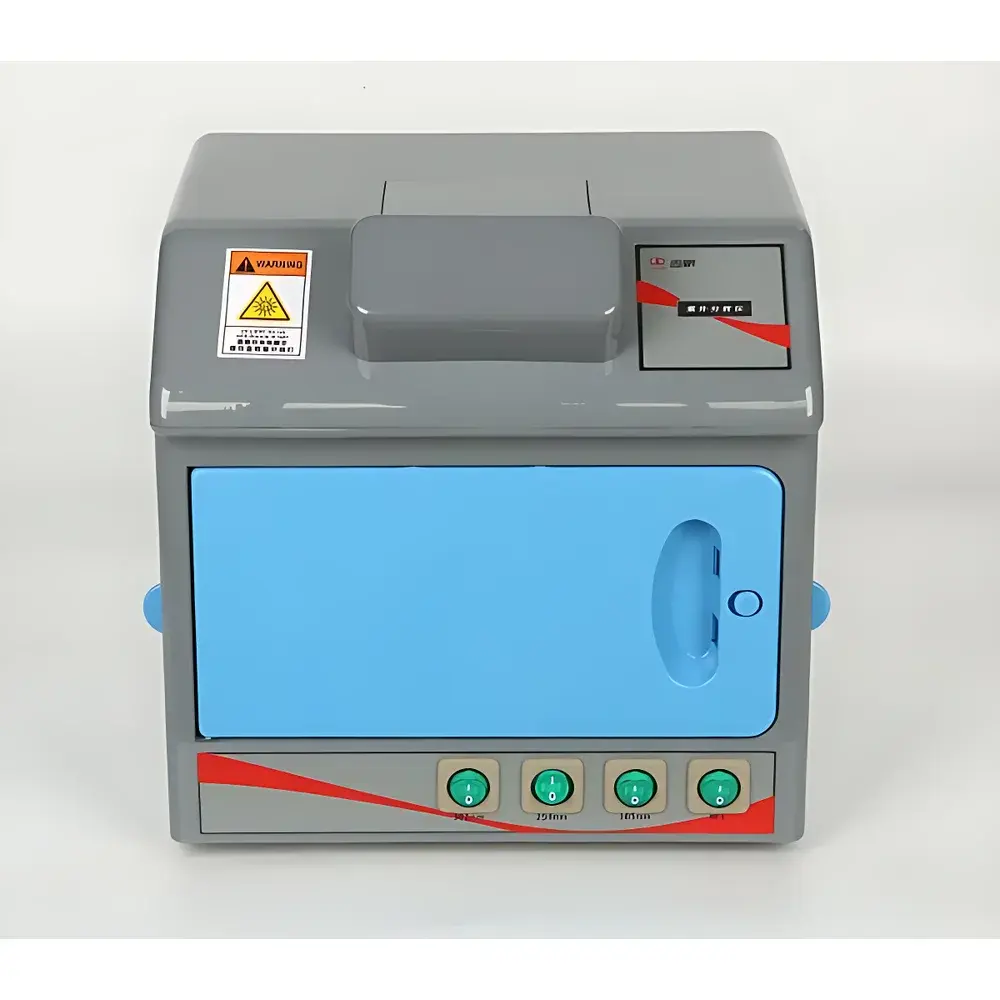
Jiapeng ZF-8 Darkroom-Style Multi-Wavelength UV Transilluminator and Gel Cutter
| Brand | Jiapeng |
|---|---|
| Origin | Shanghai, China |
| Model | ZF-8 |
| Instrument Type | Darkroom-style |
| Wavelengths | 254 nm (reflective), 302 nm (transmissive), 365 nm (reflective) |
| UV Lamp Quantity | 4 × 8 W |
| UV Filter Size | 200 × 80 mm |
| Transillumination Area | 200 × 80 mm |
| Visible Light Lamp | 1 × 6 W |
| Total Power Consumption | 38 W |
| UV Lamp Adjustability | Yes (articulated mounting) |
| Observation Window | UV-blocking acrylic (≥99% UVC/UVB attenuation) |
| Compliance | JJF 1936–2021 (National Verification Regulation for UV Analyzers) |
Overview
The Jiapeng ZF-8 is a darkroom-style, multi-wavelength UV transilluminator engineered for routine fluorescence visualization and precision gel excision in molecular biology laboratories. It operates on the principle of ultraviolet-induced fluorescence—where nucleic acids or proteins pre-stained with ethidium bromide, SYBR Safe, or similar fluorophores absorb UV photons at specific wavelengths and re-emit visible light, enabling detection and documentation of electrophoretic bands. Unlike open-frame units, the ZF-8 integrates a fully enclosed ABS polymer housing that eliminates ambient light interference and provides operator protection against direct UV exposure. Its tri-wavelength configuration (254 nm reflective, 302 nm transmissive, and 365 nm reflective) supports both high-sensitivity DNA band detection (254 nm) and low-photodamage visualization (365 nm), while the 302 nm setting balances sensitivity and reduced nucleic acid degradation during prolonged exposure—critical for downstream cloning or sequencing applications.
Key Features
- Adjustable UV lamp assembly: Four 8 W UV lamps are mounted on pivot joints, allowing precise angular alignment to uniformly illuminate any region within the 200 × 80 mm transillumination area—including edge zones near gel wells or cut lines.
- Dual-mode optical access: Left and right sliding side ports facilitate gloved-hand manipulation during gel cutting, while the front UV-shielded observation window (≥99% attenuation of 254/302/365 nm radiation) permits real-time visual monitoring without opening the chamber.
- Microcontroller-based LCD interface: Backlit Chinese-language display enables intuitive selection and toggling between 254 nm, 302 nm, 365 nm, and 6 W white-light modes; includes operational status feedback and audible alert upon shutdown.
- Compliance-certified UV output: At 20 cm working distance, irradiance measures 20 µW/cm² across all UV bands—verified per JJF 1936–2021, China’s national metrological verification regulation for UV analyzers.
- Robust mechanical construction: One-piece injection-molded high-impact ABS chassis ensures structural integrity, chemical resistance to common lab solvents (e.g., ethanol, acetic acid), and ESD-safe operation.
Sample Compatibility & Compliance
The ZF-8 accommodates standard horizontal electrophoresis gels up to 200 × 80 mm (e.g., 10–20 well mini-gels, agarose or polyacrylamide matrices), as well as blot membranes and TLC plates. Its reflective UV modes (254 nm and 365 nm) support visualization of UV-absorbing compounds on silica or cellulose substrates without staining. The instrument meets JJF 1936–2021 requirements for spectral purity, irradiance uniformity, and safety labeling. While not certified to IEC 61010-1 or ISO 15190, its enclosure design aligns with GLP-aligned lab practices for minimizing operator UV exposure during routine QC checks or academic teaching labs. No FDA 21 CFR Part 11 compliance features are included; data capture requires external imaging systems.
Software & Data Management
The ZF-8 operates as a standalone hardware platform with no embedded firmware connectivity or proprietary software suite. All control logic resides in an 8-bit microcontroller; no drivers, SDKs, or API interfaces are provided. Image acquisition must be performed using third-party equipment—such as DSLR cameras mounted via optional camera frame accessories (ZF-8N/ZF-8ND variants) or smartphone adapters. For traceability in regulated environments, users are advised to log operating parameters manually (wavelength selected, exposure duration, lamp position angle) in laboratory notebooks or LIMS-compatible electronic records. The unit does not generate audit trails, timestamps, or user authentication logs.
Applications
- Visualization and documentation of DNA/RNA fragments in agarose and native PAGE gels stained with intercalating dyes.
- Excision of target bands under controlled UV exposure to minimize thymine dimer formation—particularly relevant for TA cloning or plasmid recovery workflows.
- Fluorescence screening of protein expression in SDS-PAGE gels using SYPRO Ruby or similar stains.
- Routine QC of PCR products, restriction digests, and ligation reactions in teaching and core facility settings.
- Forensic analysis of fluorescent latent evidence (e.g., bodily fluids, fibers) on porous substrates under 365 nm illumination.
- TLC plate development monitoring for organic synthesis intermediates and natural product isolation.
FAQ
Is the ZF-8 compatible with ethidium bromide and SYBR-based stains?
Yes—the 302 nm transmissive mode delivers optimal excitation efficiency for EtBr, while 254 nm provides higher sensitivity for low-concentration samples. SYBR Green and SYBR Gold are also effectively excited at 302 nm and 365 nm.
Can the UV lamps be replaced individually?
Yes—each 8 W lamp is socket-mounted and field-replaceable using standard UV-rated gloves and tools; replacement lamps must match spectral output specifications (254/302/365 nm) to maintain calibration integrity.
Does the unit include a timer or automatic shutoff function?
No—the ZF-8 lacks programmable timing circuits; exposure duration must be manually controlled by the operator.
What safety certifications does the ZF-8 hold?
It conforms to JJF 1936–2021 for metrological performance but carries no CE, UL, or RoHS markings. Use requires adherence to institutional biosafety protocols for UV hazard mitigation.
Is the visible light mode suitable for Coomassie- or silver-stained gels?
Yes—the integrated 6 W white-light module provides uniform diffuse illumination ideal for documenting post-stained protein gels without UV-induced background fluorescence.




