
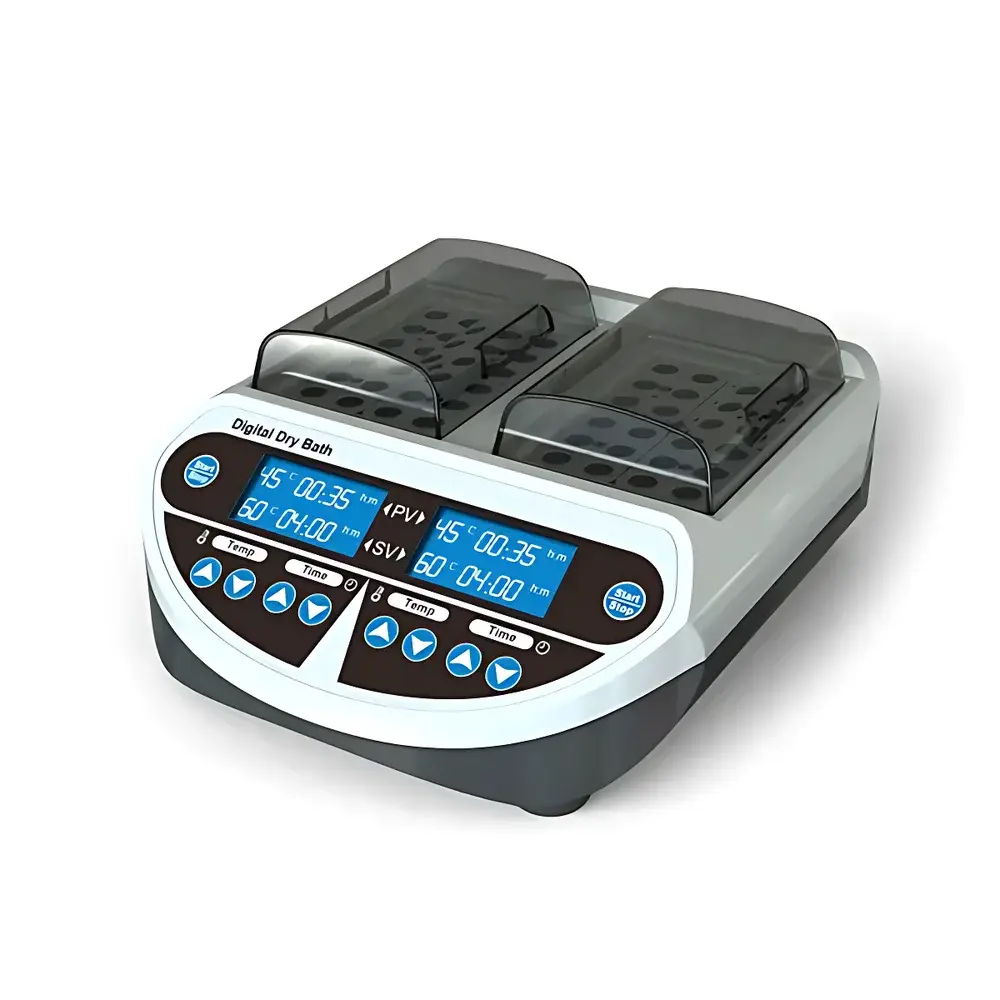
Jiayuan BTH-100 Dual-Zone Dry Block Thermostat
| Brand | Jiayuan |
|---|---|
| Origin | Beijing, China |
| Model | BTH-100 |
| Temperature Range (Heating) | RT + 5°C to 100°C |
| Temperature Range (Cooling) | –10°C to 100°C |
| Temperature Stability @ 100°C | ≤ ±0.5°C |
| Block Uniformity | ≤ ±0.3°C |
| Display Resolution | 0.1°C |
| Ramp Time (20°C → 100°C) | ≤ 15 min |
| Cooling Time (RT → RT–25°C, ambient ≤ 26°C) | ≤ 25 min |
| Max Power | 150 W |
| Dimensions (W×D×H) | 260 × 240 × 168 mm |
| Net Weight | 2.2 kg |
| Module Capacity | Up to 8 interchangeable blocks |
| Timer Range | 0–99 h 59 min |
Overview
The Jiayuan BTH-100 Dual-Zone Dry Block Thermostat is an engineered thermal management platform designed for precise, independent temperature control across two physically separated heating/cooling blocks. Unlike single-zone dry baths, the BTH-100 employs a dual-thermal-path architecture—featuring separate Peltier-based heating and cooling circuits—to enable simultaneous operation at distinct setpoints within a single instrument footprint. This design supports parallel sample processing workflows common in molecular biology, clinical diagnostics, and pharmaceutical QC labs, where differential incubation (e.g., enzyme activation at 37°C while maintaining reagent stability at 4°C) or comparative thermal profiling is required. The unit operates without consumables (e.g., water, oil, or cryogens), eliminating evaporation drift, contamination risk, and maintenance overhead associated with liquid baths. Its solid-state thermal regulation delivers high reproducibility (±0.3°C block uniformity) and rapid thermal response—critical for time-sensitive protocols such as nucleic acid denaturation, ligase inactivation, or cell lysis optimization.
Key Features
- Dual independent thermal zones with fully decoupled PID control algorithms—each zone programmable from –10°C to 100°C with 0.1°C resolution.
- OLED graphical interface with real-time dual-channel display: simultaneous readout of setpoint, actual temperature, countdown timer, and system status indicators.
- Integrated self-calibration routine for temperature offset correction; user-accessible via menu-driven calibration mode using NIST-traceable reference probes.
- Multi-layer safety architecture: hardware-limited overtemperature cutoff (110°C mechanical fuse), software-enforced thermal runaway detection, audible alarm on fault condition, and automatic shutdown on sensor failure.
- Modular block system compliant with ISO 8573-1 cleanroom-compatible materials (anodized aluminum alloy); all blocks feature precision-machined wells with ±0.05 mm tolerance for consistent tube contact and minimal thermal bridging.
- Low-power operation (≤150 W max) with passive heat-sink-assisted thermal dissipation—no fans or compressors, ensuring silent operation in noise-sensitive environments (e.g., laminar flow hoods, imaging suites).
Sample Compatibility & Compliance
The BTH-100 accommodates a wide range of standard laboratory vessels through eight interchangeable block configurations—including 0.2 mL PCR strips (24-well and 96-well formats), 0.5–2.0 mL microcentrifuge tubes, and larger 15 mL and 50 mL conical tubes. All blocks are autoclavable (121°C, 20 min) and chemically resistant to common solvents (ethanol, isopropanol, dilute acids/bases). The instrument meets IEC 61010-1:2010 safety requirements for laboratory electrical equipment and complies with electromagnetic compatibility standards per EN 61326-1:2013. While not certified for GMP manufacturing use out-of-the-box, its audit-ready features—including password-protected parameter locking, event-log timestamping, and non-volatile memory retention—support alignment with GLP documentation practices and FDA 21 CFR Part 11 data integrity expectations when integrated into validated lab workflows.
Software & Data Management
The BTH-100 operates as a standalone instrument with no external PC dependency. All operational parameters—including dual-zone setpoints, ramp rates, hold durations, and calibration offsets—are stored in non-volatile flash memory with battery-backed SRAM for power-loss resilience. The OLED interface logs up to 1,000 system events (e.g., temperature deviations > ±1.0°C, door-open alerts, calibration actions) with UTC timestamps. Optional RS-232 serial output (DB9 connector) enables integration with Lab Information Management Systems (LIMS) or custom SCADA platforms for remote monitoring and automated report generation. Firmware updates are performed via USB port using vendor-provided .bin files—validated checksums ensure firmware integrity prior to installation.
Applications
- Parallel enzymatic reactions requiring differential thermal conditions (e.g., restriction digest at 37°C + phosphatase treatment at 65°C).
- Thermal equilibration of reagents prior to qPCR setup—maintaining master mix at 4°C while preheating primers at 25°C.
- Controlled denaturation/renaturation studies of protein samples under gradient-free, vibration-free conditions.
- Stability testing of biologics across defined temperature stress points (–10°C, 4°C, 25°C, 37°C, 56°C) using sequential block swapping.
- Pre-incubation of blood culture bottles or urine specimens at standardized temperatures prior to microbiological analysis (CLSI M22-A3 compliant workflows).
FAQ
Can the BTH-100 operate both zones at extreme opposing temperatures simultaneously (e.g., –10°C and 100°C)?
Yes—the dual-zone architecture allows independent operation within the full specified range; however, sustained maximum differential (>110°C) may reduce long-term thermal cycling endurance due to cumulative Peltier junction stress.
Are third-party blocks compatible with the BTH-100?
Only Jiayuan-certified BT-100 series blocks are guaranteed for thermal performance and safety compliance; non-OEM blocks may compromise temperature uniformity and void warranty coverage.
Does the instrument support programmable multi-step temperature profiles?
No—the BTH-100 implements single-setpoint, single-hold timing per zone; complex ramp-and-hold sequences require external controller integration via RS-232.
What is the recommended recalibration interval for routine QC use?
Per ISO/IEC 17025 guidance, annual verification against traceable reference thermometers is advised; more frequent checks (e.g., daily pre-use verification) are recommended for regulated applications.
Is condensation management included for sub-ambient operation?
The base unit incorporates hydrophobic venting and internal dew-point suppression circuitry; users operating below 10°C in humid environments (>60% RH) should apply desiccant packs inside the enclosure or use optional insulated lid covers.



