
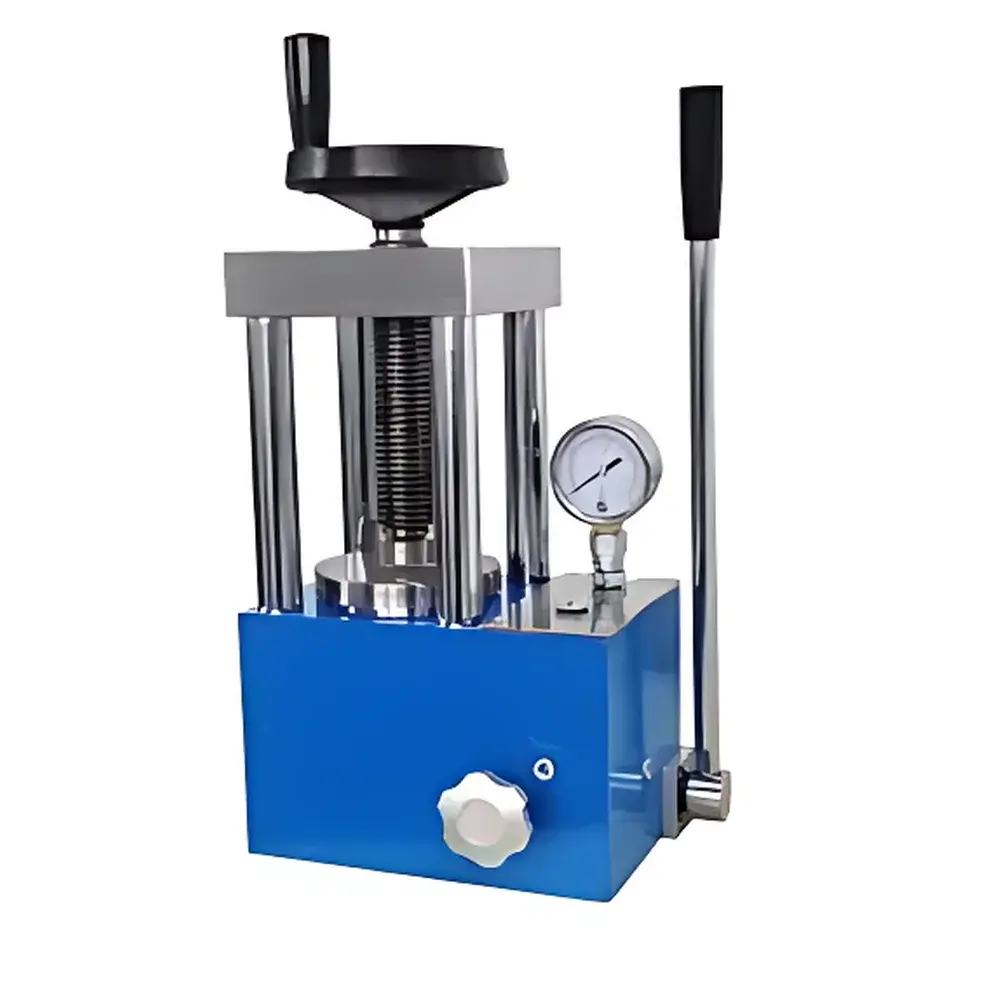
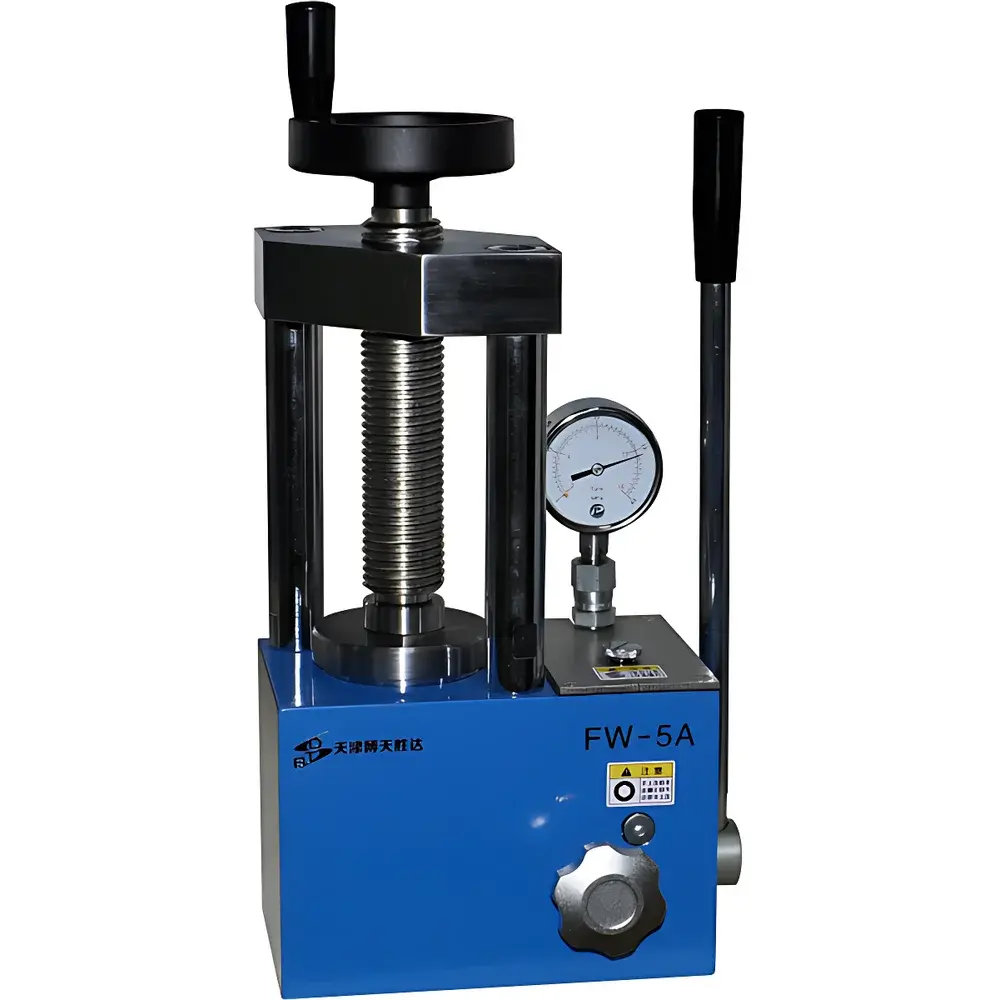
Jiayuan FW-4 Manual Hydraulic Pellet Press
| Brand | Jiayuan |
|---|---|
| Origin | Beijing, China |
| Manufacturer Type | Authorized Distributor |
| Country of Origin | China |
| Model | FW-4 |
| Instrument Type | Manual Hydraulic Pellet Press |
| Pressure Range | 0–24 T (0–38 MPa) |
| Maximum Piston Stroke | 20 mm |
| Oil Cylinder Diameter | Φ70 mm |
| Pressure Gauge | Dual-Scale Analog Pressure Gauge |
| Working Table Diameter | 80 mm |
| Working Chamber Dimensions | 120 × 120 × 130 mm |
| Pressure Stability | ≤1 MPa/10 min |
| Net Weight | 25 kg |
| Overall Dimensions | 240 × 170 × 390 mm |
| Construction | Monolithic Cast Aluminum Base Plate, Chrome-Plated Oil Cylinder, Four-Guided Column Architecture |
| Handle & Crank Material | Anodized Aluminum Alloy |
Overview
The Jiayuan FW-4 Manual Hydraulic Pellet Press is a precision-engineered, single-unit hydraulic press designed specifically for reproducible sample pelletization in analytical laboratories—particularly for Fourier Transform Infrared (FTIR) spectroscopy, X-ray fluorescence (XRF), and powder X-ray diffraction (XRD) sample preparation. Unlike conventional two-piece or bolted-frame manual presses, the FW-4 integrates the base plate, oil reservoir, cylinder, and column guide system into a rigid monolithic architecture. This structural consolidation eliminates interfacial leakage paths, significantly improving long-term pressure retention and operational reliability. The press operates on fundamental Pascal’s principle: manual force applied via the aluminum alloy crank is hydraulically amplified through an incompressible mineral oil medium within the chrome-plated Φ70 mm cylinder, delivering calibrated compressive loads up to 24 metric tons (38 MPa). Its design prioritizes mechanical stability over speed—making it ideal for applications requiring static load maintenance during extended dwell periods, such as cold-compaction of KBr pellets or borate fusion discs.
Key Features
- Monolithic cast aluminum base structure with integrated oil reservoir and cylinder housing—eliminates gasket-dependent sealing interfaces and prevents hydraulic fluid leakage under sustained load.
- Chrome-plated hydraulic cylinder (Φ70 mm) with precision-ground internal bore and hardened piston rod—ensures consistent friction coefficient and minimizes hysteresis during loading/unloading cycles.
- Dual-scale analog pressure gauge (MPa and tonnage) with ±1.6% full-scale accuracy—enables real-time verification of applied load without external calibration tools.
- Four vertically aligned hardened steel guide columns—maintain parallelism between upper platen and lower table within ±0.02 mm across full stroke, critical for uniform pellet density and edge integrity.
- Anodized aluminum alloy handwheel and lever assembly—reduces operator fatigue during high-load compression and resists oxidation in humid laboratory environments.
- Pressure stability ≤1 MPa/10 min at maximum rated load—validated per ISO 6892-1 Annex E methodology for static load hold testing.
Sample Compatibility & Compliance
The FW-4 accommodates standard die sets (e.g., 13 mm, 16 mm, and 32 mm diameter punches and dies) compliant with ASTM E1795 and ISO 13705 for pressed pellet fabrication. It supports both dry powder compaction (e.g., KBr, CsI, polyethylene matrices) and binder-assisted consolidation (e.g., cellulose, boric acid). The 80 mm diameter working table and 120 × 120 × 130 mm internal cavity permit use of multi-cavity dies and auxiliary fixtures for QA/QC batch processing. All wetted components meet RoHS Directive 2011/65/EU material restrictions. While not certified for GMP manufacturing, the FW-4’s repeatable force delivery and documented pressure stability support GLP-compliant documentation workflows when paired with external digital load loggers.
Software & Data Management
As a manually operated hydraulic press, the FW-4 does not incorporate embedded electronics or firmware. However, its dual-scale pressure gauge output is compatible with third-party analog-to-digital transducers (e.g., 0–10 V or 4–20 mA output modules) for integration into LIMS or ELN systems. Laboratories implementing 21 CFR Part 11 compliance may record pressure values manually in bound logbooks or digitally via validated tablet-based entry forms—with operator signature, timestamp, and lot traceability for each pellet batch. Optional accessories include calibrated test load cells (traceable to NIST SRM 2100) for periodic verification of gauge linearity.
Applications
- Preparation of translucent KBr pellets for quantitative FTIR analysis of organic compounds, polymers, and pharmaceutical actives.
- Consolidation of powdered geological samples (e.g., soils, sediments, ores) for XRF elemental mapping with minimal matrix effects.
- Manufacture of low-porosity reference discs for wavelength-dispersive XRF calibration standards.
- Cold compaction of battery electrode powders (LiCoO₂, graphite anodes) prior to sintering or electrochemical testing.
- Forming of ceramic green bodies for thermal expansion or sintering kinetics studies under controlled ambient conditions.
FAQ
What is the maximum recommended dwell time at full 24-ton load?
The FW-4 maintains ≤1 MPa drift over 10 minutes; for optimal pellet homogeneity, dwell times exceeding 60 seconds are advised—especially for hygroscopic matrices like KBr.
Can the FW-4 be used with heated die holders?
No—the monolithic aluminum base is not rated for continuous operation above 50 °C; external heating must be applied only to removable die assemblies, not the press body.
Is recalibration of the pressure gauge required?
Yes—annual verification against a dead-weight tester or NIST-traceable hydraulic calibrator is recommended per ISO/IEC 17025 Clause 6.5.2.
What maintenance intervals are specified for hydraulic oil?
Mineral oil should be replaced every 24 months or after 500 operating cycles—whichever occurs first—to prevent viscosity degradation and seal swelling.
Does the FW-4 comply with CE or UL safety directives?
It is supplied without CE marking; users must conduct local risk assessment per EN 692 for manually actuated machinery before installation in EU-regulated facilities.
Related Products



