
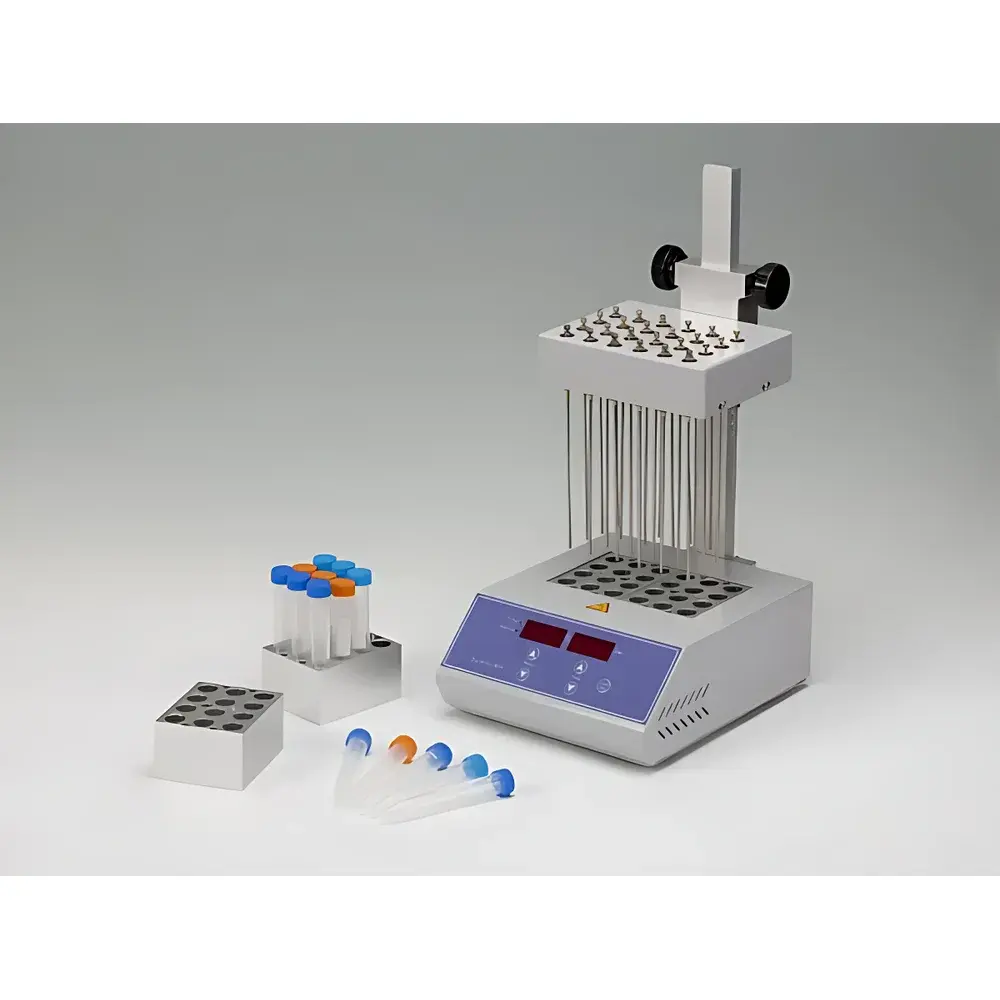
JIAYUAN MD200-1A Dry-Block Nitrogen Evaporator
| Brand | JIAYUAN |
|---|---|
| Origin | Beijing, China |
| Model | MD200-1A |
| Heating Method | Dry-block heating |
| Temperature Range | Ambient +5°C to 160°C |
| Temperature Stability | ±0.5°C (@40°C), ±1.0°C (@120°C) |
| Gas Flow Rate | 15 L/min |
| Sample Capacity | 12 positions |
| Heating Power | 300 W |
| Display Resolution | 0.1°C |
| Timer Range | 1–99 h 59 min |
| Ramp Time | ≤15 min (25°C → 160°C) |
| Max Lift Travel | 200 mm |
| Dimensions (L×W×H) | 260 × 220 × 450 mm |
| Weight | 6.5 kg |
| Compatible Modular Blocks | BK15–BK21 (12-position, diameters 10–20 mm) |
Overview
The JIAYUAN MD200-1A Dry-Block Nitrogen Evaporator is an engineered solution for controlled, inert-gas-assisted solvent removal in analytical sample preparation workflows. It operates on the principle of gentle, targeted nitrogen gas impingement onto the surface of liquid samples housed in standard test tubes or vials, coupled with precise conductive heating via a high-thermal-conductivity aluminum block. This dual-mode approach—combining regulated gas flow and stable dry-block temperature control—enables reproducible concentration of volatile organic solvents without thermal degradation of thermolabile analytes. Unlike water-bath evaporators, the dry-block design eliminates contamination risks from bath media, ensures rapid thermal response, and supports operation across a broad temperature range (ambient +5°C to 160°C), making it suitable for applications ranging from low-boiling solvents (e.g., dichloromethane, hexane) to higher-boiling matrices (e.g., ethyl acetate, methanol). The instrument is designed for integration into GLP-compliant laboratories where traceability, consistency, and method robustness are critical.
Key Features
- Independent gas needle channels—each with dedicated flow control valve—eliminate cross-contamination between samples and support heterogeneous sample sets.
- Vertically aligned needle-to-module positioning ensures intuitive, ergonomic adjustment; flow valves directly correspond to individual tube wells for repeatable setup.
- PID-controlled dry-block heating system delivers high thermal uniformity (±0.5°C at 40°C; ±1.0°C at 120°C) and rapid ramp performance (≤15 min from 25°C to 160°C).
- Motorized vertical lift mechanism with mechanical safety lock pin prevents unintended descent during operation, enhancing long-term positional stability and user safety.
- Digital LED display with 0.1°C resolution and programmable timer (1–99 h 59 min) enables unattended, protocol-driven evaporation sequences.
- Modular aluminum heating block accepts interchangeable 12-position inserts (BK15–BK21), accommodating tube diameters from 10 mm to 20 mm—ideal for diverse vial standards used in HPLC, GC, LC-MS, and EPA methods.
Sample Compatibility & Compliance
The MD200-1A supports common laboratory consumables including borosilicate glass test tubes, crimp-top vials, and polypropylene microcentrifuge tubes. Its inert nitrogen environment minimizes oxidation of sensitive compounds—critical in pesticide residue analysis (e.g., EPA Method 525.3), environmental contaminant quantification (e.g., EPA 8081B), and clinical hormone profiling. While not certified to IEC 61010-1 or ISO/IEC 17025 out-of-the-box, the instrument’s architecture—including stable temperature regulation, non-volatile heating elements, and mechanical interlocks—aligns with foundational safety and performance expectations for Class II laboratory equipment. Users implementing this system in regulated environments (e.g., pharmaceutical QC labs) may validate temperature uniformity per ASTM E2209, verify gas flow consistency using calibrated mass flow meters, and document calibration records per internal SOPs referencing ISO/IEC 17025 Clause 6.4.
Software & Data Management
The MD200-1A operates as a standalone hardware platform with no embedded software or network interface. All operational parameters—including setpoint temperature, timer duration, and real-time display—are managed locally via front-panel controls. For laboratories requiring electronic recordkeeping, external data loggers (e.g., USB-connected thermocouple arrays or pressure transducers) can be deployed to capture time-stamped temperature and gas flow profiles. When integrated into validated workflows under FDA 21 CFR Part 11, users must implement procedural controls—such as dual-operator verification of setpoints, printed calibration logs, and audit-trail documentation—to satisfy ALCOA+ principles (Attributable, Legible, Contemporaneous, Original, Accurate).
Applications
- Agricultural residue analysis: Concentration of extracts from fruits, vegetables, grains, and plant tissues prior to GC-ECD or LC-MS/MS detection.
- Environmental monitoring: Pre-concentration of aqueous samples (drinking water, groundwater, wastewater) for PAHs, PCBs, organochlorines, and neonicotinoids per EPA and ISO standards.
- Clinical & forensic toxicology: Sample cleanup in steroid hormone, vitamin D metabolite, and drug metabolite workflows where oxidative stability is essential.
- Food & beverage safety: Residue testing in dairy products, alcoholic beverages, and infant formula—particularly where matrix complexity demands clean, low-background evaporation.
- Pharmaceutical R&D: Parallel concentration of reaction mixtures, combinatorial library fractions, and botanical extract fractions during lead optimization and stability studies.
FAQ
What types of solvents are compatible with the MD200-1A?
The system is optimized for common organic solvents with boiling points below 160°C, including acetonitrile, methanol, ethanol, ethyl acetate, hexane, and dichloromethane. High-boiling solvents (e.g., DMSO, glycerol) are not recommended.
Can the instrument be used under inert atmosphere gloveboxes?
Yes—the compact footprint (260 × 220 × 450 mm) and absence of external ventilation requirements allow safe operation inside nitrogen-purged gloveboxes, provided gas supply lines are properly routed and pressure-regulated.
Is temperature calibration traceable to national standards?
The unit includes a manual offset calibration function. Users must perform periodic verification using a NIST-traceable reference thermometer inserted into designated calibration wells within the block.
Are replacement modules available for non-standard tube formats?
Standard offerings cover 10–20 mm diameters (BK15–BK21). Custom aluminum blocks can be fabricated upon request, subject to minimum order quantity and dimensional constraints.
Does the device meet CE or UL safety certification?
This model is manufactured for the domestic Chinese market and does not carry CE, UL, or UKCA markings. International users must conduct local regulatory assessment prior to deployment.



