
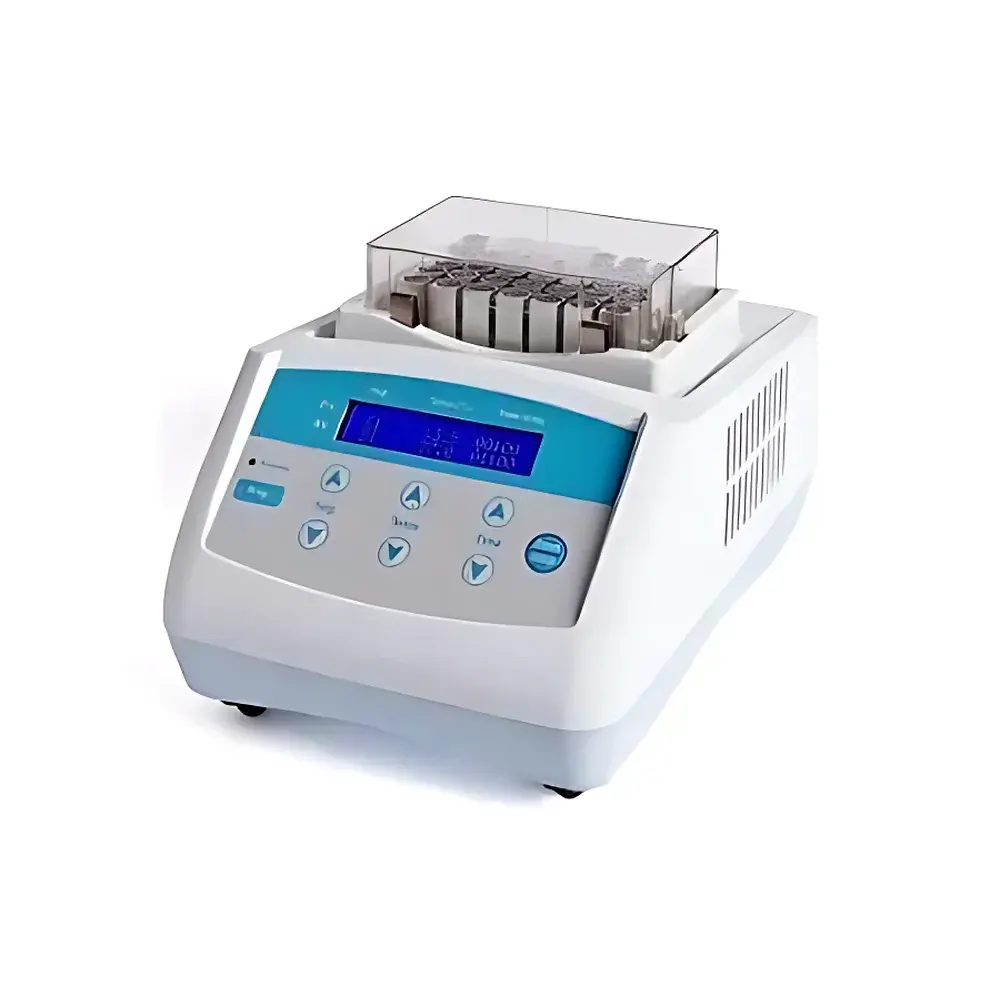
JIAYUAN MK-10 Dry Block Heater
| Brand | JIAYUAN |
|---|---|
| Origin | Beijing, China |
| Model | MK-10 |
| Temperature Range | Ambient +5°C to 100°C |
| Temperature Accuracy | ≤ ±0.5°C |
| Temperature Uniformity (at 40°C) | ≤ ±0.3°C |
| Block Temperature Stability (at 100°C) | ≤ ±0.5°C |
| Heating Time | ≤15 min (20°C → 100°C) |
| Display Resolution | 0.1°C |
| Max Timer Setting | 99 h 59 min |
| Power Consumption | 150 W |
| Net Weight | 2.2 kg |
| Dimensions (W×D×H) | 270 × 190 × 170 mm |
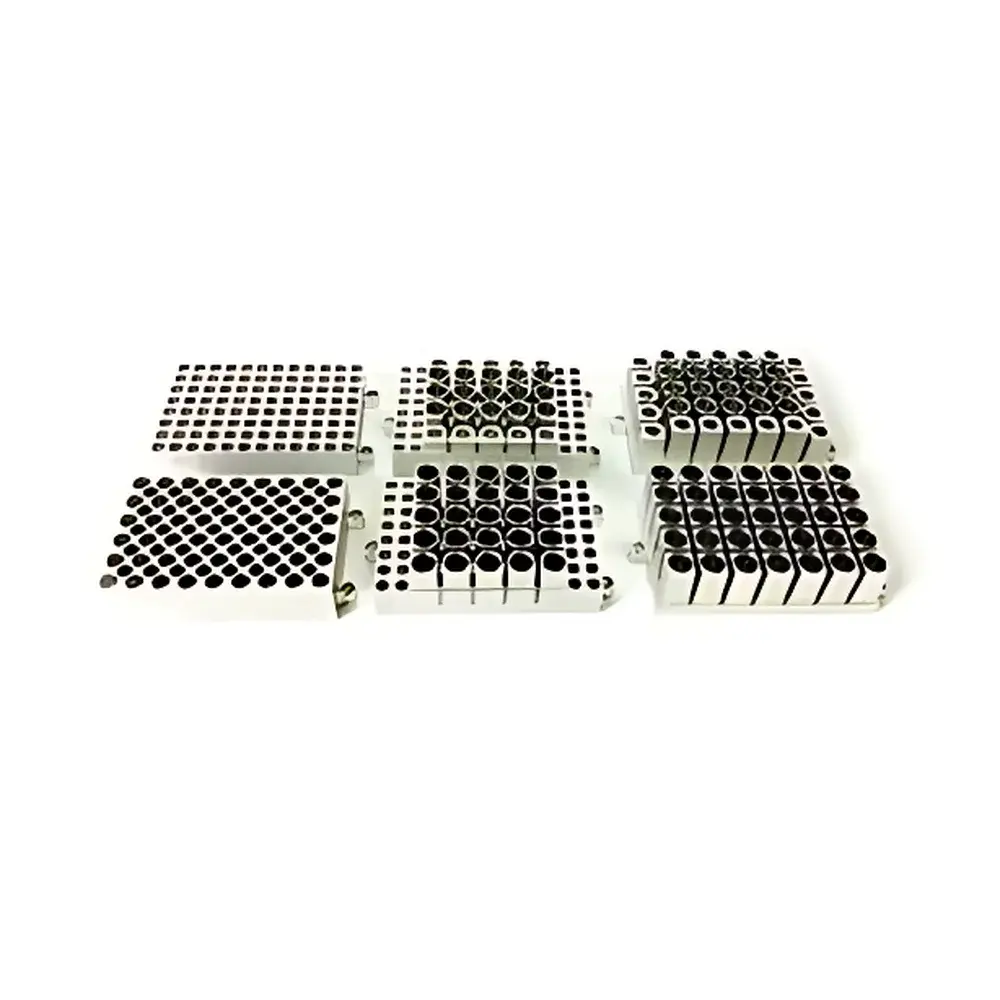
| Interchangeable Block Options | A–N (including 96-well PCR plates, 0.2–50 mL tube formats, and custom blocks) |
Overview
The JIAYUAN MK-10 Dry Block Heater is a microprocessor-controlled dry bath incubation system engineered for precise, uniform, and repeatable thermal management of biological and chemical samples in laboratory environments. Unlike water baths—whose temperature gradients, evaporation losses, contamination risks, and maintenance demands limit operational reliability—the MK-10 employs solid aluminum heating blocks with optimized thermal mass and conduction pathways to deliver rapid, stable, and contamination-free heating across diverse tube and plate formats. Its design adheres to fundamental principles of conductive heat transfer and PID-based closed-loop temperature regulation, ensuring consistent thermal delivery without reliance on liquid media. The unit operates within a calibrated range from ambient +5°C to 100°C, making it suitable for applications requiring controlled denaturation, enzyme inactivation, serum coagulation, sample thawing, and pre-PCR incubation steps.
Key Features
- High-contrast blue LCD display with intuitive dual-set interface: independent time and temperature programming, real-time temperature readout, and countdown timer with minute-second resolution.
- Rapid thermal response: achieves 100°C from 20°C in ≤15 minutes, enabled by high-efficiency resistive heating elements and low-thermal-inertia aluminum blocks.
- Temperature stability of ≤±0.5°C at 100°C and uniformity of ≤±0.3°C across the block surface at 40°C—validated per ISO/IEC 17025-aligned internal calibration protocols.
- Built-in temperature offset calibration function, allowing users to correct minor deviations against traceable reference thermometers without service intervention.
- Dual safety architecture: electronic overtemperature cutoff (independent of main controller) plus automatic fault detection with audible alarm and visual error code indication.
- Compact footprint (270 × 190 × 170 mm) and lightweight construction (2.2 kg) facilitate integration into biosafety cabinets, laminar flow hoods, or crowded benchtop workflows.
- Modular block system supports 14 standardized configurations—from 96-well PCR plates and 0.2 mL strips to 50 mL conical tubes—with all blocks manufactured from anodized aluminum for corrosion resistance and autoclavability (121°C, 20 min).
Sample Compatibility & Compliance
The MK-10 accommodates a broad spectrum of primary labware through its interchangeable block system—including thin-walled PCR tubes, skirted and non-skirted 96-well plates, microcentrifuge tubes (0.5–2.0 mL), cryovials, and larger-volume vessels up to 50 mL. All standard blocks are dimensionally compliant with ANSI/SLAS standards for well plate geometry and tube diameter tolerances. While the device itself does not carry CE, UKCA, or FDA 510(k) certification, its electrical design conforms to IEC 61010-1:2010 safety requirements for laboratory equipment. Temperature performance data may be documented for GLP/GMP traceability when used in regulated workflows; however, full 21 CFR Part 11 compliance requires integration with validated third-party LIMS or ELN software.
Software & Data Management
The MK-10 operates as a standalone instrument with no embedded firmware connectivity (e.g., USB, Bluetooth, or Ethernet). All operational parameters—including setpoint, duration, and real-time temperature—are displayed locally and retained only during active use. For audit-ready documentation, users must manually record settings and outcomes or integrate external digital loggers (e.g., calibrated thermocouple-based data acquisition systems) synchronized with procedural timestamps. Optional RS-232 or analog output modules are available upon request for OEM integration but are not included in the base configuration.
Applications
- Thermal pre-treatment of serum samples for coagulation assays (e.g., fibrinogen quantification, prothrombin time testing).
- Controlled denaturation of DNA templates prior to polymerase chain reaction (PCR) amplification and electrophoretic analysis.
- Enzyme inactivation steps following restriction digests or ligations in molecular cloning workflows.
- Consistent warming of reagents (e.g., agarose solutions, antibody diluents, cell culture media) to avoid thermal shock during experimental setup.
- Accelerated drying of small-volume samples post-extraction or precipitation, particularly where solvent volatility precludes vacuum or centrifugal methods.
- Stabilization of temperature-sensitive standards and calibrants during analytical method validation under ISO/IEC 17025 conditions.
FAQ
Is the MK-10 suitable for use with volatile organic solvents?
No. Aluminum blocks are not chemically resistant to chlorinated or aromatic solvents; only aqueous or alcohol-based solutions should contact heated surfaces.
Can the temperature calibration be verified externally?
Yes. Each block includes a dedicated 1/4″ probe port for insertion of a NIST-traceable thermometer or thermocouple to cross-validate displayed values.
Are replacement blocks supplied with calibration certificates?
Standard blocks ship without individual calibration reports; however, batch-level thermal uniformity test data is available upon request for quality assurance documentation.
Does the MK-10 support ramp-and-hold temperature profiles?
No. It provides only single-setpoint heating with fixed-time countdown; multi-step thermal protocols require external programmable controllers.
What maintenance is required to sustain long-term accuracy?
Annual verification using a certified reference thermometer is recommended; cleaning should be performed with isopropyl alcohol and lint-free wipes—never abrasive or acidic agents.



