
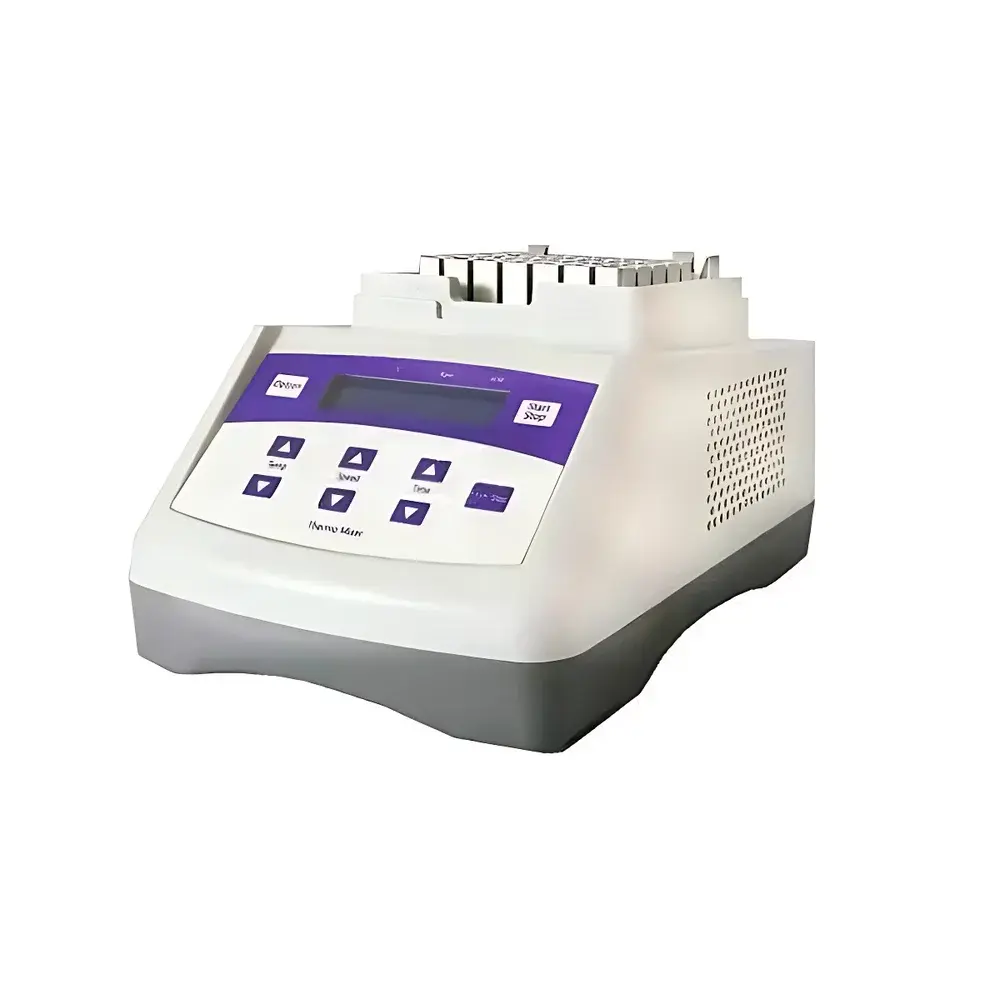
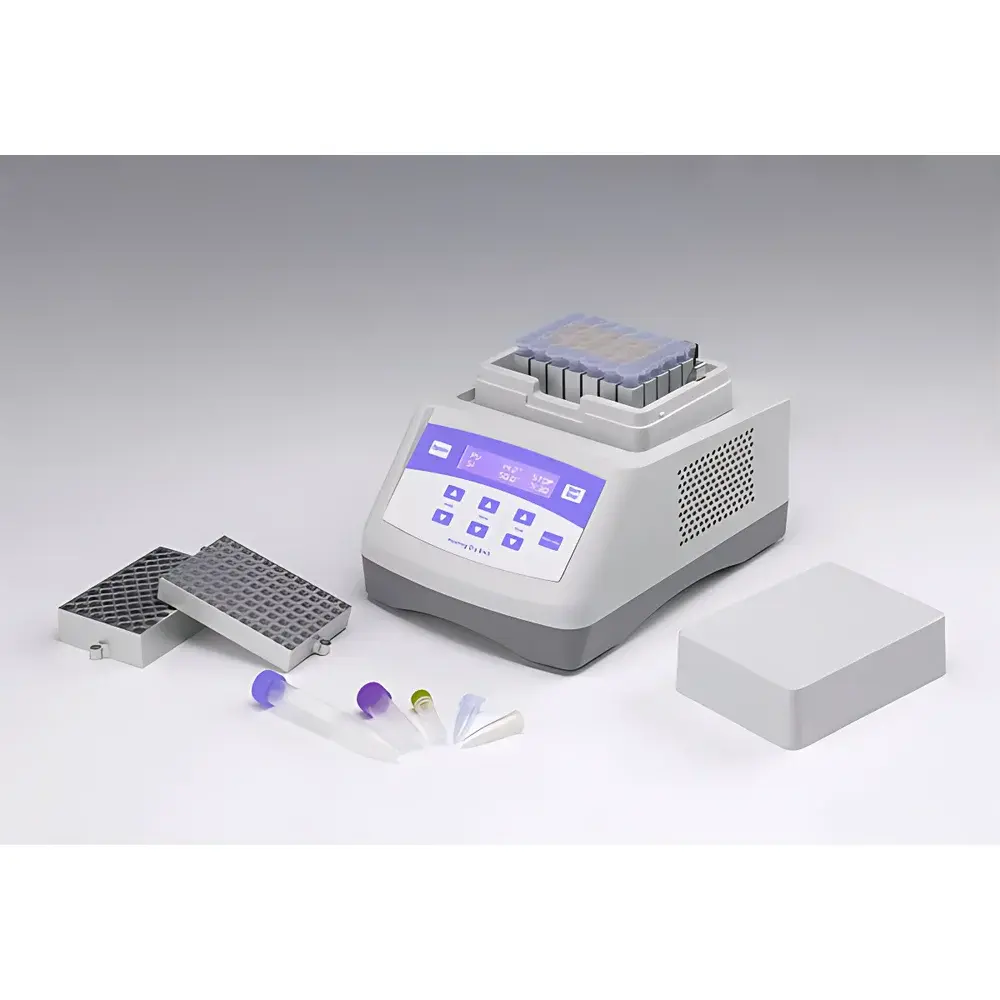
JIAYUAN MK-10 Heated Metal Block Dry Bath
| Brand | JIAYUAN |
|---|---|
| Model | MK-10 |
| Temperature Range | 0°C to 100°C |
| Temperature Accuracy | ≤ ±0.3°C |
| Heating Time | ≤12 min (from 25°C to 100°C) |
| Display Resolution | 0.1°C |
| Timer Range | 0–99 h 59 min |
| Power Consumption | 150 W |
| Net Weight | 2.2 kg |
| Dimensions (W×D×H) | 270 × 190 × 170 mm |
| Module Compatibility | Interchangeable aluminum blocks for tubes (0.2–50 mL), microplates, and custom cavities |
Overview
The JIAYUAN MK-10 Heated Metal Block Dry Bath is a microprocessor-controlled dry heating system engineered for precise, uniform thermal management of biological and chemical samples in laboratory environments. Unlike traditional water baths—prone to contamination, evaporation, and inconsistent heat transfer—the MK-10 utilizes solid aluminum heating blocks with optimized thermal conductivity and minimal thermal inertia. Its operation is based on resistive heating elements embedded beneath machined aluminum modules, delivering rapid, stable, and repeatable temperature control across the full operational range of 0°C to 100°C. Designed for applications requiring strict thermal consistency without liquid media, the MK-10 serves as a robust alternative for sample incubation, enzyme inactivation, serum coagulation, DNA denaturation prior to PCR, and pre-electrophoresis sample preparation. The device meets core functional requirements for GLP-compliant workflows where traceability, reproducibility, and minimal maintenance are essential.
Key Features
- High-precision digital PID temperature control with real-time feedback loop, achieving ≤ ±0.3°C accuracy at 100°C and ≤ ±0.5°C stability under continuous operation.
- Ultra-fast heating performance: reaches 100°C from ambient (25°C) in ≤12 minutes, minimizing protocol downtime.
- Large backlit blue LCD display with dual parameter interface—simultaneous time countdown and setpoint/actual temperature readout at 0.1°C resolution.
- Integrated safety architecture including over-temperature cut-off, automatic fault detection, audible alarm, and self-calibrating temperature offset compensation.
- Compact footprint (270 × 190 × 170 mm) and low power draw (150 W) enable deployment on crowded benchtops without HVAC load concerns.
- Modular aluminum block system supports rapid interchange between standardized configurations—including 96-well PCR plates, 0.2 mL strips, 1.5/2.0 mL microcentrifuge tubes, 5–50 mL conical tubes, and custom-machined wells—facilitating cleaning, sterilization, and cross-application flexibility.
Sample Compatibility & Compliance
The MK-10 accommodates a broad spectrum of sample containers through its interchangeable block system, validated for use with polypropylene, polycarbonate, and borosilicate glass vessels ranging from 0.2 mL PCR tubes to 50 mL centrifuge tubes. All standard modules undergo thermal uniformity mapping per ASTM E2203–18 (Standard Practice for Calibration of Laboratory Thermometers), confirming ≤0.3°C inter-well variation at 40°C—a critical threshold for enzymatic assays and coagulation studies. While the unit itself is not CE-marked or FDA-listed as a medical device, its design aligns with ISO/IEC 17025:2017 general requirements for calibration laboratories and supports internal validation protocols required under USP Analytical Instrument Qualification. It is routinely deployed in QC/QA labs performing routine serology (e.g., clotting time assays per CLSI H21-A5) and molecular biology workflows compliant with ISO 15189 Annex A.5.
Software & Data Management
The MK-10 operates as a standalone instrument with no external software dependency. All configuration and monitoring occur via the onboard keypad and LCD interface. Time and temperature settings are retained after power cycling. Though it lacks USB or Ethernet connectivity, the device supports manual audit trail generation through operator logbooks referencing batch numbers, block IDs, setpoints, durations, and observed deviations—sufficient for basic 21 CFR Part 11–aligned documentation when paired with institutional SOPs. For laboratories requiring electronic data capture, third-party environmental monitoring systems may integrate via analog voltage output (optional accessory) or external thermocouple logging synchronized with timer events.
Applications
- Serum and plasma coagulation assays requiring precise 37°C incubation followed by controlled 56°C heat inactivation.
- Pre-PCR thermal denaturation of genomic DNA templates at 95°C for consistent strand separation.
- Enzyme activity studies demanding tight thermal control across multi-step reaction kinetics (e.g., restriction digests, ligations).
- Routine storage and equilibration of reagents sensitive to thermal shock—such as antibodies, ligases, and reverse transcriptases—at defined holding temperatures (e.g., 4°C, 25°C, 37°C).
- Accelerated stability testing of formulations in small-volume vials under ISO 14644-1 Class 5 cleanbench conditions.
- Supporting ASTM D5293 (low-temperature engine oil viscosity) sample conditioning in materials testing labs.
FAQ
Does the MK-10 support refrigeration or cooling functionality?
No—the MK-10 is a heated-only dry bath. Refrigerated operation is available exclusively in the companion MK-20 model.
Can I validate temperature uniformity across the block myself?
Yes—using a calibrated NIST-traceable probe and following ISO/IEC 17025 Annex B.3 guidelines, users may map up to 9 points per module to verify ≤±0.3°C deviation.
Are replacement modules certified for autoclaving?
All standard aluminum modules are autoclavable at 121°C for 20 minutes; however, repeated cycles may affect surface finish and thermal contact integrity over time.
What is the recommended maintenance interval?
Visual inspection and cleaning of heater surfaces every 6 months; annual verification of temperature accuracy using reference standards is advised for regulated environments.
Is firmware upgrade capability supported?
No—the MK-10 uses fixed-function embedded firmware; updates are not field-serviceable and require factory-level reprogramming if revision changes occur.



