
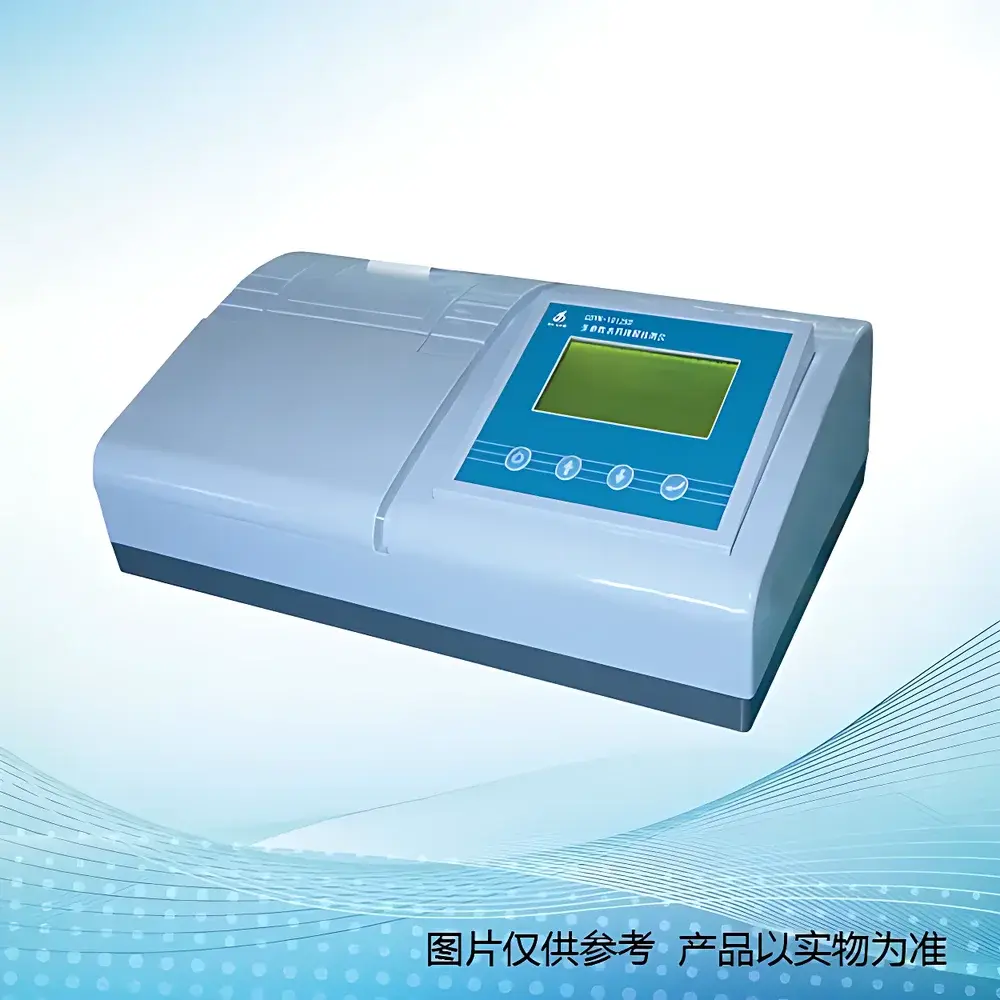
JiDa Xiaotian’e GDYN-1012SD Multi-parameter Pesticide Residue Analyzer
| Brand | JiDa Xiaotian'e |
|---|---|
| Origin | Jilin, China |
| Manufacturer Type | Direct Manufacturer |
| Country of Origin | China |
| Model | GDYN-1012SD |
| Detection Methods | Enzyme Inhibition Assay, Thin-layer Chromatography (TLC) |
| Measurement Range | Organophosphates & Carbamates Inhibition Rate: 0–100% |
| Organochlorines | 0.0–40.0 mg/kg |
| Pyrethroids | 0.0–40.0 mg/kg |
| Number of Channels | 12 |
| Measurement Error | ±10% |
| LOD | Organophosphates & Carbamates: 0.01–3.0 mg/kg |
| Organochlorines | 0.3 mg/kg |
| Pyrethroids | 0.3 mg/kg |
| Light Sources | High-brightness LEDs at 405 nm and 254 nm |
| Absorbance Range | 0.000–2.000 Abs |
| Dimensions | 470 × 280 × 180 mm |
| Weight | 3.6 kg |
| Power Supply | AC 220 V ± 10%, 50 Hz ± 1 Hz |
Overview
The JiDa Xiaotian’e GDYN-1012SD Multi-parameter Pesticide Residue Analyzer is a dedicated benchtop instrument engineered for rapid, on-site screening of pesticide residues in fresh produce and agricultural commodities. It operates on two complementary analytical principles: enzyme inhibition assay (EIA) for organophosphate and carbamate pesticides, and thin-layer chromatography (TLC) coupled with densitometric quantification for organochlorine and pyrethroid compounds. The system integrates photometric detection at dual wavelengths—405 nm for EIA-based colorimetric reaction monitoring and 254 nm for UV visualization of TLC-separated analytes—enabling simultaneous multi-class pesticide assessment within a single platform. Designed for food safety laboratories, regulatory inspection units, and farm-gate quality control stations, the GDYN-1012SD supports routine compliance screening against national maximum residue limits (MRLs), including those specified in GB 2763–2021 (China’s National Food Safety Standard for Pesticide Residue Limits). Its architecture emphasizes operational robustness, minimal reagent consumption, and reproducible results under variable ambient conditions.
Key Features
- 12-channel parallel detection capability for organophosphate and carbamate pesticides via enzyme inhibition assay, with independent temperature-controlled reaction zones (25–40 °C adjustable per channel); real-time thermal monitoring and over-temperature alarm ensure assay fidelity.
- Dual-wavelength optical system: high-stability LED sources at 405 nm (for acetylcholinesterase inhibition quantification) and 254 nm (for UV-activated TLC plate imaging), eliminating need for mercury lamps or external UV cabinets.
- Integrated 4.7-inch LCD interface with full Chinese menu navigation, clock/date display, and audible prompts for power-on, measurement initiation, and endpoint detection.
- Low-volume assay format: uses standardized 1 mL cylindrical cuvettes for EIA—no solution transfer required—reducing pipetting error and cross-contamination risk.
- Hybrid operation mode: supports standalone field use (battery-compatible via optional DC adapter) and networked lab deployment via RS232/USB interfaces for centralized data aggregation.
- Onboard thermal printer enables immediate hardcopy output of sample ID, test date, measured inhibition rate/concentration, and operator ID—fully traceable for internal QA records.
Sample Compatibility & Compliance
The GDYN-1012SD is validated for homogenized extracts from leafy vegetables (e.g., spinach, lettuce), fruit pulps (e.g., apple, tomato), and herb samples following standardized QuEChERS-inspired or acetone/water extraction protocols. It complies with methodological frameworks referenced in GB/T 5009.199–2003 (determination of organophosphates by enzyme inhibition) and GB/T 5009.146–2003 (TLC detection of DDT and HCH isomers). While not certified to ISO/IEC 17025 for accredited testing, its performance metrics—including ±10% measurement uncertainty and sub-mg/kg LODs—align with screening-level requirements defined in EU Regulation (EC) No 396/2005 Annex I for preliminary residue assessment. Temperature-controlled incubation and fixed-wavelength photometry support GLP-aligned documentation practices when paired with audit-trail-enabled software.
Software & Data Management
The instrument’s embedded firmware supports local storage of >2,000 test records, each tagged with timestamp, sample ID, operator code, and raw absorbance values. PC-based companion software (Windows-compatible) provides remote instrument control, customizable assay templates (e.g., adjustable pre-incubation and chromogenic reaction durations), and batch result review. All user inputs—including sample name, analyte class, testing institution, and analyst signature—are logged in metadata fields. Export functionality includes native Excel (.xlsx) formatting for integration into LIMS environments. Data transmission adheres to serial communication protocols compliant with FDA 21 CFR Part 11 basic electronic record requirements (user authentication, time-stamped audit trail, and non-editable result archiving upon finalization).
Applications
- Routine surveillance of retail and wholesale produce for acute neurotoxic pesticides (e.g., chlorpyrifos, methamidophos, carbofuran) using enzyme inhibition kinetics.
- Confirmatory TLC screening for persistent organochlorines (e.g., p,p′-DDT, β-HCH) and synthetic pyrethroids (e.g., deltamethrin, bifenthrin) in dried herbs and spices where matrix interference limits ELISA applicability.
- Field-deployable verification at cold-chain distribution hubs to enforce supplier MRL compliance prior to market entry.
- Educational use in food science curricula for teaching fundamental principles of enzymatic biosensing and planar chromatographic separation.
- Supporting HACCP critical control point monitoring in fresh-cut processing facilities through daily residue trend analysis.
FAQ
What pesticide classes does the GDYN-1012SD detect, and what are the primary methods used?
It detects organophosphates and carbamates via enzyme inhibition assay (EIA), and organochlorines and pyrethroids via thin-layer chromatography (TLC) with UV densitometry at 254 nm.
Is the instrument suitable for quantitative analysis or only qualitative/semi-quantitative screening?
It delivers semi-quantitative results—expressed as inhibition percentage (EIA) or concentration estimates (TLC)—intended for rapid pass/fail decisions against regulatory thresholds, not definitive quantification per ISO 17025 standards.
Can the device be integrated into a laboratory information management system (LIMS)?
Yes—via USB or RS232, exported Excel files and ASCII log outputs enable manual or scripted ingestion into third-party LIMS platforms.
Does the system require external calibration standards for each test run?
EIA mode requires daily blank and positive control checks; TLC mode relies on co-chromatographed reference standards spotted on the same plate for relative Rf and intensity comparison.
What maintenance is required to ensure long-term photometric accuracy?
LED light sources are rated for >10,000 hours; periodic verification using neutral density filters and absorbance standards (0.5–1.5 Abs) is recommended every 6 months per internal QC protocol.





