
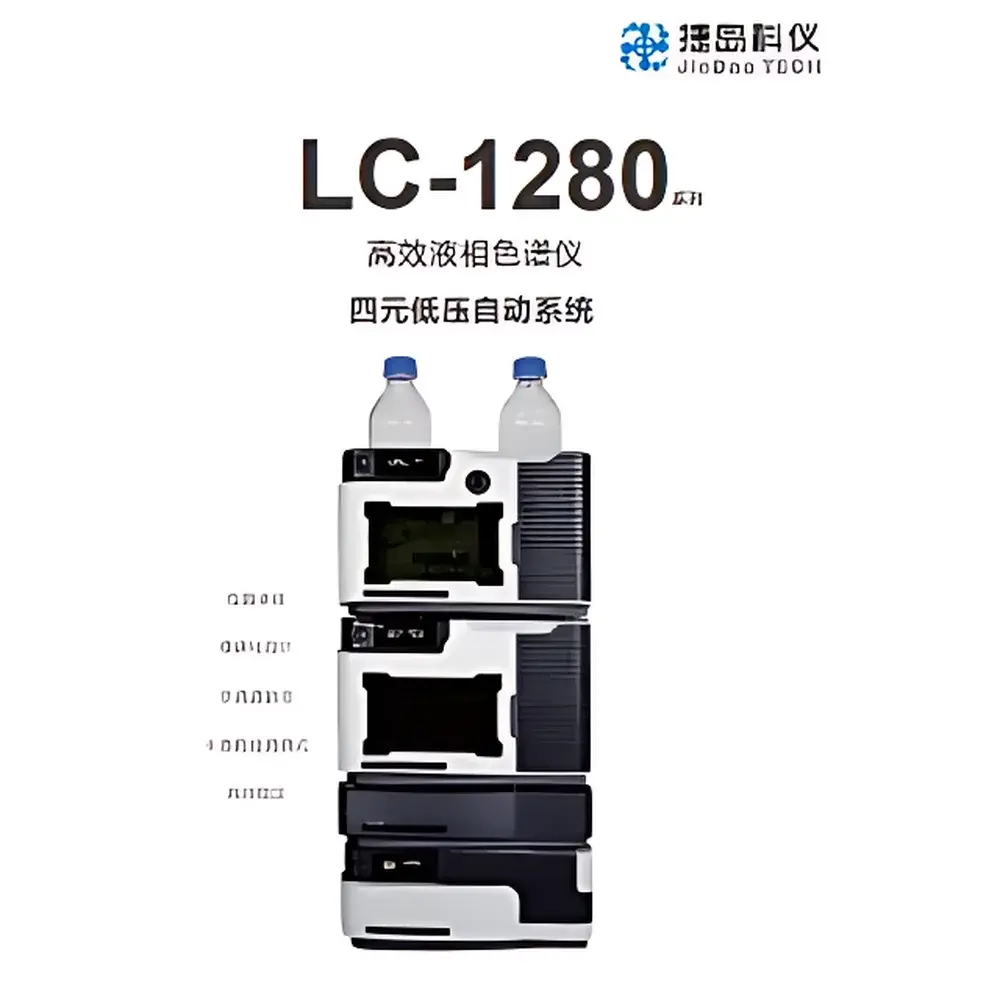
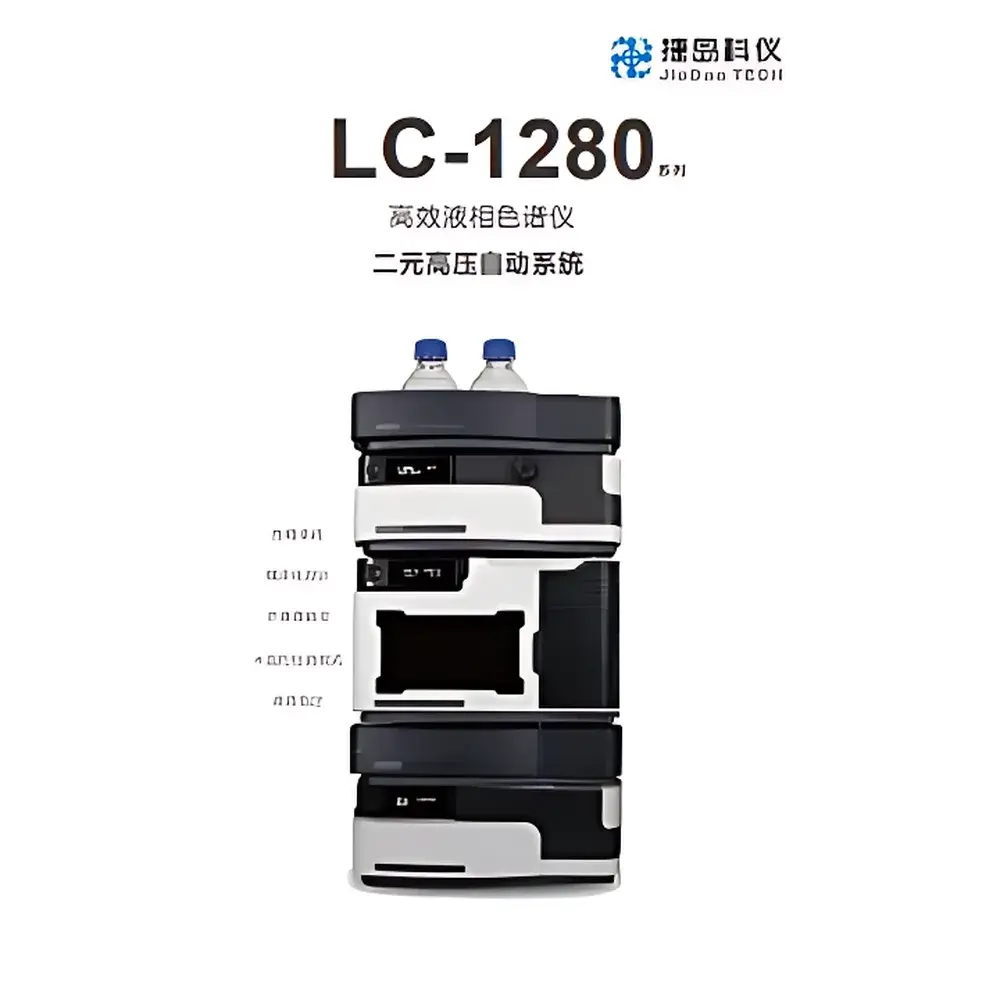
Jiedao LC-1280 Series Binary/Quaternary High-Performance Liquid Chromatograph
| Brand | Jiedao |
|---|---|
| Origin | Zhejiang, China |
| Manufacturer Type | Authorized Distributor |
| Product Category | Domestic |
| Model | LC-1280 Series |
| Price Range | USD 14,000–28,000 |
| Instrument Type | Conventional HPLC System |
| Application Scope | General-Purpose Analytical Use |
| Flow Rate Range | 0.001–10.000 mL/min (0.001 mL/min increment) |
| Maximum Pressure | 9000 psi |
| Flow Accuracy | ±0.2% RSD |
| Injection Volume | Standard 100 µL (Optional: 10, 20, 50 µL) |
| Sample Tray Capacity | Dual 48-position vial racks (Optional: 96-well and 384-well plate compatibility) |
| Column Oven Temperature Range | +5 °C to 70 °C above ambient |
| UV-Vis Wavelength Range | 190–800 nm |
| Data Acquisition Rate | 100 Hz |
Overview
The Jiedao LC-1280 Series is a modular, high-reliability high-performance liquid chromatography (HPLC) platform engineered for precision separation, quantification, and method transfer across diverse laboratory environments. Built on classical reversed-phase, normal-phase, size-exclusion (SEC/GPC), and ion-exchange chromatographic principles, the system supports both binary high-pressure gradient delivery and quaternary low-pressure mixing configurations—enabling users to select the optimal architecture based on application complexity, solvent compatibility, and method robustness requirements. Its 9000 psi maximum operating pressure accommodates sub-2 µm particle-packed columns for enhanced resolution and faster analysis cycles, while the ±0.2% flow accuracy and ultra-low dispersion gradient system (< 500 µL total delay volume) ensure high reproducibility in retention time and peak shape—critical for regulated QC/QA workflows and method validation per ICH Q2(R2) guidelines.
Key Features
- Modular dual-configurability: Select between binary high-pressure gradient (LC-1280B) or quaternary low-pressure gradient (LC-1280Q) pump architectures—each optimized for specific method demands including multi-solvent screening, pH-gradient methods, or volatile mobile phase compatibility.
- High-precision micro-piston pumps with active solvent compressibility compensation deliver stable flow across the full 0.001–10.000 mL/min range, supporting capillary, analytical, and semi-preparative column formats.
- Autosampler with dual 48-position vial racks enables unattended operation; optional 96-well and 384-well plate handling expands throughput for pharmaceutical stability studies or environmental multi-analyte screening.
- Column compartment with precise +5 °C to 70 °C temperature control (±0.5 °C stability) minimizes retention time drift and improves peak symmetry for thermally sensitive analytes.
- UV-Vis detector featuring a 190–800 nm spectral range, 100 Hz data acquisition rate, and variable bandwidth optics supports both single-wavelength quantitation and wavelength-switching methods—fully compliant with USP , EP 2.2.46, and ASTM D7762 for polymer molecular weight distribution analysis.
Sample Compatibility & Compliance
The LC-1280 Series is validated for use with standard stainless-steel, PEEK, and titanium fluidic paths compatible with aqueous, organic, and corrosive mobile phases (e.g., TFA, HFBA, ammonium acetate/formate buffers). It meets essential mechanical and electrical safety standards per GB/T 18268.1–2010 (IEC 61326-1 equivalent) and electromagnetic compatibility (EMC) Class B requirements. While not pre-certified for FDA 21 CFR Part 11 out-of-the-box, the system’s chromatography data system (CDS) architecture supports audit trail logging, electronic signatures, and role-based access control when deployed with validated third-party software—enabling alignment with GLP, GMP, and ISO/IEC 17025 quality management frameworks.
Software & Data Management
Controlled via a Windows-based chromatography workstation, the LC-1280 Series supports sequence-driven batch processing, real-time chromatogram visualization, peak integration using tangent skim or valley-to-valley algorithms, and customizable report templates compliant with ISO 17025 reporting clauses. Raw data files are stored in vendor-neutral .cdf format (compatible with OpenLab CDS, Chromeleon, and Empower import utilities), ensuring long-term archival integrity. System suitability testing (SST) parameters—including theoretical plates, tailing factor, resolution, and %RSD of replicate injections—are automatically calculated and logged with timestamped metadata for regulatory review.
Applications
The platform serves as a foundational analytical tool across multiple regulated and research-intensive domains: small-molecule pharmaceutical assay and dissolution testing (per USP ); residual solvent analysis in APIs (ICH Q3C); pesticide multiresidue screening in food matrices (AOAC 2007.01); hydrocarbon profiling in petroleum fractions (ASTM D5186); polymer molecular weight distribution via SEC/GPC (ASTM D5296); and amino acid analysis in biological fluids using pre-column derivatization. Its flexibility in gradient programming, detector wavelength agility, and autosampler expandability makes it suitable for method development labs requiring rapid transition from scouting to validated routine operation.
FAQ
Is the LC-1280 Series compatible with mass spectrometry interfaces?
Yes—the system’s low-dead-volume flow cell design, pulse-free gradient delivery, and configurable output pressure regulation support seamless coupling to ESI and APCI sources without additional backpressure modules.
Can the column oven accommodate 150 mm × 4.6 mm ID columns with guard cartridges?
Yes—the chamber accepts standard analytical columns up to 250 mm length and includes adjustable column clamps and integrated solvent pre-heating channels to minimize thermal mismatch.
Does the autosampler support needle wash protocols between injections?
Yes—programmable solvent selection (up to 3 wash solvents), dwell time control, and external waste routing are fully configurable within the sequence method.
What validation documentation is provided with the instrument?
Factory-installed IQ/OQ documentation (per ASTM E2500-13) is included, covering pump linearity, detector wavelength accuracy (using holmium oxide filter), temperature uniformity mapping, and autosampler precision verification.
Is remote monitoring supported?
The workstation supports secure LAN-based remote desktop access and basic status polling via SNMP; full web-based instrument control requires integration with enterprise LIMS or middleware platforms.
Related Products






