
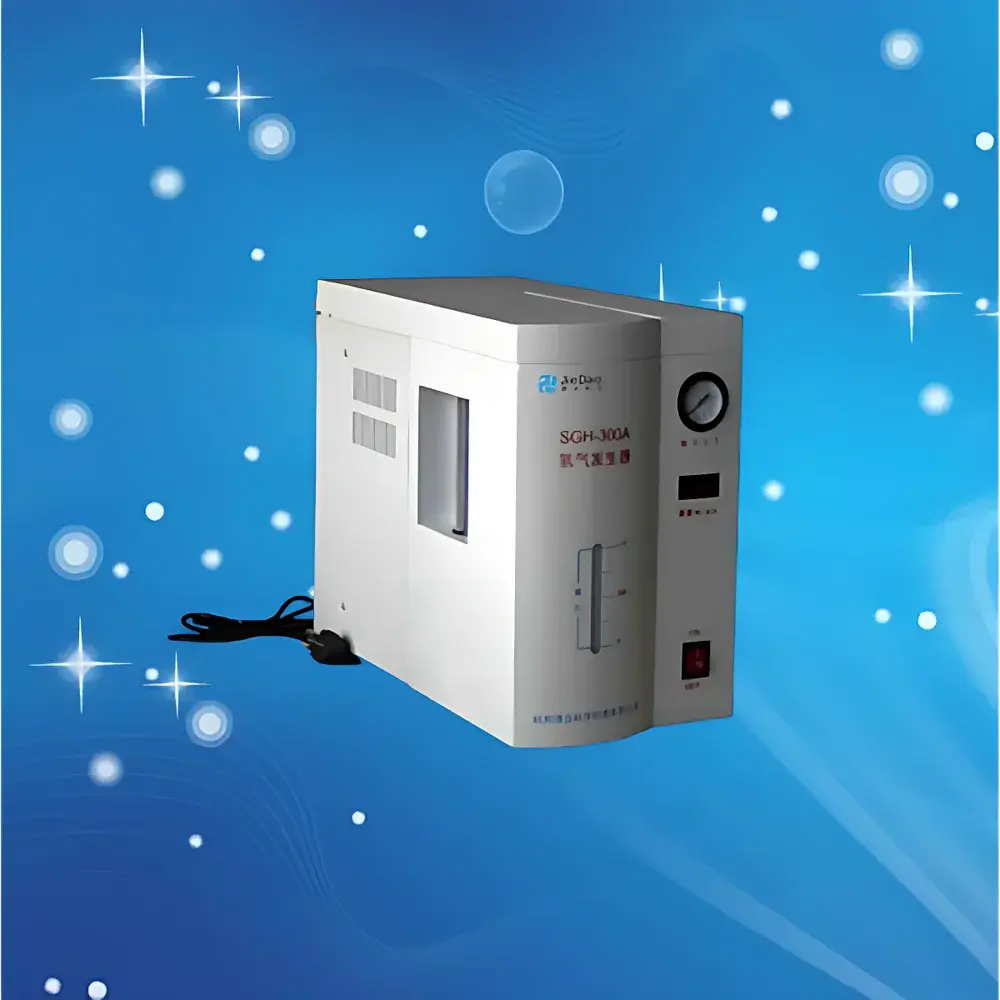
Jiedao SGH-300A / SGH-500A High-Purity Hydrogen Generator
| Brand | Jiedao |
|---|---|
| Origin | Zhejiang, China |
| Model | SGH-300A, SGH-500A |
| Output Flow | 0–300 mL/min (SGH-300A), 0–500 mL/min (SGH-500A) |
| Output Pressure | 0.4 MPa (factory-set) |
| Hydrogen Purity | >99.999% |
| Max Power Consumption | 150 W |
| Dimensions (L×W×H) | 390 × 185 × 320 mm |
| Input Power | AC 220 V ±10%, 50 Hz |
| Operating Temperature | 5–40 °C |
| Relative Humidity | <85% RH (non-condensing, dust-free environment) |
Overview
The Jiedao SGH-300A and SGH-500A High-Purity Hydrogen Generators are compact, electrolysis-based gas generation systems engineered for continuous, on-demand hydrogen supply in analytical laboratories. These units utilize proton exchange membrane (PEM) electrolysis technology—where deionized water is split into high-purity H₂ and O₂ at the anode and cathode—followed by multi-stage catalytic purification and palladium-silver alloy membrane diffusion to achieve ≥99.999% hydrogen purity. Designed as direct replacements for high-pressure hydrogen cylinders, they eliminate associated hazards including storage, transport, handling, and regulatory compliance burdens. Both models operate fully automatically: pressure regulation is maintained via infrared optical feedback coupled with a high-efficiency switching power supply, enabling real-time dynamic adjustment of electrolysis current to match downstream demand while holding output pressure constant at 0.4 MPa. This closed-loop control architecture ensures stable gas delivery across variable load conditions—critical for GC-FID, GC-TCD, and hydrogenation reactors requiring consistent stoichiometric flow.
Key Features
- Proton exchange membrane (PEM) electrolysis core with integrated catalyst-coated membranes for efficient, low-maintenance H₂ generation
- Dual-stage purification: catalytic recombination of residual oxygen followed by selective diffusion through a Pd–Ag alloy membrane
- Digital LED display showing real-time hydrogen output flow (mL/min), system status, and fault diagnostics
- Factory-calibrated pressure setpoint of 0.4 MPa with overpressure safety cutoff (mechanical + electronic redundancy)
- Energy-efficient operation: ≤150 W maximum power draw; no external cooling required under standard lab ambient conditions
- Robust stainless-steel and corrosion-resistant polymer construction; compliant with IEC 61010-1 for laboratory electrical safety
- Modular design supports routine maintenance—electrolyte replenishment (deionized water only), filter replacement, and membrane inspection—without specialized tools
Sample Compatibility & Compliance
These generators produce hydrogen suitable for trace-level analytical applications where baseline stability and detector response consistency are essential. The ≥99.999% purity level meets or exceeds requirements for flame ionization detection (FID) in gas chromatography per ASTM D3606 and ISO 10378, and supports TCD carrier gas applications per USP . Oxygen content remains below 0.1 ppm, moisture <1 ppm (v/v), and total hydrocarbons <0.1 ppm—verified by in-line gas chromatographic verification during factory acceptance testing. Units comply with CE marking directives (EMC 2014/30/EU, LVD 2014/35/EU) and are designed to support GLP/GMP environments: all operational parameters—including runtime, pressure events, and error logs—are timestamped and stored in non-volatile memory for audit readiness. While not FDA 21 CFR Part 11–validated out-of-the-box, the firmware architecture allows integration with validated LIMS or ELN platforms via RS-232 or optional Ethernet interface.
Software & Data Management
The SGH series features embedded microcontroller firmware with local data logging capability. System events—including startup/shutdown cycles, pressure excursions, low-water alerts, and overtemperature warnings—are recorded with UTC timestamps and retained for up to 30 days. Optional PC connectivity (via USB-to-RS232 adapter) enables export of CSV-formatted logs for trend analysis or QA documentation. No proprietary software installation is required; raw serial output is ASCII-encoded and compatible with standard terminal emulators (e.g., PuTTY, Tera Term). For automated lab environments, Modbus RTU protocol support (on request) permits integration into SCADA or building management systems. All firmware updates are delivered as signed binary files and applied via secure bootloader—ensuring integrity and traceability.
Applications
- Carrier and fuel gas for gas chromatography (GC-FID, GC-TCD, GC-NPD)
- Hydrogen supply for laboratory-scale catalytic hydrogenation reactors and electrochemical cells
- Calibration gas blending systems requiring ultra-high-purity H₂ as a base component
- FTIR spectrometer purge gas and semiconductor process chamber conditioning
- Research applications in materials science, fuel cell development, and isotopic labeling studies
The SGH-300A is optimized for single-instrument deployment (e.g., one GC system), while the SGH-500A supports dual-GC configurations or higher-flow applications such as continuous-feed hydrogenation. Both models maintain stable output across intermittent and continuous duty cycles—demonstrating no measurable degradation in flow accuracy or purity after 10,000 hours of cumulative operation under recommended maintenance intervals.
FAQ
What type of water must be used?
Deionized water with resistivity ≥15 MΩ·cm (ASTM Type I) is mandatory. Tap water, distilled water, or reverse-osmosis-only water will damage the PEM stack and void warranty.
Is external cooling required?
No. The unit operates passively cooled within ambient temperatures of 5–40 °C and relative humidity <85% non-condensing.
How often does maintenance need to be performed?
Water reservoir refilling every 3–7 days (depending on usage); particulate filter replacement every 6 months; Pd–Ag membrane inspection recommended annually under continuous operation.
Can output pressure be adjusted beyond 0.4 MPa?
No. The pressure regulator is factory-set and sealed. Field modification is prohibited for safety and warranty compliance.
Does the generator produce oxygen as a byproduct?
Yes—oxygen is generated stoichiometrically at the anode and safely vented through a dedicated exhaust port. Ensure adequate ventilation in enclosed spaces per OSHA 1910.104(b)(2).



