
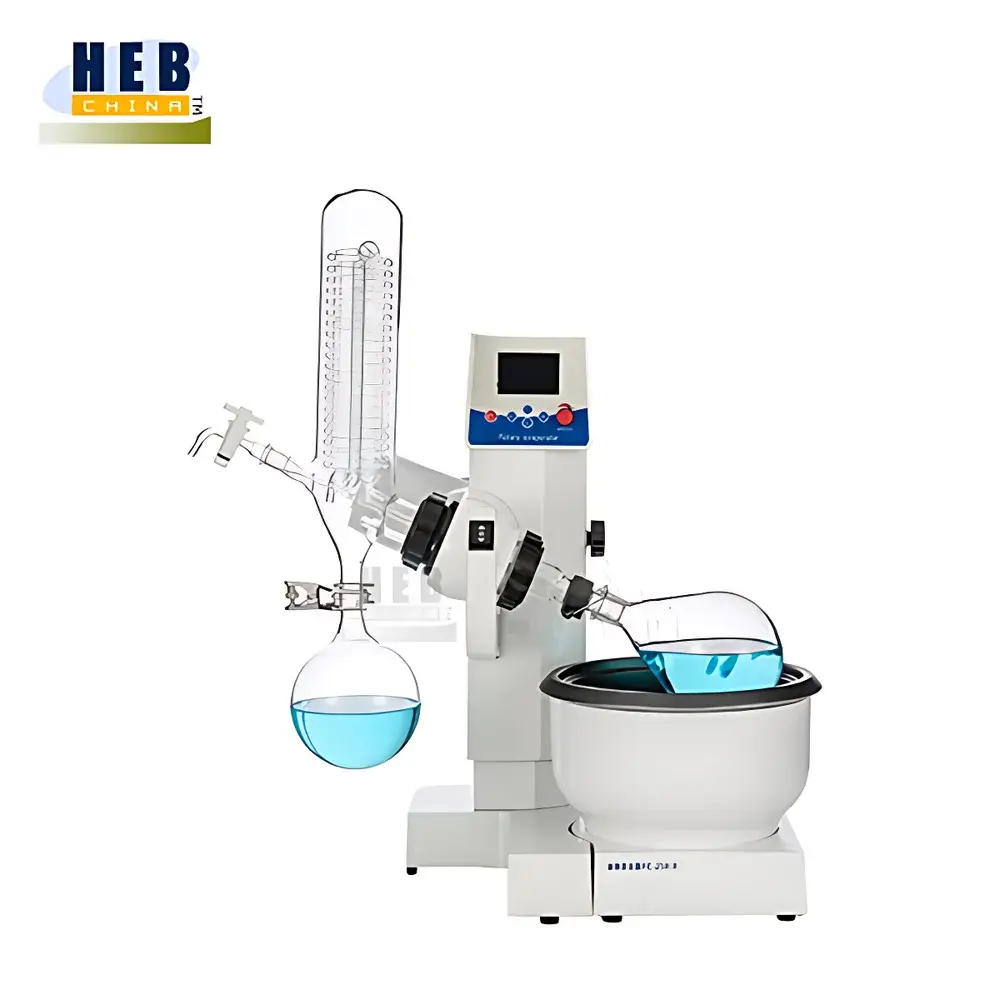
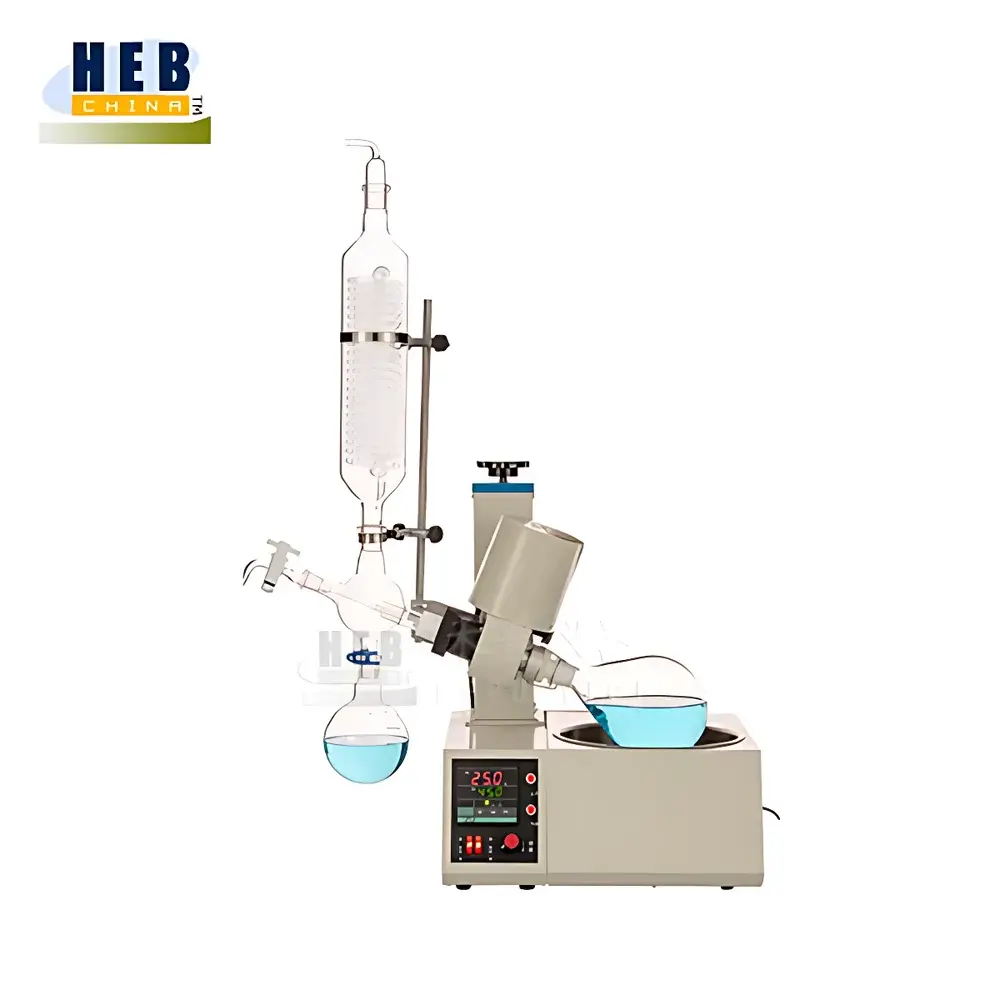
Jihepu RE-2000E Rotary Evaporator
| Brand | Jihepu |
|---|---|
| Origin | Shandong, China |
| Model | RE-2000E |
| Capacity | 2 L |
| Ultimate Vacuum | 0.098 MPa |
| Rotation Speed | 0–200 rpm |
| Temperature Range | Ambient to 99 °C |
| Temperature Control Accuracy | ±1 °C |
| Condenser Cooling Area | 0.11 m² |
| Power Supply | 220 V / 50 Hz (optional 110 V / 60 Hz) |
| Heating Power | 1.5 kW |
| Motor Power | 40 W |
| Lift Motor Power | 20 W |
| Evaporation Rate | 20 mL/min |
| Rotating Flask | 1000 mL (Φ131 mm, 24/40 standard taper) |
| Collection Flask | 1000 mL (Φ131 mm, 35/40 spherical joint) |
| Condenser Dimensions | Φ85 × 460 mm |
| Bath Volume | ~6.3 L |
| Overall Dimensions | 660 × 420 × 830 mm (L×W×H) |
| Net Weight | 23 kg |
Overview
The Jihepu RE-2000E Rotary Evaporator is a precision-engineered laboratory instrument designed for efficient solvent removal, concentration, crystallization, and recovery under controlled vacuum and thermal conditions. It operates on the principle of thin-film evaporation: a rotating evaporation flask spreads sample liquid into a uniform, high-surface-area film along its inner wall; simultaneous vacuum application lowers the boiling point of solvents, while an intelligent water bath provides stable, uniform heating. Vaporized solvent passes through a vertically oriented double-layer coiled condenser—fabricated from high-borosilicate glass (GG-17)—where it is rapidly condensed and collected in a dedicated receiving flask. All wetted components—including flasks, condenser, and vapor ducts—are constructed from GG-17 glass and PTFE, ensuring chemical inertness, thermal stability (−80 °C to +250 °C), and compatibility with aggressive organic solvents, acids, and bases. The system is widely deployed in pharmaceutical R&D, fine chemical synthesis, natural product isolation, and biotechnology labs where gentle, scalable, and reproducible concentration of heat-sensitive compounds—such as peptides, enzymes, and labile APIs—is required.
Key Features
- Aluminum alloy mainframe with optimized structural rigidity and corrosion resistance for long-term laboratory use.
- Dual-seal system combining PTFE and imported fluorocarbon rubber (FKM), engineered to maintain stable vacuum down to 0.098 MPa without leakage or degradation over extended operation.
- Full GG-17 borosilicate glass assembly—including rotating flask, condenser, collection flask, and vapor duct—certified to ISO 3585 standards for thermal shock resistance and hydrolytic stability.
- Brushless DC motor drive delivering silent, spark-free, low-heat rotation across the full 0–200 rpm range with electronic stepless speed control and real-time RPM feedback.
- Intelligent digital water bath featuring PT100 platinum resistance temperature sensor, PID-based temperature regulation, and ±1 °C accuracy across 0–99 °C (optional 0–400 °C configuration available).
- Stainless steel bath pot with PTFE-coated interior, fully enclosed heating elements, and dual safety protection: thermal fuse cutoff and dry-run auto-shutdown.
- Motorized vertical lift mechanism (0–150 mm travel) enabling precise, repeatable flask immersion and removal without manual adjustment.
- Large backlit LCD display showing simultaneous real-time values for bath temperature, rotation speed, and system status indicators.
- Front-access PTFE stopcock with 19/22 standard taper port for continuous feed or solvent addition during operation.
- Standardized quick-connect ports (10 mm OD, 12 × 8 mm tubing interface) for vacuum pump, chiller, or recirculating coolant lines—compatible with common lab-grade vacuum sources and cryogenic circulators.
Sample Compatibility & Compliance
The RE-2000E supports broad sample compatibility across aqueous, polar aprotic, and nonpolar organic systems—including acetone, dichloromethane, ethyl acetate, methanol, toluene, and DMF—without risk of leaching or catalytic side reactions. Its all-glass/PTFE fluid path complies with USP Class VI and ISO 10993-5 biocompatibility requirements for extractables testing. While not certified to GLP or GMP out-of-the-box, the system’s design facilitates audit-ready operation: temperature and rotation parameters are digitally logged (via optional RS232/USB interface), and its consistent performance meets routine QC needs aligned with ASTM E2654 (Standard Guide for Validation of Analytical Methods for Volatile Organic Compound Recovery) and ISO 17025 traceability frameworks. Optional transparent acrylic safety shield (not included) satisfies institutional requirements for splash and implosion protection during volatile solvent handling.
Software & Data Management
The RE-2000E operates via embedded microcontroller firmware with no proprietary software dependency. All operational parameters—bath setpoint, rotation speed, and runtime—are manually configured and retained across power cycles. For laboratories requiring electronic recordkeeping, an optional USB-to-serial adapter enables integration with third-party data acquisition platforms (e.g., LabVIEW, MATLAB, or custom Python scripts) to log timestamped temperature and RPM values at user-defined intervals. The system does not natively support FDA 21 CFR Part 11 compliance features (e.g., electronic signatures, audit trails); however, its deterministic behavior and mechanical repeatability make it suitable for SOP-driven workflows in regulated environments when paired with external validation protocols and manual logbook documentation.
Applications
- Concentration of crude extracts in phytochemistry and natural product isolation.
- Solvent exchange and final drying of synthetic intermediates prior to NMR or HPLC analysis.
- Removal of low-boiling solvents (e.g., diethyl ether, pentane) following Grignard or lithiation reactions.
- Recovery and reuse of expensive or hazardous solvents—reducing waste disposal costs and environmental footprint.
- Preparative-scale dehydration of heat-labile biomolecules under mild vacuum (<50 mbar) and sub-40 °C bath temperatures.
- Parallel processing support: multiple RE-2000E units can be networked to centralized vacuum manifolds and chillers for multi-step purification workflows.
FAQ
What vacuum level is required for optimal performance?
A vacuum source capable of achieving ≤0.098 MPa (≤20 mbar absolute) is recommended. Use of a two-stage oil-sealed rotary vane pump or diaphragm pump with cold trap ensures stable operation with low-boiling solvents.
Can the RE-2000E handle corrosive solvents like concentrated HCl or HF?
No. While GG-17 glass and PTFE resist most organics and dilute acids/bases, hydrofluoric acid (HF), hot concentrated sulfuric acid, and strong oxidizers (e.g., fuming nitric acid) will etch or degrade the glass and seals. Consult material compatibility charts before use.
Is the water bath compatible with silicone oil or other high-temperature media?
Yes—the stainless-steel/PTFE-coated bath pot and sealed heating elements permit safe operation with silicone oil up to 200 °C; however, the standard control electronics are rated only to 99 °C. High-temperature configurations require factory calibration and upgraded temperature sensors.
Does the unit include vacuum and cooling accessories?
No. Vacuum pumps, coolant circulators, and connecting tubing must be selected and procured separately based on solvent volatility, throughput, and ambient lab conditions.
What maintenance is required for long-term reliability?
Monthly inspection of PTFE seals and O-rings for cracking or deformation; annual replacement of fluorocarbon gaskets; periodic cleaning of the condenser coil with ethanol or acetone; and verification of bath temperature accuracy using a calibrated NIST-traceable thermometer.



